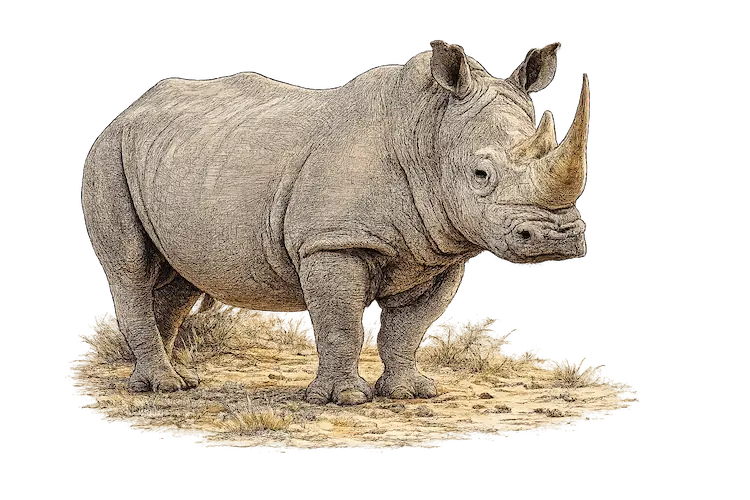
White Rhinoceros
(Ceratotherium simum)
The white rhinoceros is one of the most iconic and sought-after animals to see in Kruger National Park . As part of Africa’s famous Big 5 , its sheer size, calm presence, and prehistoric appearance leave a lasting impression on anyone fortunate enough to encounter it.
Unlike many of Kruger’s more elusive mammals, white rhinos are relatively well distributed and can often be seen grazing quietly in open grassland or resting near waterholes. Their broad mouths, large front horn, and slow, deliberate movements make them one of the easier large mammals to identify, even from a distance.
This guide covers identification, habitat, behaviour, diet, breeding, and how to find the white rhinoceros while exploring Kruger’s wildlife . If you are interested in how it differs from its more solitary and rarer counterpart, you can also explore the black rhinoceros or read a deeper comparison here: difference between white and black rhino .
Identification
The white rhinoceros is the largest rhino species and one of the heaviest land mammals in Africa, second only to the African bush elephant . It has a massive, barrel-shaped body, thick grey skin, and a large head carried low to the ground. Adults can weigh well over two tonnes, giving them a powerful and unmistakable presence in the bush.
The most distinctive feature is its wide, square-shaped mouth, perfectly adapted for grazing. This “square-lipped” appearance is the easiest way to separate it from the black rhinoceros , which has a narrower, hooked lip used for browsing. White rhinos also tend to hold their heads lower as they feed, moving steadily across grasslands.
Like all rhinos, it has two horns made of keratin, with the front horn usually being longer and more prominent. The ears are large and mobile, constantly rotating to pick up sound, while the small eyes give them relatively poor eyesight. Despite this, their sense of smell and hearing are highly developed.
At a distance, white rhinos may sometimes be confused with large African buffalo , especially in open areas. However, their bulkier shape, prominent horn structure, and slow, grazing behaviour quickly set them apart once observed more closely.
Habitat & Where It Lives
White rhinoceroses are most commonly found in open grassland and lightly wooded savanna, where grazing opportunities are abundant. In Kruger National Park , they favour areas with short grasses, access to water, and relatively open visibility, allowing them to feed efficiently while remaining aware of their surroundings.
These habitats are most prominent in the southern and central regions of the park, where a mix of grassland, bushveld, and seasonal water sources create ideal conditions. White rhinos are rarely found in dense thickets, which are more suited to the black rhinoceros , a species adapted to browsing on shrubs and trees.
Water plays an important role in their daily routine. White rhinos regularly visit waterholes and rivers not only to drink, but also to wallow in mud. These mud baths help regulate body temperature and protect their skin from parasites and the harsh African sun.
For a broader understanding of how these landscapes fit together across the park, it is worth exploring the Kruger National Park guide , which breaks down regions, habitats, and wildlife distribution in more detail.
Behaviour
White rhinoceroses are generally calm, slow-moving animals that spend much of their day grazing. They are most active during the early morning and late afternoon, often resting in the shade during the heat of the day. Despite their size and strength, they are typically peaceful unless disturbed, at which point they can become surprisingly fast and defensive.
Unlike the more solitary black rhinoceros , white rhinos are semi-social and are often seen in small groups known as crashes. These groups usually consist of females and calves, while adult bulls tend to be more territorial and may occupy defined areas within favourable habitat.
Communication between individuals is subtle but effective, involving scent marking, dung middens, and body language. Territorial males will often patrol their areas and leave clear signs of their presence. Calves remain close to their mothers for protection, especially in areas where large predators such as lions or spotted hyenas are present.
Although adults have few natural predators, young calves can be vulnerable. This results in highly protective maternal behaviour, with mothers positioning themselves between their calves and any perceived threat. When approached too closely, a white rhino may charge, often more as a defensive reaction than an aggressive one.
Diet
The white rhinoceros is a specialised grazer, feeding almost entirely on short grasses. Its wide, square-shaped mouth is perfectly adapted for cropping grass close to the ground, allowing it to move steadily across open areas while feeding. This grazing behaviour plays an important role in maintaining grassland structure within Kruger National Park .
Unlike browsing animals such as the greater kudu or the impala , which feed on leaves, pods, and shrubs, white rhinos depend almost entirely on grass availability. Their movements are therefore closely tied to seasonal changes and rainfall patterns, which influence grass growth across the park.
For a deeper look at the grasses that support much of Kruger’s herbivore life, you can explore the grasses of Kruger National Park , which form the foundation of this ecosystem.
Breeding
White rhinoceroses do not have a strict breeding season, and calves can be born throughout the year in Kruger National Park . However, births are often more common during periods when food is abundant, particularly after good rains when grass growth is at its peak.
After a long gestation period of around 16 months, a single calf is born. The calf will remain close to its mother for several years, learning movement patterns, feeding areas, and how to navigate the landscape. During this time, the bond between mother and calf is strong, with the mother offering constant protection.
Females typically give birth every two to three years, depending on environmental conditions and calf survival. Young rhinos are vulnerable in their early months, which is why mothers are highly defensive and will not hesitate to confront any potential threat.
How to Find White Rhinoceros in Kruger
White rhinoceroses are among the more reliably seen members of the Big 5 , particularly in the southern and central regions of Kruger National Park . Open grasslands, roadside grazing areas, and waterholes are some of the best places to encounter them, often feeding calmly or resting in the shade nearby.
Early mornings and late afternoons offer the best chances of sightings, when temperatures are cooler and animals are more active. During the heat of the day, white rhinos are more likely to be found resting under trees or wallowing in mud near water sources, making waterholes a reliable place to scan slowly and patiently.
Unlike more elusive predators such as the African leopard , white rhinos do not rely on cover and are often visible from a distance. Moving slowly through grassland areas and keeping an eye on open plains can lead to rewarding sightings, sometimes of entire groups grazing together.
While sightings are possible on self-drive trips, having a guide can make a noticeable difference. Experienced guides understand habitat patterns, recent movement, and how to position vehicles respectfully for the best viewing opportunities. You can explore private Kruger safaris or browse all-inclusive safari packages to increase your chances of meaningful wildlife encounters.
Why People Love Seeing White Rhinoceros
There is something quietly powerful about encountering a white rhinoceros in the wild. Despite its immense size, it often moves with a calm, almost unhurried rhythm, grazing peacefully as if unaware of its own strength. For many visitors, this contrast between power and stillness becomes one of the most memorable moments of a safari.
Seeing a white rhino up close also carries a deeper significance. As one of Africa’s most iconic yet threatened species, it represents both the beauty and fragility of the natural world. Watching one feed in open grassland, with oxpeckers perched along its back and the sounds of the bush all around, creates a connection that goes beyond a simple sighting.
Unlike fast-moving predators or elusive nocturnal animals, white rhinos offer a slower, more grounded experience. They allow time to observe detail — the texture of their skin, the movement of their ears, the steady sweep of their grazing. It is often these quieter sightings that stay with people long after their time in Kruger National Park has come to an end.
For many, a sighting of a white rhinoceros is not just about ticking off a member of the Big 5 , but about experiencing one of Africa’s most ancient and enduring animals in its natural environment.
Experience Kruger’s Wildlife for Yourself
Whether you are hoping to see white rhinoceros, complete the Big 5, or simply enjoy Kruger at a slower and more observant pace, a guided safari gives you the time, patience, and local knowledge to experience the bush properly.
View All Kruger Safari PackagesWhite Rhinoceros FAQ
Are white rhinoceroses common in Kruger National Park?
White rhinoceroses are among the more regularly seen rhinos in Kruger, especially in suitable grassland and savanna habitats. Sightings are never guaranteed, but they are more likely than the rarer and more secretive black rhinoceros.
Where is the best place to see white rhino in Kruger?
White rhinos are most often associated with open grassland, lightly wooded savanna, and areas near water. The southern and central parts of Kruger are generally good regions to look for them.
What is the difference between white rhino and black rhino?
White rhinos have a broad, square mouth used for grazing, while black rhinos have a hooked lip used for browsing leaves and shrubs. White rhinos are also usually more social and often prefer more open habitats.
What do white rhinoceroses eat?
White rhinoceroses are grazers and feed mainly on short grasses. Their wide mouth is specially adapted for cropping grass close to the ground.
Are white rhinoceroses dangerous?
White rhinos are generally calm when left undisturbed, but they are large, powerful wild animals and should always be treated with respect. A mother with a calf or a startled rhino can become defensive.