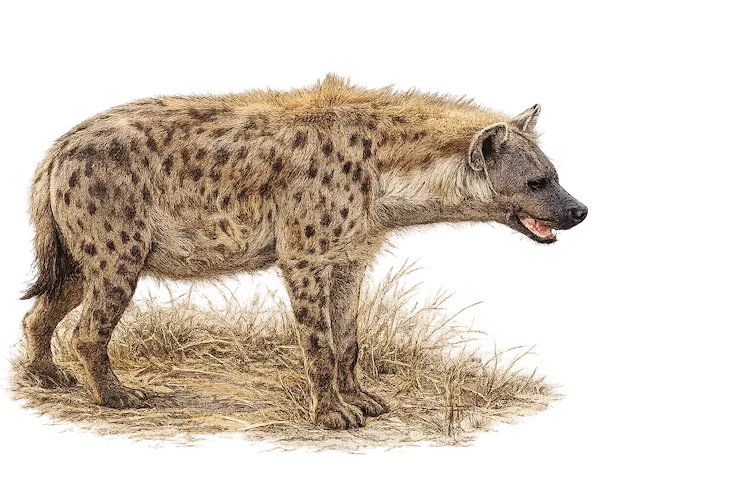
Spotted Hyena
(Crocuta crocuta)
The spotted hyena is one of the most misunderstood yet fascinating animals found in Kruger National Park. Often heard before it is seen, its haunting calls and distant laughter-like sounds form part of the night soundtrack of the African bush. Despite its reputation as a scavenger, the spotted hyena is a highly skilled predator, intelligent, social, and deeply adapted to life on the savanna.
In Kruger, hyenas are relatively common and are most often encountered in the early mornings, late afternoons, or after dark. They are regularly seen moving along roads, pausing near waterholes, or lingering at the edges of predator activity. Sightings often feel raw and authentic, offering a glimpse into the less polished, more natural side of the bush compared to animals like the lion or leopard.
This guide covers identification, habitat, behaviour, diet, breeding, and how to find spotted hyenas while exploring Kruger’s wildlife.
Identification
The spotted hyena is a strongly built carnivore with a distinctive sloping back, where the shoulders sit noticeably higher than the hindquarters. Its coat is sandy to grey-brown, covered in irregular dark spots that vary between individuals. The head is broad with powerful jaws, and the rounded ears are shorter than those of most other predators in Kruger.
One of the most noticeable features is its movement. Hyenas have a steady, tireless gait, often described as a loping walk, which allows them to cover long distances with ease. When seen on the move, they appear purposeful and efficient, rarely rushing unless interacting with other predators or approaching a carcass.
Although sometimes confused with the African wild dog, the spotted hyena is heavier, less colourful, and lacks the large rounded ears and patchwork coat pattern. It can also be distinguished from the smaller black-backed jackal by its size, build, and more powerful, almost bear-like frame.
Habitat & Where It Lives
Spotted hyenas are highly adaptable and occur throughout Kruger National Park, from open savanna to lightly wooded areas. They tend to favour landscapes where visibility is good and prey is abundant, particularly grassland and mixed woodland systems where large herbivores are regularly found.
Dens are often established in quiet, undisturbed areas such as old aardvark burrows, erosion banks, or rocky outcrops. These sites may be used for many years and are usually positioned close to productive feeding areas, allowing clans to move efficiently between resting and hunting grounds.
While they can be found across the park, hyenas are often especially active in regions with strong predator presence, where competition and scavenging opportunities are higher. This overlap with animals like the lion and leopard forms an important part of their ecological role within Kruger’s wildlife.
Behaviour
Spotted hyenas are highly social animals, living in structured groups known as clans. These clans can range from just a few individuals to large, complex societies with clear hierarchies. Unlike most mammals, females dominate the social structure, often larger and more assertive than males. Within a clan, relationships are long-lasting, and individuals recognise one another through scent, vocalisations, and behaviour.
They are primarily nocturnal, becoming active as the sun begins to set. At night, their presence is often revealed by their distinctive calls — a mix of whoops, giggles, and eerie laughter-like sounds that carry far across the bush. During the day, they may be seen resting near den sites or moving slowly along roads, particularly in quieter areas of the park.
Although often labelled as scavengers, spotted hyenas are efficient and capable hunters. They work alone or cooperatively to bring down prey, and in many cases, they are responsible for their own kills rather than relying on leftovers. Interactions with other predators, especially the lion, can be intense, with hyenas sometimes attempting to steal carcasses or defend their own kills against larger rivals.
Encounters between hyenas and the African wild dog are less common but equally dynamic, often involving caution, tension, and opportunistic behaviour. These interactions form part of the complex balance that defines predator life in Kruger.
Diet
The spotted hyena is an opportunistic carnivore with a varied and highly adaptable diet. It feeds on a wide range of animals, from small mammals to large ungulates, depending on availability and opportunity. In Kruger, common prey includes species such as impala, young blue wildebeest, and occasionally smaller animals that can be caught with ease.
While they are skilled hunters, hyenas are also well known for scavenging. They make full use of carcasses left behind by other predators, often consuming almost every part of the animal, including bone. Their exceptionally strong jaws allow them to crush and digest material that few other predators can utilise.
This flexible feeding behaviour plays an important role in maintaining balance within Kruger’s wildlife, ensuring that little goes to waste and helping to keep the ecosystem clean and functioning naturally.
Breeding
Spotted hyenas do not have a strict breeding season, and cubs can be born at any time of year in Kruger. After a gestation period of around three to four months, females give birth to one or two cubs, usually within the safety of a den.
Dens are often shared within a clan, with multiple females raising young in the same general area. Cubs are born with their eyes open and are noticeably more developed than many other carnivores, already showing strong personalities and early signs of social hierarchy.
Maternal care is attentive and long-lasting, with cubs remaining dependent on their mothers for many months. As they grow, they gradually begin to explore beyond the den, learning the complex social structure of the clan and the behaviours needed to survive within Kruger’s wildlife.
How to Find Spotted Hyena in Kruger
Spotted hyenas are most active during the cooler hours of the day, making early mornings and evenings the best times to encounter them. Night drives, where available, offer some of the most rewarding sightings, as this is when hyenas are fully active and moving between feeding areas.
They are often seen travelling along roads, particularly quieter stretches where traffic is low. Listening can be just as important as looking — their distinctive calls can guide you toward their position, especially in open savanna areas where sound carries easily.
Areas with strong predator activity tend to produce more consistent sightings. Watching for vultures, other scavengers, or signs of a recent kill can also increase your chances, as hyenas are quick to arrive where there is opportunity.
Dens are another reliable place to find hyenas, particularly during the day when adults may be resting nearby and cubs remain close to the entrance. These sites are often located in quieter sections of the park and can be revisited over time as clans continue to use them.
For visitors wanting to maximise their chances, guided safaris offer a clear advantage. Local knowledge, tracking experience, and an understanding of predator movement all help turn occasional sightings into consistent encounters. Exploring Kruger on private safaris or choosing tailored Kruger safari packages allows more time to focus on these quieter, often overlooked moments.
While hyenas are not always the headline species, they are among the most rewarding to watch, especially when given the time and space to observe their natural behaviour.
Why People Love Seeing Spotted Hyena
There is something quietly captivating about the spotted hyena. It may not carry the same immediate appeal as some of Kruger’s more iconic animals, but time spent watching one often leaves a lasting impression. Their movements are purposeful, their behaviour layered, and their presence feels deeply connected to the rhythm of the bush.
For many visitors, it is the atmosphere that surrounds a hyena sighting that stands out. The fading light, the distant calls, and the sense that something unseen is unfolding nearby all add to the experience. These are moments that feel less staged and more natural, offering a deeper connection to the wild.
Hyenas reveal a different side of Kruger — one that is raw, intelligent, and often overlooked. For those willing to slow down and observe, they become one of the most rewarding animals to encounter while exploring the park’s wildlife.
Experience Kruger’s Wildlife for Yourself
Whether you are hoping to see spotted hyena or simply want to experience the quieter, more natural side of the bush, a guided safari allows you the time and insight to truly understand what you are seeing.
View All Kruger Safari PackagesSpotted Hyena FAQ
Are spotted hyenas dangerous to humans?
Spotted hyenas are generally not a threat to humans, especially within Kruger National Park where wildlife is accustomed to vehicles. As with all wild animals, they should be respected and observed from a safe distance.
Are hyenas scavengers or hunters?
Spotted hyenas are both. While they do scavenge when the opportunity arises, they are highly effective hunters and often catch their own prey.
When is the best time to see hyenas in Kruger?
Early morning, late afternoon, and nighttime offer the best chances. Hyenas are most active during cooler hours and are often seen moving along roads or near den sites.
Do hyenas live in groups?
Yes, spotted hyenas live in social groups called clans. These groups have complex hierarchies, with females typically dominating males.