

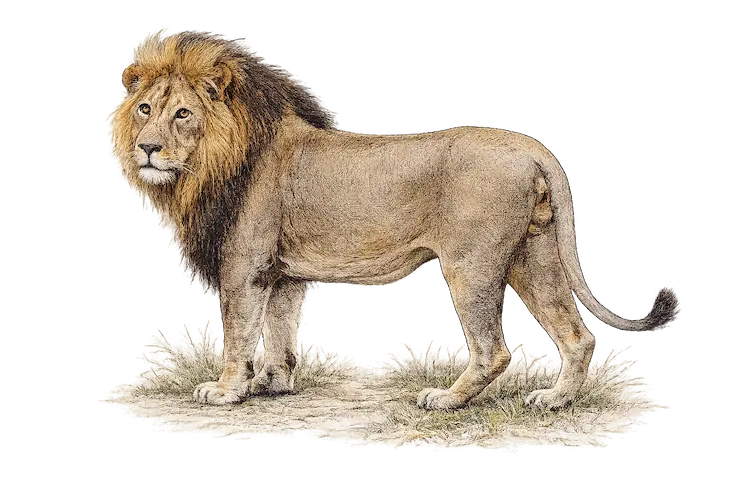
Male
Significantly larger and heavier than the female, with a thick mane ranging from golden to almost black. The mane darkens with age and is often used to judge a male's condition and dominance.


Kruger National Park is home to an estimated 1,500–2,000 lions, one of the largest wild lion populations remaining in Africa. The lion is also the most iconic of all animals in the park, and for many visitors, seeing one is the defining moment of their safari. As one of the famous Big 5, lions sit at the top of almost every wish list, and Kruger gives you a genuine chance of making it happen.
Lions are not always easy to find. Much of their day is spent resting in shade, often invisible in the surrounding bushveld until you are almost on top of them. Sightings are most reliable in areas with healthy prey populations, particularly where impala, wildebeest, and zebra are abundant. The central and southern regions of the park offer the most consistent encounters.
This guide covers identification, lion population and conservation status, habitat, behaviour, diet, breeding, and exactly where and when to find lions while exploring Kruger's wildlife.
| Size | Males stand at 1.2 meters at shoulder and female 1.1 |
|---|---|
| Weight | Males weigh 190-260kg and females 130kg |
| Lifespan | 10-14 years females live longer than males |
| Habitat & Distribution | Wide tolerance, even penetrate into deserts along dry river courses. Require barest of cover to stalk, and adequate medium to large-sized prey animals |
| Gestation | 110 days, 3.5 months |
| Number of Young | one to six |
| Food | Mammals from mice to buffalo (even elephants), birds up to the size of ostrich, reptiles, insects, fish and carrion. Common prey species are giraffe, wildebeest, zebra, impala, waterbuck, warthog and kudu |
| Predators | Hyenas and man, other carnivores and pythons take cubs |
The lion is the largest cat in Kruger National Park, with males easily recognised by their thick mane, which can range from golden to dark brown or almost black. Females lack a mane and are more lightly built, with a uniform sandy colour that blends well into the surrounding grasslands.
Lions have a powerful, muscular build with a broad chest, strong legs, and a relatively long body. Their tails are distinctive, ending in a dark tuft of hair. When walking, they move with a steady, confident stride, often holding their head level and scanning their surroundings.
Compared to the leopard, lions lack spots and appear far bulkier, with less agility in trees. Unlike the slender and fast-moving cheetah, lions are built for strength rather than speed, with a heavier frame and a more deliberate movement.
At a distance, their size, uniform colouring, and social behaviour, often seen resting in groups, make them relatively easy to identify once spotted, even in thicker bush.
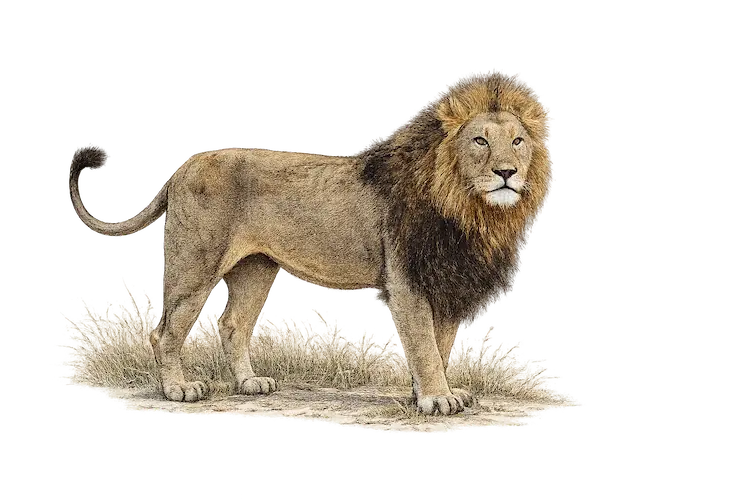
A side-by-side view makes the differences easier to see. Look especially at the mane, overall build, and the size difference between male and female lions.
Significantly larger and heavier than the female, with a thick mane ranging from golden to almost black. The mane darkens with age and is often used to judge a male's condition and dominance.
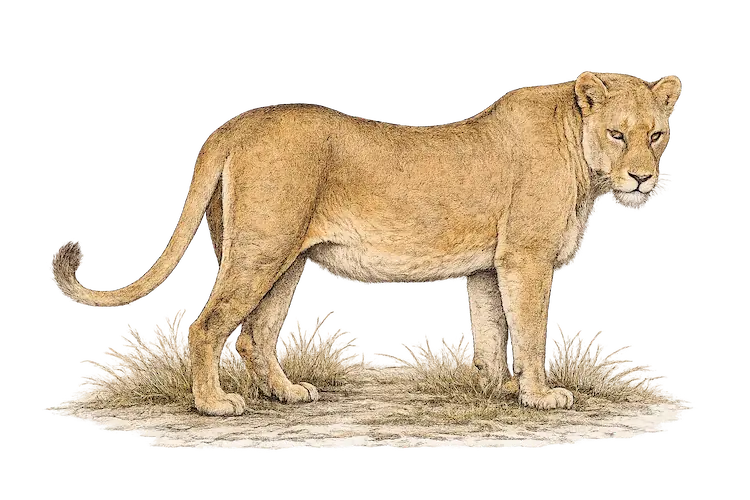
Lighter and more agile than the male, with no mane and a uniform sandy coat that blends into the surrounding grassland. Females are the primary hunters within the pride.
Lions are highly adaptable and can be found throughout Kruger National Park, but they are most commonly associated with open savanna, grassland, and lightly wooded areas where prey is abundant. These habitats allow lions to move easily while still providing enough cover for stalking.
Areas with reliable water sources, river systems, seasonal pans, and permanent waterholes, tend to support higher densities of prey, and lions follow accordingly. The Sabie, Olifants, and Letaba river systems are particularly productive, drawing large herds of buffalo, zebra, and wildebeest that sustain resident prides year-round. The southern and central regions of the park generally offer the most consistent lion sightings as a result.
While lions are less dependent on dense vegetation than species like the leopard, they still make use of shade during the heat of the day, often resting under trees or within thicker bushveld. In the drier northern reaches of the park, habitat becomes more challenging, prey is more dispersed and lion densities lower, a pattern confirmed by recent population surveys.
Seasonal conditions have a significant effect on where lions are easiest to find. During the dry season, thinning vegetation and shrinking water sources concentrate both prey and predators, making sightings more predictable. The best time to visit Kruger guide covers how the seasons shape wildlife distribution across the park in more detail.
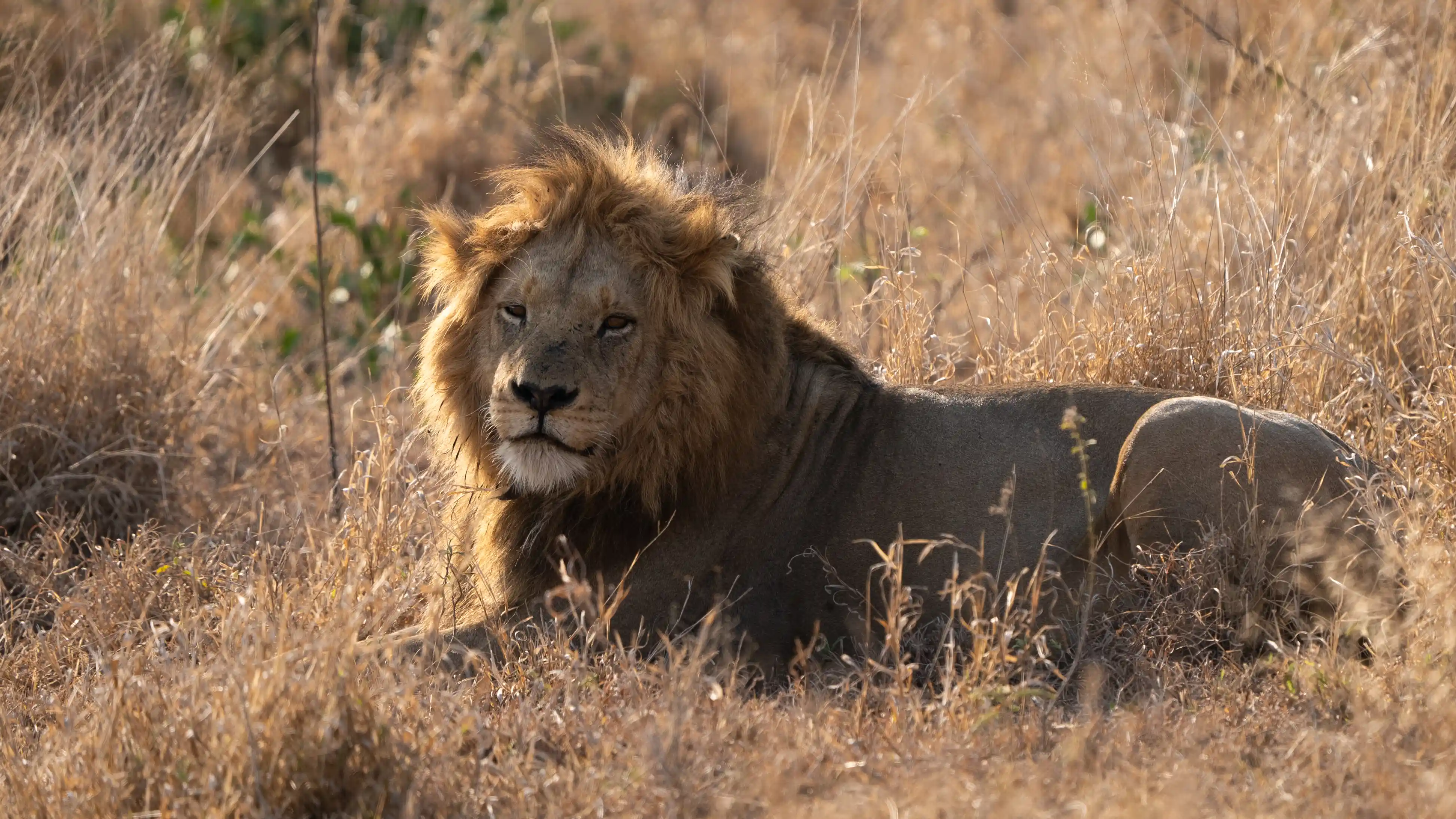
Male Lion in grass near Satara Rest Camp
Lions are highly social animals and are most often seen in groups known as prides. A typical pride consists of related females, their cubs, and one or more dominant males. Prides in Kruger can range from just a few individuals to groups of twenty or more, depending on prey availability and territory size. This social structure sets them apart from most other large predators in Kruger National Park, such as the more solitary leopard or the pack-hunting wild dog.
Much of a lion's day is spent resting, often lying in shade during the heat of the afternoon. Activity typically increases in the cooler hours of early morning, late afternoon, and especially at night. During these times, lions may patrol their territory, interact within the pride, or prepare to hunt.
Hunting is usually a coordinated effort led by lionesses, who work together to stalk and ambush prey. Their approach is slow and deliberate, making use of cover before a short burst of speed. Although powerful hunters, success rates are relatively low, estimated at around one in five attempts, and lions often rely on teamwork and patience to improve their chances. They will also scavenge opportunistically, and clashes with spotted hyena over kills are among the most dramatic encounters in the bush.
Lions are also known for their deep, resonant roar, which can carry over five kilometres on a still night. This vocalisation is used to communicate with pride members, locate one another across large territories, and signal dominance to rival males or competing predators. Hearing a lion roar after dark is one of the most memorable experiences Kruger offers, something no recording quite prepares you for.
When observed on a game drive, lions may appear relaxed and indifferent, but their behaviour is constantly shaped by their surroundings, the movement of prey, the wind direction, the presence of other predators nearby. Watching these subtle interactions, and understanding what they mean, often reveals far more than the initial sighting itself.
Lions are carnivores and feed primarily on medium to large-sized mammals found throughout Kruger National Park. Their diet is varied, but the most common prey species are impala, wildebeest, zebra, waterbuck, and warthog. In the open grasslands around Satara and Lower Sabie, where these prey species are particularly abundant, established prides are able to hunt regularly and reliably.
Larger prey, including African buffalo and southern giraffe, may also be targeted, particularly by larger, experienced prides working together. Buffalo hunts are among the most dramatic wildlife encounters in Kruger, the prey is powerful, highly defensive, and will often turn on its attackers or attempt to rescue herd members from a kill.
Lions are opportunistic feeders and will scavenge whenever the chance arises, sometimes displacing other predators from their kills entirely. Competition at a carcass can be fierce, particularly with spotted hyena, which hunt independently but will mob a lion kill in numbers if the odds favour them.
Feeding happens quickly and with urgency, especially when other predators are close. A large lion can consume up to 30kg of meat in a single sitting. After gorging, prides often rest near the carcass for several days, returning to feed until little remains.
Lions can breed throughout the year in Kruger National Park, although peaks in births often follow periods of good rainfall when prey is more abundant. After a gestation period of around 110 days, a lioness will give birth to a litter of one to six cubs, typically two or three, usually hidden away in dense cover, well away from the rest of the pride, during their earliest weeks.
As the cubs grow stronger, they are gradually introduced to the pride, where they benefit from the protection and tolerance of other females. This cooperative care is a defining feature of lion social structure, cubs will suckle from multiple lionesses within the group, and females often synchronise births so that cubs of similar ages are raised together.
Life for young lions is precarious. Cub mortality in the wild is high, with many not surviving their first year. Threats come from spotted hyena, leopard, and other predators, but the most significant danger comes from rival male lions. When a new coalition takes over a pride, incoming males will often kill existing cubs to bring the females back into oestrus quickly, a brutal but well-documented behaviour that drives much of the instability in pride dynamics.
Watching cubs interact within a pride is often one of the most memorable moments a safari can offer, playful, chaotic, and completely at odds with the power these animals will eventually carry. If you encounter a pride with young cubs, patience almost always rewards you.
Lions can be found throughout Kruger National Park, but sightings are most consistent in areas with high prey density. The central and southern regions of the park offer the best conditions, open savanna with reliable water, large herds of prey, and well-established prides that have held the same territories for years.
Satara region (central Kruger) — Widely regarded as the single best area for lion sightings in the park. The flat, open grasslands around Satara support enormous concentrations of zebra, wildebeest, and impala, which sustain some of the park's largest and most active prides. The S100, H1-4, and H7 roads radiating out from Satara camp are among the most productive lion routes in Kruger.
Lower Sabie and Crocodile Bridge (southern Kruger) — The southern section of the park has consistently high prey density year-round. The H4-1 road running between Lower Sabie and Crocodile Bridge along the Crocodile River is one of the most reliable lion roads in the south, with resident prides regularly sighted along the riverine vegetation. This area also offers excellent general wildlife viewing for the Big 5.
Skukuza area — Kruger's largest rest camp sits at the heart of prime lion territory along the Sabie River. Prides in this area are well-habituated to vehicles, making for relaxed, close sightings. The roads south and west of Skukuza toward Pretoriuskop produce consistent results.
Letaba and Olifants (central-north) — Recent survey data confirms that lion densities in the Letaba and Mooiplaas management sections remain relatively healthy, supported by good prey availability including buffalo and southern giraffe. Sightings here tend to be less frequent than in the south but often feel more remote and unhurried.
Far north — Punda Maria and Shingwedzi — Lion sightings are possible but considerably less reliable. Population surveys have confirmed lower densities in this region due to reduced prey availability and increased poaching pressure near the park boundary. Worth visiting for the wilderness atmosphere and different species mix, but not the place to base yourself if lions are your primary goal.
Early morning — from gate opening until around 9:00am, and late afternoon from 4:00pm until last entry are consistently the most productive windows. Lions rest through the heat of the day, often completely invisible in shade. Night drives, available at several camps, offer the chance to see lions actively hunting, which is rare to witness during daylight hours.
The dry season from June through October gives you the best conditions. Vegetation thins out significantly, prey concentrates around shrinking waterholes, and lions are easier to spot against open ground. Winter mornings can be cold, but the trade-off in visibility is well worth it. For a full breakdown of how seasons affect wildlife sightings across the park.
Some of the best lion sightings begin before you see the lions themselves. Fresh tracks pressed into the road surface, alarm calls from impala or zebra, circling vultures, or a cluster of vehicles stopped ahead — all point toward something worth investigating. A gathering of spotted hyena watching a treeline intently almost always means lions are nearby.
While self-driving produces excellent sightings, an experienced guide reads these signs instinctively and understands pride territories, recent movements, and the subtle body language that signals when lions are about to become active. A private Kruger safari or one of the all-inclusive safari packages allows you to spend more time in productive areas with someone who knows exactly where to look.
Patience is the one thing no guide can substitute for. Lions may rest for six hours without moving, but when a pride becomes active, standing, stretching, beginning to move with purpose — the pace of everything changes very quickly.
Estimating the exact number of lions in Kruger National Park is more difficult than it might seem. Lions range across nearly 20,000 km² of varied terrain, are often nocturnal, and spend much of the day hidden in shade, making a reliable head count genuinely challenging.
The most comprehensive park-wide survey, conducted between 2005 and 2006 by researchers from the Tshwane University of Technology and the University of Pretoria, estimated the population at approximately 1,600 lions, with a confidence range of 1,158 to 2,042. A 2015 estimate revised this to around 1,803 individuals — figures that established Kruger as one of Africa's most important lion strongholds.
More recent surveys tell a more nuanced story. Research conducted in 2023 and 2024 by the Endangered Wildlife Trust (EWT), in partnership with SANParks and the Lion Recovery Fund, focused on the northern half of the park, a semi-arid region known as Nxanatseni. The findings were concerning: in 2005, this area supported an estimated 455 lions. Combined surveys in 2023 and 2024 found approximately 179 individuals across the same region, a significant decline linked to targeted poaching, bushmeat snaring, and the closure of artificial waterholes that had previously supported prey species in this drier landscape.
The picture varies considerably across the park. In the central and southern regions — around Satara, Letaba, Lower Sabie, and Skukuza — prey is abundant and lion populations remain relatively stable and dense. Lion densities in the southern basalts are among the highest in the park, estimated at 10–15 lions per 100 km². In the far north, densities drop to around 1 lion per 100 km², with home ranges expanding significantly as prey becomes more dispersed.
The primary threats driving decline in the north are well documented. Bushmeat snares set for wildebeest and impala kill lions as bycatch. Targeted poisoning — used to eliminate predators or harvest body parts for trade — has increased near park boundaries. Pressure from expanding human settlements along Kruger's western edge adds further strain, affecting both lions and other wide-ranging predators such as wild dog and spotted hyena.
Kruger remains one of only ten lion strongholds left on the African continent and one of the last places where truly wild, self-sustaining lion populations exist at scale. A full park-wide population update is currently underway. What the data already makes clear is that informed wildlife management — and the kind of responsible tourism that supports it — matters more now than ever.
There is something unmistakable about seeing a lion in the wild. It is not just their size or strength, but the quiet confidence they carry. Whether resting in the shade or walking slowly through open grass, lions have a presence that stops you and holds your attention in a way that is difficult to explain until you have experienced it.
For many visitors to Kruger National Park, the lion represents the essence of an African safari. It sits at the top of almost every wish list, and sightings, even brief ones, tend to leave a lasting impression that shapes how people think about the bush long after they have gone home.
It is also the variety of moments that makes lions so memorable. A pride resting in the afternoon shade is one kind of experience. The distant sound of a roar after dark, carrying across the bush while you sit around a fire, is something else entirely, a reminder of just how wild and alive the landscape around you truly is.
Cubs playing at the edge of a pride, young males sparring half-heartedly, lionesses moving into position as the light fades, each of these moments adds another layer to what lions are. The more time you spend watching them, the more you realise how much is happening beneath the surface.
In the end, it is rarely just the sight of a lion that people carry home. It is the stillness before something happens, the weight of the moment when it does, and the sense, however briefly, of being part of a world that does not need us in it.
Join me on safari to track a pride at first light, witness a hunt, or simply sit with lions long enough to understand how they move through the day, a guided safari gives you the time and knowledge to experience Kruger properly.
View All Kruger Safari PackagesThe most comprehensive park-wide survey estimated approximately 1,600 lions, with a confidence range of 1,158 to 2,042. A 2015 estimate put the figure at around 1,803 individuals. More recent surveys in the northern regions have shown a decline in that area, linked to poaching and reduced prey availability, while the central and southern regions remain strongholds. A full park-wide update is currently underway.
In the northern sections of the park, yes. Surveys conducted in 2023 and 2024 by the Endangered Wildlife Trust found significantly fewer in the Nxanatseni region than in 2005, with poaching, bushmeat snaring, and reduced water availability identified as the main pressures. In the central and southern regions, populations appear more stable, supported by high prey density.
They are fairly widespread in Kruger, especially in the southern and central regions where prey is abundant. Sightings are most reliable in open savanna areas around Satara, Lower Sabie, and Skukuza. They are often resting during the day, so patience and good timing matter.
The Satara region in central Kruger is widely considered the best, with large resident prides sustained by abundant zebra, wildebeest, and impala. Lower Sabie, Crocodile Bridge, and the Skukuza area are also consistently productive. The H4-1 road in the south and the S100 near Satara are particularly well regarded for lion sightings.
Early morning from gate opening until around 9:00am, and late afternoon from 4:00pm onward, are the most productive windows. They rest through the heat of the day and are often invisible in shade. Night drives offer the chance to see them actively hunting, which is rare to witness during daylight hours.
The dry season from June through October gives the best conditions. Vegetation thins out, prey concentrates around waterholes, and they are much easier to spot. Winter mornings can be cold, but the visibility is far superior to the wet season when thick bush makes sightings harder.
They prey mainly on medium to large mammals including impala, wildebeest, zebra, waterbuck, and warthog. Larger prides also target African buffalo and southern giraffe. A large lion can consume up to 30kg of meat in a single sitting. They will also scavenge opportunistically, and competition with spotted hyena over kills is common.
Yes, they are one of the Big 5 in Kruger National Park, along with leopard, elephant, buffalo, and rhinoceros.
Yes, they exist in several other reserves across South Africa, but Kruger holds by far the largest wild population. It is one of only ten remaining strongholds on the African continent, making it the primary destination for anyone hoping to see them in truly wild conditions.