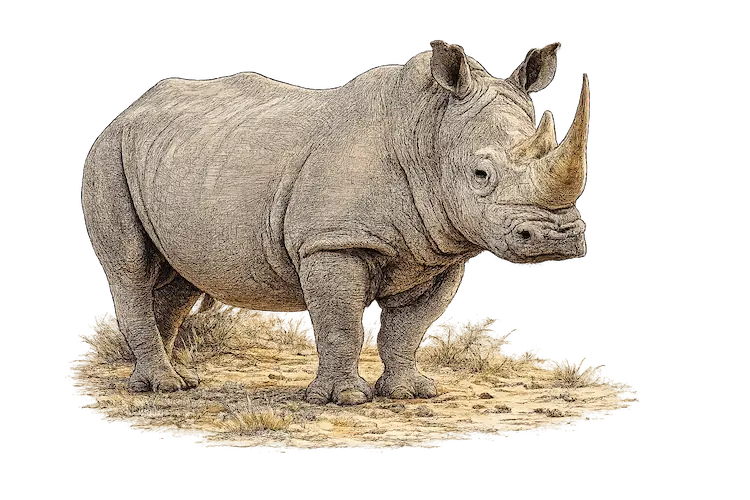
White Rhinoceros
Larger, lower-headed and built for grazing open grassland with a wide, square mouth.
View the white rhino guideSeeing a rhinoceros in Kruger National Park is often a quiet, memorable moment. At first glance, the two species found here — the white rhinoceros and the black rhinoceros — can appear almost identical, both carrying the same grey colour and heavy, prehistoric form.
The differences, however, reveal themselves with a little more time. The shape of the mouth, the way each animal feeds, and even how it moves through the landscape all begin to tell a different story.
This guide explores the key differences between the two species and offers simple ways to recognise each one while exploring Kruger’s wildlife.
A side-by-side view makes the differences easier to see. Look especially at the mouth shape, head position, body size and the way each rhino is built for feeding.
Larger, lower-headed and built for grazing open grassland with a wide, square mouth.
View the white rhino guide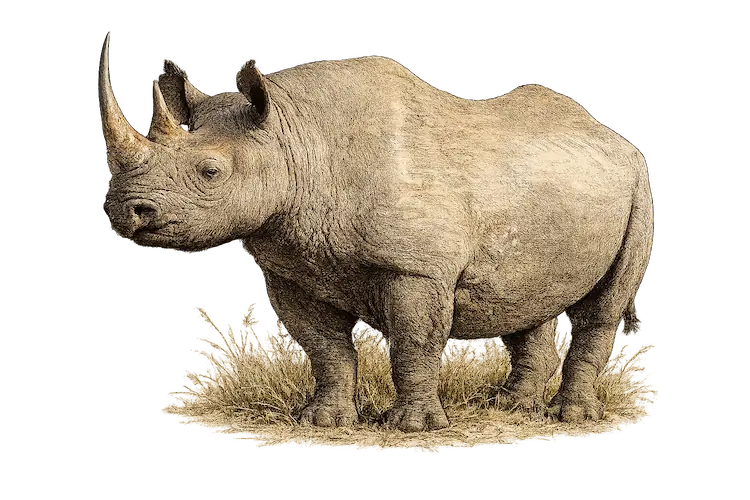
Smaller, more compact and adapted for browsing leaves and shrubs with a hooked upper lip.
View the black rhino guideWhile both species share the same grey colour and overall shape, a few key features make it possible to tell them apart in the field.
| Feature | White Rhino | Black Rhino |
|---|---|---|
| Mouth Shape | Wide, flat lip for grazing | Pointed, hooked lip for browsing |
| Feeding Style | Grazes on grass | Browses leaves and shrubs |
| Head Position | Held low while feeding | Held higher and more alert |
| Size | Larger and heavier | Smaller and more compact |
| Behaviour | Calm, often in small groups | Solitary and more reactive |
| Habitat | Open grasslands | Dense bush and thickets |
A simple way to remember: white rhinos are built for grazing in open areas, while black rhinos are adapted for browsing in thicker vegetation.
On safari, you may not always get a perfect side view of a rhino. Dust, distance, grass, and thick bush can hide the finer details. The best approach is to look for a combination of clues rather than relying on only one feature.
The mouth is the most useful clue. A white rhinoceros has a broad, square mouth for cropping grass close to the ground. A black rhinoceros has a more pointed, hooked upper lip, useful for pulling leaves and twigs from shrubs.
White rhinos often move with the head held low, especially while feeding. Black rhinos tend to carry the head a little higher, giving them a more alert and compact appearance as they browse through thicker vegetation.
A rhino feeding in open grassland is more likely to be a white rhino. A rhino partly hidden in dense bush, browsing leaves or standing in thicker cover, may be a black rhino. Habitat is not a perfect rule, but it is often a helpful field clue.
White rhinos usually look heavier, longer, and lower-slung, with a noticeable shoulder hump. Black rhinos are smaller, shorter-bodied, and often appear more upright. When seen briefly, this overall posture can be just as useful as a close look at the face.
The easiest way to understand the difference between white and black rhinos is to look at what they eat. Their mouths, posture, and preferred habitats are all shaped by their feeding habits.
The white rhinoceros is built for grazing. Its wide mouth works like a lawnmower, cropping short grass in open areas. This is why white rhinos are more often seen in grasslands, open savanna, and areas where visibility is good.
The black rhinoceros is a browser. Its hooked upper lip helps it pull leaves, shoots, and small branches from shrubs and low trees. This feeding style keeps it closer to thicker bush, where it is often harder to see.
In Kruger National Park, these different feeding habits allow both species to live in the same wider landscape without using the habitat in exactly the same way.
Although both species share the same landscape, their behaviour can feel quite different in the field. These differences often shape how encounters unfold on safari.
The white rhinoceros is generally more relaxed in its behaviour. It is not uncommon to see small groups, especially females with calves, grazing together in open areas. Their predictable movements and tolerance of open space often make them easier to observe.
The black rhinoceros tends to be more solitary and cautious. It spends much of its time in thicker vegetation, moving quietly and often remaining unseen. When surprised, black rhinos can react quickly, which is why sightings are usually brief and more unpredictable.
These differences are not about one species being more aggressive than the other, but rather how each has adapted to its environment. Spending time watching their behaviour often reveals these patterns more clearly than any single feature.
Both white and black rhinoceros are among the most protected animals in Kruger National Park, yet their conservation stories are very different.
The white rhinoceros is often seen as one of Africa’s great conservation successes. Once close to extinction, populations were carefully rebuilt through protection and management. Today, they are still vulnerable to poaching, but their numbers remain significantly higher than those of black rhinos.
The black rhinoceros remains one of the most endangered large mammals in Africa. Smaller populations, slower recovery, and ongoing threats make every individual sighting especially meaningful.
Seeing either species in the wild is a reminder of the ongoing effort required to protect them. Each encounter is not only a highlight of a safari, but also a reflection of the conservation work taking place behind the scenes.
Encounters with rhinoceros are often brief but memorable. Whether it is a white rhino grazing quietly in open grassland or a black rhino moving through thicker bush, each sighting carries a sense of rarity and presence.
If you would like to explore Kruger National Park with a deeper understanding of its wildlife, you can view our private safaris or learn more about the wider wildlife found across the park.
The main difference is the shape of the mouth. White rhinos have a wide, flat mouth for grazing grass, while black rhinos have a pointed, hooked lip for browsing leaves and shrubs.
Both species are grey. The name “white rhino” comes from the Afrikaans word “wyd,” meaning wide, referring to its mouth. The name “black rhino” was used simply to distinguish between the two species.
The white rhino is significantly larger and heavier than the black rhino, making it the second-largest land mammal after the elephant.
Black rhinos are generally more reactive and defensive, especially when surprised. White rhinos tend to be calmer and more tolerant of open spaces.
Black rhinos are much harder to see. They are fewer in number and prefer dense bush, while white rhinos are more common and often found in open areas.