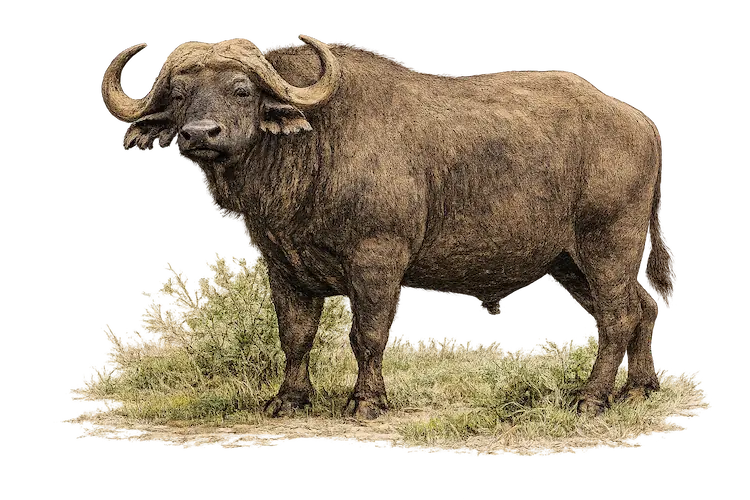
African Buffalo
(Syncerus caffer)
The African buffalo is one of the most iconic and widely encountered animals in Kruger National Park, often seen moving in large herds across open plains and along water-rich areas. As one of the legendary Big 5 animals, it carries a strong presence in the bush, both for its sheer size and its reputation for being unpredictable when threatened.
Sightings are frequent throughout much of the park, making buffalo one of the most reliable large mammals to encounter on safari. Watching a herd gather at a waterhole or slowly graze through the savanna offers a quiet but powerful glimpse into Kruger’s wild rhythm. This guide covers identification, habitat, behaviour, diet, breeding, and how to find this species while exploring Kruger’s wildlife.
| Size | Up to 1.4 metres at the shoulder |
|---|---|
| Weight | Males can weigh up to 800 kg, while females reach around 750 kg |
| Lifespan | Approximately 20-23 years in the wild |
| Habitat & Distribution | Widely distributed across sub-Saharan Africa, occurring in habitats with sufficient grazing, water, and shade, including savannahs, woodlands, and floodplains |
| Gestation | Around 11 months |
| Number of Young | Typically one calf |
| Food | Primarily bulk grazers, feeding on grasses; will take small amounts of browse during dry periods when grazing is limited |
| Predators | Lions are the primary natural predators; humans pose the greatest overall threat |
Identification
The African buffalo is a large, heavily built herbivore with a dark brown to almost black coat, often appearing mud-stained from regular wallowing. Adult males are especially distinctive due to their massive, curved horns that meet in the centre to form a solid boss across the forehead. Females have slimmer horns, typically lacking the fully developed boss seen in bulls.
Buffalo have a broad, powerful body with a slightly lowered head posture, giving them a purposeful and grounded appearance when walking. Their tails are thin with a tuft at the tip, and their ears are large and often fringed with hair. In good light, the skin and coat can show subtle variations of brown and charcoal tones, especially on younger individuals.
At a distance, buffalo can sometimes be confused with blue wildebeest, but buffalo are bulkier, darker, and lack the sloping back and facial markings typical of wildebeest. Their heavy horn structure is usually the clearest distinguishing feature.
Habitat & Where It Lives
African buffalo are strongly tied to water and are most commonly found in areas of Kruger National Park where permanent rivers, dams, and seasonal pans are present. They favour open savanna, mixed woodland, and riverine habitats where grazing is good and water is never too far away.
Large herds are especially common in the southern and central regions of the park, where grasslands are more productive and water sources are frequent. In drier northern areas, buffalo are still present but tend to move more widely between water, often forming smaller groups or spreading out across the landscape.
Because of their dependence on water, buffalo movements are often predictable, particularly during the dry winter months when herds gather along rivers and around reliable waterholes. This makes them one of the easier large mammals to locate when following well-planned routes through the park, as outlined in the Kruger National Park guide.
Behaviour
African buffalo are highly social animals, most often seen in large herds that can range from a few dozen to several hundred individuals. These herds are typically made up of females, calves, and younger males, moving slowly together as they graze and drink. Their behaviour is generally calm, but there is always an underlying alertness, especially in areas where predators are active.
Older bulls often separate from the main herd and form smaller bachelor groups, commonly referred to as “dagga boys.” These individuals are frequently found resting in mud wallows or shaded areas near water, and can appear more solitary and unpredictable than herd animals.
Buffalo are known for their strong defensive behaviour. When threatened, herds may bunch together to protect their young, and individuals are capable of standing their ground rather than fleeing. This makes them one of the more dangerous animals in the park, particularly when encountered on foot.
Their relationship with predators is one of the most dramatic interactions in Kruger. Buffalo are a primary prey species for lions, and encounters between the two can be intense and unpredictable. Despite this, buffalo often turn the tables, with coordinated herd defence sometimes driving predators away.
Diet
African buffalo are strict grazers, feeding almost entirely on grasses. They prefer short, green grasses that are rich in nutrients, especially during the wet summer months when food is abundant across the park.
During the dry season, when grasses become sparse and less nutritious, buffalo rely heavily on areas where grazing conditions are still good, often near rivers, dams, and low-lying plains. This seasonal movement is closely linked to both food availability and access to water.
Their feeding patterns play an important role in shaping the landscape, as large herds can graze extensive areas over time. Many of the grasses they rely on can be explored further in Kruger’s grass species guide, which helps explain how grazing animals like buffalo fit into the wider ecosystem.
Breeding
African buffalo do not have a strict breeding season, but calving tends to peak during the summer months when rainfall is higher and grazing conditions are at their best. This ensures that young calves are born at a time when food is plentiful and herds are in strong condition.
After a gestation period of around 11 months, a single calf is born. Newborns are able to stand and move within a short time, staying close to their mothers within the safety of the herd. Calves are protected collectively, with the group forming a defensive barrier if danger is detected.
As they grow, young buffalo gradually integrate into the herd structure, learning movement patterns and social behaviour from older individuals. This strong herd dynamic plays a key role in survival, particularly in areas where predators are present.
How to Find African Buffalo in Kruger
African buffalo are among the most reliably seen large mammals in Kruger National Park, particularly in areas where water is consistently available. Rivers such as the Sabie and Crocodile, as well as productive grasslands in the southern and central regions, are some of the best places to encounter large herds.
Early mornings and late afternoons are ideal times to find buffalo on the move, either grazing or heading toward water. During the heat of the day, they are often seen resting in shade or wallowing in mud near waterholes. In the dry winter months, sightings become even more predictable as herds concentrate around permanent water sources.
While buffalo are common, finding the most interesting behaviour — such as large herd crossings, interactions with predators, or solitary “dagga boys” — often comes down to timing, patience, and knowing where to look. This is where local experience can make a noticeable difference.
Joining one of the private Kruger safaris allows for a more flexible approach, focusing on productive areas and spending more time at sightings. For a more complete experience, explore the available Kruger safari packages, which are designed to maximise wildlife encounters throughout the park.
Why People Love Seeing African Buffalo
There is something quietly powerful about encountering African buffalo in the wild. Unlike some of the more elusive predators, buffalo are often seen in large numbers, allowing visitors time to observe their behaviour and understand the rhythm of the herd. Watching them move slowly across the landscape, feeding and interacting, offers a deeper, more grounded safari experience.
Their presence carries weight. Whether it is a massive herd gathered at a waterhole or a solitary bull resting in the shade, buffalo have a way of holding attention. The heavy curve of their horns, the steady pace of their movement, and the occasional moment of tension within the herd all contribute to a sense of quiet intensity.
For many visitors, seeing buffalo also completes the story of the Big 5. While they may not always be the most dramatic sighting, they are among the most authentic — a constant presence in the bush that reflects the true character of Kruger National Park.
Experience Kruger’s Wildlife for Yourself
Whether you are hoping to see African buffalo moving through the savanna or simply want to experience the quiet rhythm of the bush, a guided safari offers the time and local knowledge needed to truly understand Kruger’s wildlife.
With flexible routes and experienced guiding, each day is shaped around the best possible sightings — from large buffalo herds to the predators that follow them.
View All Kruger Safari PackagesFrequently Asked Questions
Are African buffalo dangerous?
Yes, African buffalo are considered one of the more dangerous animals in Kruger National Park. While they are generally calm when undisturbed, they can become aggressive if threatened, especially when in herds or when calves are present.
Where can you see African buffalo in Kruger National Park?
African buffalo are commonly seen throughout the park, particularly in the southern and central regions where water and grazing are abundant. Rivers such as the Sabie and Crocodile are especially reliable areas for sightings.
Are African buffalo part of the Big 5?
Yes, African buffalo are one of the Big 5 animals, along with lion, leopard, elephant, and rhinoceros. They earned this title due to their size, strength, and the difficulty they presented to early hunters.
What do African buffalo eat?
African buffalo are grazers and feed mainly on grasses. They prefer short, nutrient-rich grasses and tend to stay close to water sources, especially during the dry season.
Why are buffalo called “dagga boys”?
Older male buffalo often leave the herd and spend time wallowing in mud, known locally as “dagga.” These solitary or small-group bulls are commonly referred to as dagga boys.