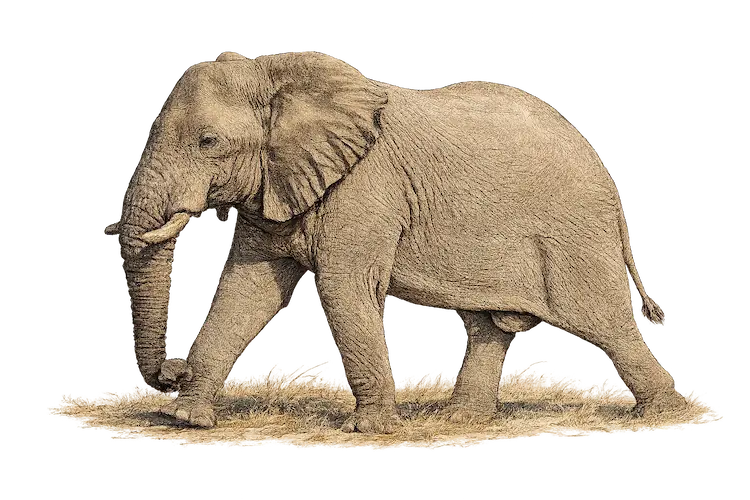
African Bush Elephant
(Loxodonta africana)
The African bush elephant is one of the most iconic animals to encounter in Kruger National Park. Moving slowly through woodland and open plains, these immense animals shape the landscape as they feed, drink, and travel in relaxed family groups. Sightings are frequent, yet never feel ordinary, with each encounter offering a quiet sense of scale, presence, and connection to the African bush.
As one of the famous Big 5 animals, the elephant is often high on a visitor’s wish list. Unlike more elusive species such as the leopard, elephants are seen regularly throughout the park, making them a defining part of any safari experience.
This guide covers identification, habitat, behaviour, diet, breeding, and how to find elephants while exploring Kruger’s wildlife, helping you better understand both their role in the ecosystem and how to appreciate them safely in the wild.
| Size | Bulls stand up to 3 metres at the shoulder, while cows reach around 2.5 metre |
|---|---|
| Weight | Bulls can weigh up to 6 tons, with cows reaching up to 4 tons |
| Lifespan | Typically 55-60 years |
| Habitat & Distribution | The African bush elephant occupies a wide range of habitats across Africa, wherever sufficient food, shade, and water are available. These include savannahs, woodlands, grasslands, forests, swamps, deserts, semi-deserts, and even mountainous regions |
| Gestation | Approximately 22 months, the longest gestation period of any land mammal |
| Number of Young | Usually a single calf is born at a time |
| Food | Herbivorous with a highly varied diet, feeding on up to 90% of locally available plant species. Their diet includes grasses, herbs, sedges, aquatic plants, roots, bulbs, tubers, fruits, bark, leaves, seeds, pods, and even branches and wood |
| Predators | Lions and hyenas primarily prey on calves, although in some regions lions are capable of taking down adult elephants. Other causes of death include disease, parasites, and starvation |
Identification
The African bush elephant is the largest land mammal on Earth, instantly recognised by its immense size, thick grey skin, and broad, fan-shaped ears. These ears are noticeably larger than those of the African forest elephant and help regulate body temperature in the heat of the Kruger bush. The trunk is long and muscular, used for feeding, drinking, communication, and even delicate tasks such as picking up small objects.
Both males and females may carry tusks, although those of mature bulls are often significantly longer and thicker. Bulls can grow to an impressive size, with a heavier build and more rounded forehead, while cows are generally smaller and move within tightly bonded family groups. Calves are often seen tucked safely between adults, their smaller trunks still learning coordination.
Unlike species such as the white rhinoceros, which may appear bulky and low to the ground, elephants carry their mass with a more upright, fluid movement. Their slow, rolling walk and constantly swinging trunk make them easy to identify even at a distance.
Habitat & Where It Lives
African bush elephants are highly adaptable and are found throughout much of Kruger National Park, from dense riverine forests to open savanna and mopane woodland. Their movements are often guided by the availability of food and water, with herds regularly travelling between grazing areas and reliable water sources.
In the drier northern regions, elephants are commonly associated with mopaneveld and broad floodplains, while in the south they are frequently seen along rivers and in mixed woodland where vegetation is more varied. Seasonal changes also influence their distribution, with larger concentrations forming around permanent water during the dry winter months.
Because of their size and feeding habits, elephants play a major role in shaping the landscape, often pushing over trees and opening up areas for other species. For a deeper understanding of these habitats and how they change across the park, it is worth exploring the Kruger National Park guide, which provides broader insight into the ecosystems that support this remarkable animal.
Behaviour
African bush elephants are highly social animals, most often seen in family groups led by an experienced matriarch. These herds are typically made up of related females and their young, moving together with a calm, coordinated rhythm as they feed and travel. The matriarch plays a vital role, guiding the group to water and feeding areas while responding to potential threats.
Adult bulls, on the other hand, tend to live more solitary lives or form loose bachelor groups. At times, older males enter a period known as musth, during which they become more dominant and focused on breeding. During this phase, their behaviour can be more assertive, and they are often seen moving independently across large areas.
Despite their size, elephants are generally calm and deliberate in their movements, communicating through a combination of low-frequency rumbles, body language, and touch. While they have few natural predators, calves may occasionally be vulnerable to large predators such as the lion, although such encounters are uncommon and usually avoided by the protective behaviour of the herd.
Diet
African bush elephants are herbivores with a varied and substantial diet, feeding on grasses, leaves, bark, roots, and fruit depending on the season. Using their flexible trunks, they are able to strip leaves from branches, dig for roots, and pull down vegetation with remarkable strength and precision.
During the summer months, when grasses are abundant, elephants spend much of their time grazing. In the drier winter season, their diet shifts more towards browsing, including branches, bark, and woody vegetation. This seasonal flexibility allows them to thrive across a wide range of habitats within Kruger.
Their feeding behaviour has a noticeable impact on the surrounding environment, often breaking branches or pushing over trees to access food. This natural disturbance helps shape the landscape and creates opportunities for other species to feed and grow. Many of the plants they rely on can be explored further within Kruger’s grasses and flowering plants sections.
Breeding
African bush elephants have one of the longest gestation periods of any land mammal, lasting around 22 months. Calves are usually born as single individuals and are able to stand and walk within a short time after birth, although they remain closely protected within the herd.
Breeding does not follow a strict seasonal pattern, but births are often more common during periods when food is plentiful. Females receive strong support from the herd, with other adults showing interest in and helping to care for the calf in its early stages of life.
Young elephants remain dependent on their mothers for several years, gradually learning how to feed, interact, and navigate the environment. This extended period of care plays an important role in shaping the social bonds and knowledge that define elephant family groups.
How to Find African Bush Elephants in Kruger
African bush elephants are widely distributed throughout Kruger National Park, making them one of the more reliable animals to encounter on safari. They are most often seen near water sources such as rivers, dams, and waterholes, particularly during the dry winter months when natural water becomes limited.
Early mornings and late afternoons tend to offer the best opportunities, as herds move between feeding areas and water. In the southern regions of the park, sightings are especially frequent due to higher vegetation density and water availability, although elephants can be found across all regions depending on seasonal conditions.
Spending time driving slowly along river systems or pausing at waterholes often rewards patient observers with relaxed, natural behaviour. Larger herds are commonly seen crossing roads or feeding in open clearings, while solitary bulls may be encountered moving quietly through woodland.
For those wanting a deeper and more consistent experience, guided private Kruger safaris offer the advantage of local knowledge, allowing guides to track movement patterns and position vehicles for better sightings.
Alternatively, fully planned Kruger safari packages provide a relaxed way to explore the park, ensuring enough time is spent in the right areas to encounter elephants and other iconic species.
Why People Love Seeing African Bush Elephants
There is something quietly powerful about encountering an African bush elephant in the wild. Despite their immense size, their movements are often calm and deliberate, creating a sense of stillness rather than intensity. Watching a herd feed, drink, or simply stand together reveals a depth of connection that is both gentle and grounding.
Many visitors find themselves drawn not just to the scale of the animal, but to its presence. The slow rhythm of a swinging trunk, the soft communication between herd members, and the careful way calves are protected all add to the experience. These moments tend to stay with people long after the sighting has passed.
Whether seen crossing a road, gathering at a waterhole, or moving through the trees at sunset, elephants offer a sense of perspective that few other animals can match. It is this combination of strength, intelligence, and quiet social interaction that makes them one of the most memorable animals to encounter in Kruger.
Experience Kruger’s Wildlife for Yourself
Whether you are hoping to spend time with African bush elephants or simply want to experience the rhythm of the bush, a guided safari offers the space and insight to truly appreciate Kruger. With the right pace and local knowledge, even familiar sightings become something memorable.
View All Kruger Safari PackagesAfrican Bush Elephant FAQs
Are African bush elephants common in Kruger National Park?
Yes, African bush elephants are commonly seen throughout Kruger National Park. They are especially frequent near rivers, dams, and waterholes, particularly during the dry winter months.
Where is the best place to see elephants in Kruger?
Elephants can be found across the park, but they are often seen near permanent water sources and along river systems. The southern and central regions can be very productive, although sightings are possible in almost every part of Kruger.
Are African bush elephants part of the Big 5?
Yes, the African bush elephant is one of the Big 5 animals. In Kruger, it is one of the most reliable Big 5 species to encounter on safari.
What do African bush elephants eat?
African bush elephants are herbivores. They feed on grasses, leaves, bark, roots, branches, fruit, and other plant material, with their diet changing between the wet and dry seasons.
Are elephants dangerous on safari?
Elephants are usually calm when given space and treated with respect, but they are powerful wild animals and can be dangerous if approached too closely. A good guide will read their behaviour and keep a safe distance.