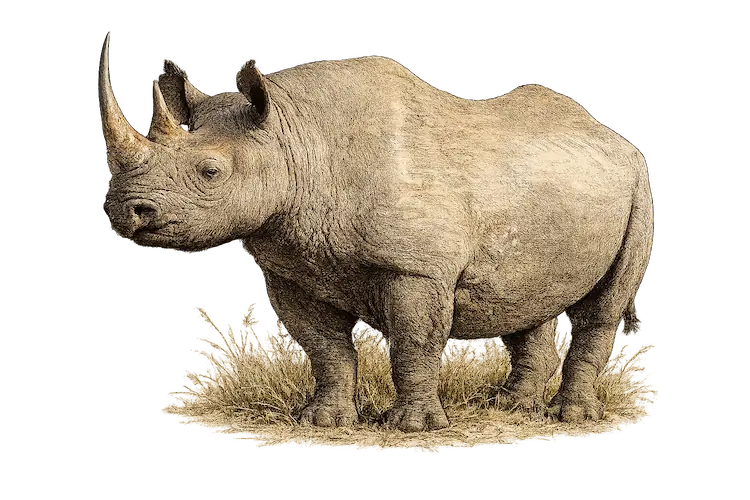
Black Rhinoceros
(Diceros bicornis)
The black rhinoceros is one of the most elusive and powerful animals found in Kruger National Park. Unlike its more commonly seen relative, the white rhinoceros, the black rhino is shy, solitary, and far less frequently encountered, making every sighting feel rare and deeply rewarding.
Known for its hooked lip, compact build, and alert nature, this species moves quietly through dense bushveld, often disappearing before it is even noticed. It is a true symbol of wild Africa—powerful yet vulnerable—and remains one of the most sought-after members of the Big 5.
This guide covers identification, habitat, behaviour, diet, breeding, and how to find this species while exploring Kruger’s wildlife.
Identification
The black rhinoceros is smaller and more compact than the white rhinoceros, with a noticeably hooked upper lip that is perfectly adapted for browsing on shrubs and trees. This pointed lip is often the easiest way to distinguish the species in the field, especially when vegetation partially obscures the animal.
Its body is more rounded and less elongated than that of a white rhino, with a higher head carriage and a more alert posture. The ears are constantly moving, picking up sounds, and individuals often appear tense and aware of their surroundings. The horns are typically long and sharply pointed, with the front horn often more prominent.
In contrast, the white rhinoceros has a wide, square-shaped mouth adapted for grazing, along with a longer body and a more relaxed, head-down feeding posture. When seen side by side, the differences are clear, but in dense bushveld, noticing the lip shape and feeding behaviour is often the most reliable way to tell them apart.
Habitat & Where It Lives
The black rhinoceros favours dense, wooded habitats where cover is thick and visibility is limited. In Kruger National Park, this typically includes thornveld, riverine bush, and areas of mixed woodland where shrubs and small trees provide reliable browsing.
It is most often found in quieter, less open regions of the park, particularly where human activity is lower and vegetation is dense. These conditions allow the species to move undetected and remain well hidden during the heat of the day. Unlike grazers that depend on open grasslands, black rhinos are closely tied to areas rich in browse, often near seasonal water sources.
For a broader understanding of how these habitats fit into the park’s landscape, the Kruger National Park guide provides useful insight into regional differences, vegetation types, and how wildlife is distributed across the reserve.
Behaviour
The black rhinoceros is largely solitary and highly territorial, with individuals often moving alone through dense vegetation. It is most active during the cooler hours of early morning, late afternoon, and at night, spending the heat of the day resting in thick cover. Unlike many of Kruger’s more relaxed herbivores, this species is known for its alert and sometimes unpredictable nature.
With relatively poor eyesight but excellent hearing and smell, black rhinos rely heavily on their senses to detect danger. When startled, they may react quickly and decisively, sometimes charging toward perceived threats before assessing them fully. This behaviour, while rare to witness, is part of what gives the species its reputation for being both powerful and cautious at the same time.
Calves remain close to their mothers for several years, learning movement patterns and feeding behaviour in dense bushveld. While adult black rhinos have few natural predators, young calves may occasionally fall prey to large carnivores such as the lion. Despite this, their primary threat remains human-related, making their presence in Kruger both significant and carefully protected.
Diet
The black rhinoceros is a browser, feeding primarily on leaves, shoots, and branches from a wide range of shrubs and small trees. Its distinctive hooked upper lip is perfectly adapted for grasping and pulling vegetation, allowing it to feed selectively even in dense bush.
In Kruger National Park, it commonly feeds on thorny species, woody shrubs, and seasonal growth that emerges after rains. This browsing behaviour sets it apart from grazing animals that rely on grasses, and often leads it into thicker, less accessible habitats.
For a broader look at the plant life that supports species like the black rhino, exploring Kruger’s flowers and surrounding vegetation gives useful insight into the diversity of browse available across the park.
Breeding
Black rhinoceroses breed throughout the year, although peaks may occur depending on local conditions and rainfall. After a gestation period of around 15 to 16 months, a single calf is born, usually in a secluded area with dense cover.
The calf remains close to its mother for several years, learning feeding behaviour and movement patterns through thick bushveld. During this time, the mother is highly protective, often positioning herself between the calf and any perceived threat.
Breeding intervals are relatively long, with females typically giving birth every 2.5 to 4 years. This slow reproductive rate makes population recovery gradual, which is why the species remains carefully protected within Kruger National Park.
How to Find Black Rhinoceros in Kruger
Finding a black rhinoceros in Kruger National Park requires patience, timing, and a bit of luck. Unlike the more visible white rhino, this species prefers dense vegetation and quieter areas, often moving through thick bush where it can remain hidden for long periods.
Early mornings and late afternoons offer the best chances, particularly in regions where woodland and riverine habitats dominate. Signs such as fresh tracks, broken branches, or dung middens can sometimes reveal their presence before the animal itself is seen. Because sightings are rare, guides often rely on experience and knowledge of habitat rather than predictable locations.
Exploring the park with an experienced guide significantly increases your chances of encountering species like this. On private Kruger safaris, more time can be spent tracking subtle signs and focusing on quieter areas of the bush, rather than simply driving between well-known sightings.
For travellers looking for a fully planned experience, Kruger safari packages combine accommodation, guiding, and local expertise—allowing you to slow down and appreciate even the most elusive wildlife encounters.
Why People Love Seeing Black Rhinoceros
Seeing a black rhinoceros in the wild is not just another sighting—it is a moment that stays with you. Because they are so rarely encountered, each appearance feels quiet, personal, and completely unfiltered. There is no crowd, no sense of routine—just a powerful animal moving through its natural environment, often disappearing as quickly as it arrived.
Their presence carries a different kind of energy to that of the more commonly seen members of the Big 5. A black rhino sighting is often quieter, more intimate, and filled with a sense of respect for an animal that has survived against the odds.
For many visitors, it becomes one of the most meaningful moments of their time in Kruger National Park—a reminder that the bush is not only about what is seen, but about what is felt in the stillness between sightings.
Experience Kruger’s Rare Wildlife for Yourself
Whether you are hoping for a rare black rhinoceros sighting or simply want to enjoy the slower details of the bush, a guided safari gives you the time, patience, and local knowledge to experience Kruger properly.
View All Kruger Safari PackagesBlack Rhinoceros FAQ
Are black rhinoceroses found in Kruger National Park?
Yes, black rhinoceroses occur in Kruger National Park, but they are far less commonly seen than white rhinoceroses. They prefer dense bushveld and are naturally shy, making sightings rare and special.
What is the difference between a black rhino and a white rhino?
The easiest difference is the mouth shape. A black rhino has a hooked upper lip for browsing leaves and shrubs, while a white rhino has a wide, square mouth for grazing grass. Black rhinos are also usually smaller, more solitary, and more often found in thicker vegetation.
Are black rhinos dangerous?
Black rhinos can be unpredictable when startled, especially because they rely more on hearing and smell than eyesight. From a vehicle, respectful viewing distance and calm behaviour are important.
When is the best time to see black rhino in Kruger?
Early morning and late afternoon are often best, especially in quieter areas with dense woodland or riverine bush. Sightings are never guaranteed, but patient searching in suitable habitat gives the best chance.
What do black rhinoceroses eat?
Black rhinos are browsers. They feed mainly on leaves, shoots, twigs, and woody shrubs, using their hooked upper lip to pull selected vegetation from bushes and small trees.