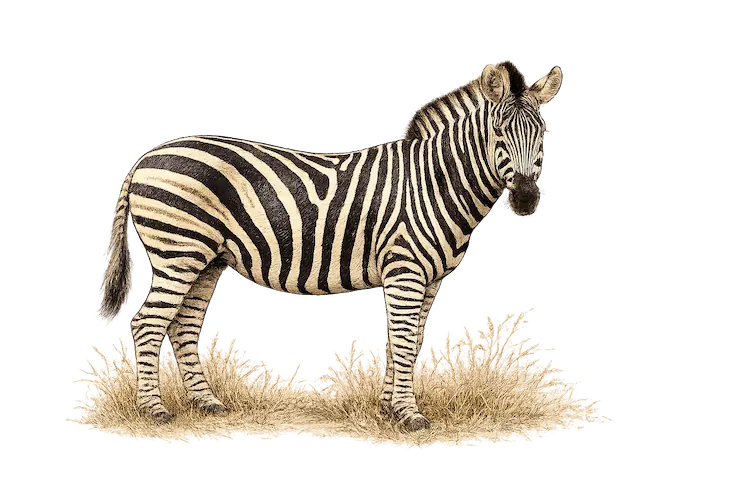
Burchell’s Zebra in Kruger National Park
(Equus quagga burchellii)
The Burchell’s zebra is one of the most recognisable and frequently seen animals in Kruger National Park, its bold black-and-white stripes standing out against the golden grasslands of the Lowveld. Often encountered in small family groups or larger herds, zebra bring a sense of movement and life to the open plains, particularly in the early morning and late afternoon.
Unlike some of Kruger’s more elusive species, zebra are reliably seen throughout much of the park, making them a favourite for both first-time visitors and experienced safari-goers. Their social behaviour, constant alertness, and striking patterns make them one of the most engaging animals to spend time with in the wild.
This guide covers identification, habitat, behaviour, diet, breeding, and how to find this species while exploring Kruger’s wildlife, along with helpful insights to improve your sightings in the field.
Identification
The Burchell’s zebra is a medium-sized, robustly built antelope-like grazer, easily recognised by its striking pattern of bold black and white stripes. Each individual carries a unique stripe pattern, much like a fingerprint. In Kruger National Park, Burchell’s zebra typically show softer, slightly shadowed stripes on the hindquarters, sometimes with faint brown “shadow stripes” between the black bands, especially toward the rear of the body.
The body is rounded with a relatively short neck and a distinctive upright mane that follows the line of the neck. The face is clearly striped, with narrower lines that become more defined around the eyes and muzzle. The legs are also striped all the way down to the hooves, giving the animal a clean, high-contrast appearance even from a distance.
One useful field clue is the absence of the crisp, unbroken striping seen in more arid-adapted zebra species. Compared to the rarer plains wildlife around them, Burchell’s zebra often appear slightly “softer” in contrast, particularly on the flanks and hindquarters.
They are often seen moving in relaxed, steady herds, heads down while grazing, but lifting frequently to scan their surroundings. This constant alertness, combined with their distinctive patterns, makes them one of the easiest animals to identify while exploring Kruger’s wildlife.
Habitat & Where It Lives
Burchell’s zebra are widely distributed throughout Kruger National Park, favouring open savanna, grasslands, and lightly wooded areas where grazing is good and visibility is high. They are especially common in regions where grasses dominate the landscape, often sharing space with other grazing species such as impala and blue wildebeest.
They are most frequently encountered in the central and southern parts of the park, where open plains and mixed bushveld provide ideal feeding conditions. In these areas, zebra are often seen moving between grazing grounds and nearby water sources, as they are regular drinkers and seldom stray far from water.
During the dry winter months, when grass becomes shorter and more concentrated around waterholes, zebra sightings can become even more predictable. This seasonal movement ties closely into the broader patterns described in the best time to visit Kruger National Park guide, where visibility and wildlife density often improve as vegetation thins out.
While they prefer open areas, Burchell’s zebra will occasionally move through woodland and along riverine fringes, particularly in search of fresh grazing after rains. Their adaptability allows them to thrive across much of the park, making them one of the most consistently encountered species when exploring Kruger’s diverse habitats.
Behaviour
Burchell’s zebra are highly social animals, most often seen in small family groups made up of a dominant stallion, several mares, and their young. These groups are stable and can remain together for long periods, forming the core of larger, loosely structured herds that move across the landscape in search of grazing.
Their behaviour is calm and rhythmic, particularly while feeding, but this is balanced by a constant state of alertness. Zebra will regularly lift their heads while grazing, scanning their surroundings and listening for danger. This vigilance plays an important role in mixed herds, where zebra often act as early warning systems for other species.
In Kruger National Park, zebra frequently associate with grazers such as wildebeest and antelope, benefiting from safety in numbers. However, they remain a key prey species for large predators, including the lion and spotted hyena. When threatened, zebra rely on speed, strong group cohesion, and powerful kicks to defend themselves.
They are active throughout the day, with peaks in movement during the cooler hours of early morning and late afternoon. Dust bathing, mutual grooming, and social interactions are commonly observed, offering quiet but memorable moments for those who take the time to watch them closely while exploring Kruger’s wildlife.
Diet
Burchell’s zebra are primarily grazers, feeding almost entirely on grasses. They favour shorter, more nutritious grass shoots and are often among the first animals to move into an area after rains, taking advantage of fresh growth. Their strong teeth and digestive system allow them to process tougher grasses than many other herbivores, making them highly adaptable across different habitats in Kruger.
Because of this, zebra often play an important role in the grazing cycle. By feeding on taller, coarser grasses first, they help create conditions that allow more selective feeders, such as impala, to follow. This natural sequence is a common and fascinating sight across Kruger’s wildlife.
While grass makes up the majority of their diet, zebra will occasionally feed on leaves, bark, and stems when grazing is limited, particularly during the dry winter months. Even so, they remain closely tied to areas where grass is available and will move accordingly as conditions change.
Access to water is essential, and zebra drink regularly, often daily if possible. For this reason, they are frequently seen near rivers, dams, and waterholes, especially during the dry season when water sources become focal points for wildlife activity.
Breeding
Burchell’s zebra do not have a strict breeding season, and foals can be born throughout the year in Kruger National Park. However, there is often a peak during the summer months when food is more abundant and conditions are favourable for raising young.
After a gestation period of around 12 months, a single foal is born. Newborns are able to stand and walk within a short time, an essential adaptation in a landscape where predators are always present. In the early days, the foal stays close to its mother, learning her unique stripe pattern, which helps it recognise and remain bonded to her within the herd.
Mares are attentive and protective, often positioning themselves between their young and potential danger. Within the family group, other members may also contribute to the overall vigilance of the herd, creating a safer environment for the foal to grow.
Young zebra remain with their family group as they mature, gradually becoming more independent while still benefiting from the structure and protection of the herd. Seeing a foal alongside its mother is a gentle and memorable moment while exploring Kruger’s wildlife.
How to Find Burchell’s Zebra in Kruger
Burchell’s zebra are among the easiest animals to find in Kruger National Park, and are regularly seen throughout much of the park. They favour open grasslands and savanna areas, particularly in the central and southern regions, where grazing is good and visibility is clear.
Early morning and late afternoon are the best times to encounter zebra, as herds move between grazing areas and water sources. During the heat of the day, they may rest in lightly shaded areas, though they remain visible and active compared to many other species.
Waterholes, open plains, and roadside grazing areas are all reliable places to look. Zebra are often seen alongside other herbivores such as wildebeest and antelope, so scanning mixed herds can quickly lead to sightings. In the dry winter months, when grass is shorter and wildlife concentrates around water, sightings become even more consistent.
While zebra are common, taking the time to observe their behaviour, social structure, and interactions with other species can add depth to the experience. This is where a slower, more considered approach to game viewing becomes especially rewarding.
For those wanting to experience these moments more fully, guided private Kruger safaris or fully all-inclusive safari packages allow for a flexible pace, giving you the time to stop, watch, and truly appreciate even the more familiar animals.
Why People Love Seeing Burchell’s Zebra
There is something quietly captivating about Burchell’s zebra. At first glance, they may seem familiar, almost expected, yet the longer you spend with them, the more their subtle details begin to stand out. No two individuals are the same, and it is often in these small differences that their beauty reveals itself.
Watching a herd move through the grasslands is a gentle, almost rhythmic experience. The soft sound of hooves, the occasional call between individuals, and the constant shifting of stripes against the landscape create a scene that feels both calm and alive. It is these slower moments that often become the most memorable.
Zebra also play an important role in the broader safari experience. They are often among the first animals encountered on a drive, setting the tone for what lies ahead. Their presence frequently signals healthy grazing areas, which in turn attract other wildlife and, at times, predators such as lion, adding a quiet sense of anticipation to each sighting.
For photographers, their bold patterns offer endless opportunities, especially in the soft light of early morning or late afternoon. For others, it is simply the peaceful act of watching them graze, interact, and exist within the landscape that makes them so special while exploring Kruger’s wildlife.
Experience Kruger’s Wildlife for Yourself
Whether it’s your first sighting of Burchell’s zebra or a quiet moment spent watching a herd move through the grasslands, these are the experiences that shape a safari. With time, patience, and the right guidance, even the most familiar animals reveal something new.
A guided safari allows you to slow down, understand animal behaviour, and fully appreciate the smaller details that are often missed when travelling on your own. From open plains filled with zebra to predator-rich areas nearby, every drive becomes more meaningful.
View All Kruger Safari Packages