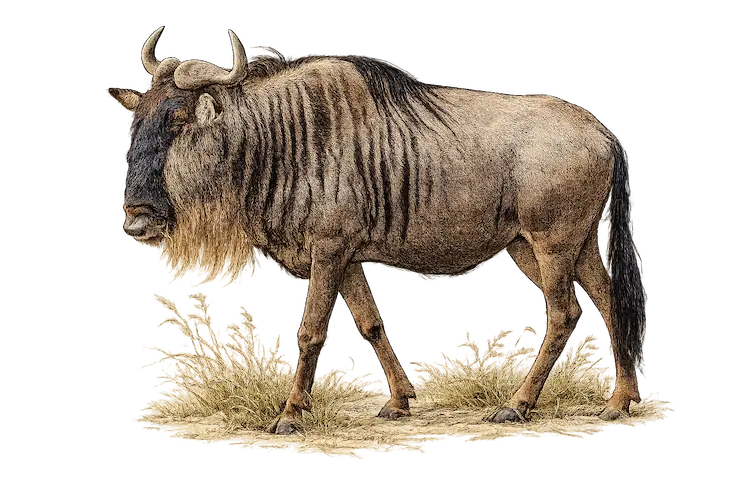
Blue Wildebeest in Kruger National Park
(Connochaetes taurinus)
The Blue Wildebeest is one of the most characteristic animals of Kruger National Park , often seen moving steadily across open plains or grazing in loose herds alongside zebra and antelope. With its heavy front build, sloping back, and distinctive beard, it carries a prehistoric appearance that feels perfectly at home in the African bush.
Sightings are frequent, particularly in open grassland and savanna areas where grazing is good. While they may not always draw the same immediate attention as predators, Blue Wildebeest play a central role in the ecosystem and are often part of dynamic wildlife scenes, especially where large herds attract lions and other predators.
This guide covers identification, habitat, behaviour, diet, breeding, and how to find this species while exploring Kruger’s wildlife .
Identification
The Blue Wildebeest is a medium to large antelope with a distinctive, slightly unusual shape that makes it easy to recognise once you become familiar with it. It has a heavy, muscular front end, a sloping back, and relatively slender hindquarters, giving it a somewhat unbalanced appearance when standing still.
The coat is typically grey to brown with faint vertical dark stripes along the shoulders and ribs. A dark mane runs along the neck and back, while a long black tail, similar to that of a horse, hangs down behind. One of its most recognisable features is the shaggy beard beneath the throat, which adds to its rugged, almost prehistoric look.
Both males and females carry strong, curved horns that sweep outward, then upward, forming a broad, helmet-like shape across the head. The face is often darker than the body, and when viewed head-on, the horns and broad forehead give the animal a powerful, slightly intimidating presence.
In movement, Blue Wildebeest have a steady, purposeful gait when walking, but can suddenly break into fast, energetic runs. During moments of excitement, they are known for their erratic, playful bursts of movement, often bucking and changing direction quickly.
They are sometimes confused with African Buffalo at a distance due to their darker colouring, but Wildebeest are lighter, more agile, and lack the heavy boss across the horns. They are also frequently seen grazing alongside Burchell’s Zebra , forming one of the most iconic wildlife pairings in Kruger National Park.
Habitat & Where It Lives
Blue Wildebeest favour open grassland and lightly wooded savanna, where visibility is good and grazing is plentiful. They are strongly tied to areas with short to medium grasses, often selecting habitats that provide a balance between food availability and the ability to detect predators early.
In Kruger National Park , they are most commonly found in the central and southern regions, where open plains and mixed savanna dominate the landscape. These areas support the kinds of grazing systems that Wildebeest depend on, often in close association with other herbivores.
Their distribution closely follows the availability of grasses , and they are frequently seen in areas that have recently received rain, where fresh growth provides higher nutritional value. During drier periods, they tend to remain within reach of reliable water sources, as they need to drink regularly.
Although they can occur in a range of habitats, Blue Wildebeest generally avoid dense woodland or thick bush where visibility is limited. Their preference for open country makes them one of the more visible and regularly encountered antelope species while exploring Kruger’s broader wildlife areas.
Behaviour
Blue Wildebeest are highly social animals, most often seen in loose herds that vary in size depending on the season and availability of food. These groups may consist of females with young, bachelor males, or mixed herds, all moving slowly through the landscape as they graze.
Despite their calm appearance while feeding, Wildebeest are alert and responsive to their surroundings. Herd members frequently lift their heads to scan for danger, relying on both sight and the awareness of others in the group. This collective vigilance helps them survive in areas where predators are common.
When alarmed, Blue Wildebeest can react suddenly and dramatically, breaking into fast runs with surprising speed and agility. They are well known for their energetic bursts of movement, often bucking, twisting, and changing direction in what appears to be chaotic motion. This behaviour can confuse predators and is sometimes seen even when there is no immediate threat.
They are an important prey species in Kruger National Park , frequently targeted by lions and spotted hyena . Their presence often indicates active predator areas, especially where herds gather in larger numbers.
Blue Wildebeest are also known to associate closely with Burchell’s Zebra , forming mixed groups that benefit both species. Zebra tend to graze taller grasses first, while Wildebeest follow behind feeding on shorter regrowth, creating a natural and efficient grazing system.
Diet
Blue Wildebeest are grazers, feeding almost entirely on grasses. They prefer short, fresh growth that is rich in nutrients, and are often seen moving steadily across open areas as they feed.
Their diet is closely linked to the seasonal cycle of the bush. After rainfall, when new grass begins to grow, Wildebeest concentrate in these areas to take advantage of the higher-quality forage. During drier periods, they may travel further in search of suitable grazing, often remaining within reach of water.
In Kruger National Park , their feeding habits play an important role in shaping the landscape, as they help maintain grassland structure through constant grazing.
Blue Wildebeest are frequently found feeding alongside other grazers such as Burchell’s Zebra , each species selecting different parts of the same grazing system. For a deeper understanding of the vegetation that supports them, explore Kruger’s grasses .
Breeding
Blue Wildebeest follow a seasonal breeding pattern, with calving typically linked to the rainy season when food is most abundant. This timing ensures that young are born when fresh grass is available, giving them the best chance of survival.
Females usually give birth to a single calf after a gestation period of around eight and a half months. One of the most remarkable features of Wildebeest calves is how quickly they are able to stand and move, often on their feet within minutes of birth and capable of keeping up with the herd soon after.
This rapid development is essential in an environment where predators such as lions and spotted hyena are always present.
During the calving period, herds may become more concentrated in favourable grazing areas, creating moments of heightened activity in the bush. These periods can offer some of the most dynamic wildlife viewing experiences in Kruger National Park , as both predator and prey activity increases.
How to Find Blue Wildebeest in Kruger
Blue Wildebeest are among the more regularly seen antelope in Kruger National Park , particularly in open grassland and savanna areas where grazing is good. The central and southern regions of the park tend to offer the most consistent sightings, especially where large open plains meet water sources.
Early morning and late afternoon are often the best times to observe them, when herds are actively feeding and moving between grazing areas. During the heat of the day, they may be seen standing or resting in more open spaces, still remaining alert to their surroundings.
One of the easiest ways to locate Wildebeest is to look for mixed herds with Burchell’s Zebra . These species frequently move and feed together, and spotting one often leads to the other. Areas with fresh grass growth, especially after rain, are particularly reliable.
Watching their behaviour can also provide clues. Herds that appear tense or tightly grouped may indicate the presence of nearby predators such as lions or spotted hyena , adding another layer to the experience.
While sightings are common, understanding where to look and how to read the landscape can make a significant difference. A guided experience allows you to focus on these details and spend more time in the right areas.
Explore private Kruger safaris or fully planned Kruger safari packages to experience these moments with local insight and a slower, more immersive approach.
Why People Love Seeing Blue Wildebeest
At first glance, the Blue Wildebeest may not seem as immediately striking as some of Kruger’s more iconic animals, but spending time around them often changes that impression. There is something quietly captivating about their presence on the landscape, especially when seen in groups moving steadily across open plains.
Their unusual shape, with its heavy front and sloping back, combined with the dark mane and beard, gives them a character that feels both ancient and perfectly adapted to the bush. Watching them graze alongside zebra or stand alert in the early morning light creates scenes that feel deeply connected to the rhythm of the African wilderness.
Moments of sudden energy are often what stay with people the most. A calm herd can quickly transform into a burst of movement, with individuals running, turning, and leaping in unpredictable ways. These flashes of behaviour add a sense of life and unpredictability to what might otherwise seem like a quiet sighting.
Perhaps most importantly, Blue Wildebeest are part of the larger story of Kruger’s wildlife . They connect grasslands, predators, and seasonal change, offering a deeper understanding of how the ecosystem fits together. For many visitors, this is where the real appreciation begins.
Experience Kruger’s Wildlife for Yourself
Whether you are hoping to spend time observing Blue Wildebeest or simply want to experience the quieter rhythm of the bush, a guided safari allows you to slow down and notice the details that make Kruger special. From open grasslands filled with grazing herds to the subtle signs of predators nearby, each drive offers something different.
With a private guide, you have the flexibility to follow wildlife activity, spend more time at sightings, and explore areas that best suit your interests.
View All Kruger Safari Packages