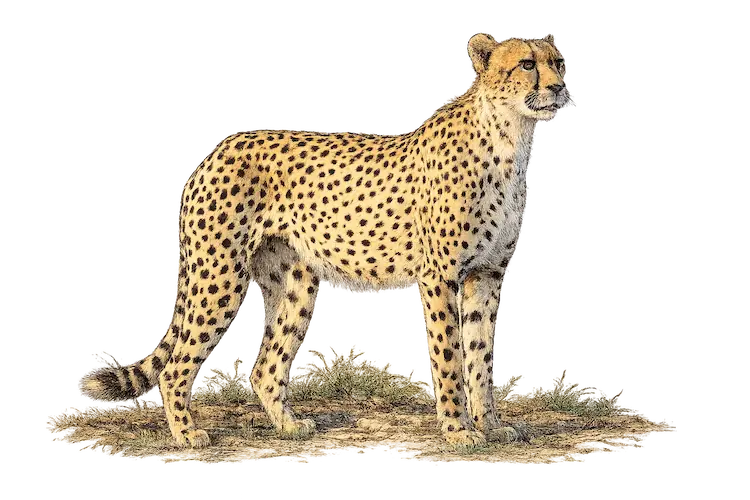
Cheetah
(Acinonyx jubatus)
The cheetah is one of Kruger’s most elegant and specialised predators, built for speed and precision rather than power. Unlike many of the park’s larger carnivores, sightings are never guaranteed, which makes encountering one feel particularly special. Often seen moving through open grassland or pausing on a slight rise to scan the horizon, the cheetah carries a quiet intensity that sets it apart from other cats in Kruger National Park.
While less commonly seen than animals like the lion or leopard, the cheetah rewards patience with moments of remarkable beauty—whether resting in the shade or moving with effortless grace across the savanna. This guide covers identification, habitat, behaviour, diet, breeding, and how to find this species while exploring Kruger’s wildlife.
Identification
The cheetah is immediately recognisable by its slender build, long legs, and small, rounded head. Its coat is a warm golden-yellow, covered in evenly spaced solid black spots, with no rosettes. One of its most distinctive features is the pair of black “tear marks” running from the inner corners of the eyes down to the mouth, giving the face a focused, almost intense expression.
Compared to the leopard, which is more muscular and marked with rosettes, the cheetah appears lighter and more streamlined. It is built for speed rather than strength, with a deep chest, narrow waist, and a long tail that helps with balance during high-speed chases. When moving, it often walks with a slightly hunched posture, the head held low and alert.
In the field, cheetahs are usually seen alone or in small groups, often resting in open areas where their spotted coat blends subtly with dry grass and light bush. Their posture, body shape, and facial markings make them one of the easiest large predators to identify once seen clearly.
Habitat & Where It Lives
Cheetahs favour open landscapes where their speed can be used to full advantage. In Kruger, they are most often found in grassland and lightly wooded savanna, where visibility is good and prey species such as impala and young antelope are abundant. Unlike more secretive predators, cheetahs tend to avoid dense thickets, preferring areas where they can scan the surroundings from a slight rise or termite mound.
Within Kruger National Park, sightings are generally more frequent in the central and southern regions, where open plains and mixed bushveld create suitable hunting conditions. Areas around Satara and the broader central grasslands are often considered some of the more reliable places, although cheetahs can appear anywhere given the right conditions.
Understanding the park’s different landscapes can greatly improve your chances of a sighting, and a broader overview of these regions can be explored in the Kruger National Park guide, where habitat, wildlife distribution, and seasonal movement are explained in more detail.
Behaviour
Cheetahs are primarily solitary animals, although males may form small coalitions—often brothers—that move and hunt together. Females, on the other hand, tend to roam alone, except when raising cubs. Compared to other large predators, cheetahs are generally more cautious and avoid confrontation, often giving way to stronger animals such as the lion or hyena.
Unlike many of Kruger’s predators, cheetahs are active during the day, particularly in the early morning and late afternoon. This behaviour helps them avoid competition and reduces the risk of losing a kill. They rely on sight rather than scent, often climbing onto termite mounds or slight rises to scan the surrounding landscape before beginning a hunt.
When hunting, a cheetah will stalk its prey quietly before launching into a short, explosive chase. These bursts of speed are incredibly fast but brief, and if the attempt fails, the cheetah will usually abandon the chase quickly to conserve energy. After a successful hunt, it must feed quickly, as scavengers and larger predators are never far away.
Diet
Cheetahs are specialised carnivores, feeding mainly on small to medium-sized antelope. In Kruger, their most common prey includes animals such as impala, as well as young wildebeest, kudu calves, and occasionally smaller mammals like hares or ground-dwelling birds.
Their hunting strategy relies on speed rather than strength. After carefully stalking to close the distance, a cheetah will launch into a rapid chase, aiming to trip or knock down its prey before delivering a suffocating bite to the throat. These chases are short and energy-intensive, and success depends on timing, terrain, and surprise.
Once a kill is made, the cheetah will often drag it to a quieter area and feed quickly. Unlike stronger predators, it cannot defend its meal for long, and will usually abandon the carcass if disturbed by larger animals. This need to eat quickly is an important part of its daily survival in Kruger’s competitive predator landscape.
Breeding
Cheetahs do not have a fixed breeding season and may reproduce at any time of the year, depending on conditions and food availability. After a gestation period of around three months, a female will give birth to a small litter, usually between two and five cubs, in a well-hidden den within thick vegetation or rocky cover.
The cubs are born with a distinctive mantle of longer, greyish fur along their backs, which is thought to help with camouflage. During the early weeks, the mother keeps them well concealed, moving them regularly to avoid detection. This stage is particularly vulnerable, as cub mortality is high due to predators such as lions and hyenas.
As they grow, the cubs begin to follow their mother, learning to stalk and hunt through observation and practice. This period can last up to a year and a half, after which the young cheetahs will eventually separate and establish their own ranges, continuing the cycle across Kruger’s open landscapes.
How to Find Cheetah in Kruger
Finding a cheetah in Kruger often comes down to patience and an understanding of the landscape. They favour open areas where visibility is good, so focusing on grasslands and lightly wooded savanna can improve your chances. Early mornings and late afternoons are the most productive times, when temperatures are cooler and cheetahs are more active.
The central regions of the park, particularly around Satara, are widely regarded as some of the better areas for sightings. Driving slowly through these open habitats, scanning termite mounds and slightly raised ground, can often reveal a resting cheetah watching the plains. Unlike more secretive predators, they are sometimes visible from a distance if you take the time to look carefully.
Because sightings are less frequent than animals like lion or elephant, spending extended time in suitable habitat greatly improves your chances. This is where a guided experience can make a meaningful difference, as local knowledge and familiarity with recent sightings help narrow down the search.
Joining a private Kruger safari or choosing one of the Kruger safari packages allows you to focus on these quieter, more open areas at the right times of day, increasing the likelihood of a memorable encounter.
Why People Love Seeing Cheetah
There is something quietly captivating about a cheetah sighting. Unlike the raw power of a lion or the secrecy of a leopard, the cheetah carries a sense of lightness and precision that feels almost effortless. Even when resting, it seems alert to every movement in the landscape, its gaze fixed on the open plains.
For many visitors, it is the rarity of the encounter that makes it so memorable. A cheetah is not an animal you simply come across by chance—it is one you find through patience, careful observation, and a bit of luck. That moment of recognition, when a shape in the grass resolves into a spotted form, often becomes one of the highlights of a Kruger safari.
Whether watching one scan from a termite mound or move with quiet purpose across the savanna, the experience feels unhurried and natural. It is a reminder of the subtle beauty of the bush, where not everything is immediate, and the most rewarding sightings are often the ones you have to wait for.
Experience Kruger’s Wildlife for Yourself
Whether you are hoping to see cheetah moving across the open plains or simply want to experience the quieter rhythms of the bush, a guided safari allows you to slow down and explore Kruger with purpose and understanding.
View All Kruger Safari PackagesFrequently Asked Questions
Are cheetahs common in Kruger National Park?
Cheetahs are present throughout Kruger but are not as commonly seen as lions or leopards. Sightings tend to be less frequent, which makes encountering one particularly special.
Where is the best place to see cheetahs in Kruger?
The central regions of Kruger, especially around Satara, are often considered some of the better areas for cheetah sightings due to the open grasslands and good visibility.
What time of day are cheetahs most active?
Cheetahs are mainly active during the early morning and late afternoon. Unlike many other predators, they often hunt during daylight hours when visibility is best.
What do cheetahs eat in Kruger?
Cheetahs primarily feed on small to medium-sized antelope such as impala, as well as young animals and occasionally smaller mammals or birds.
How fast can a cheetah run?
A cheetah is the fastest land animal and can reach speeds of up to 90–100 km/h in short bursts, although these chases usually last only a few seconds.
Are cheetahs dangerous to humans?
Cheetahs are generally shy and avoid human interaction. In Kruger National Park, they pose no threat when viewed respectfully from a vehicle.