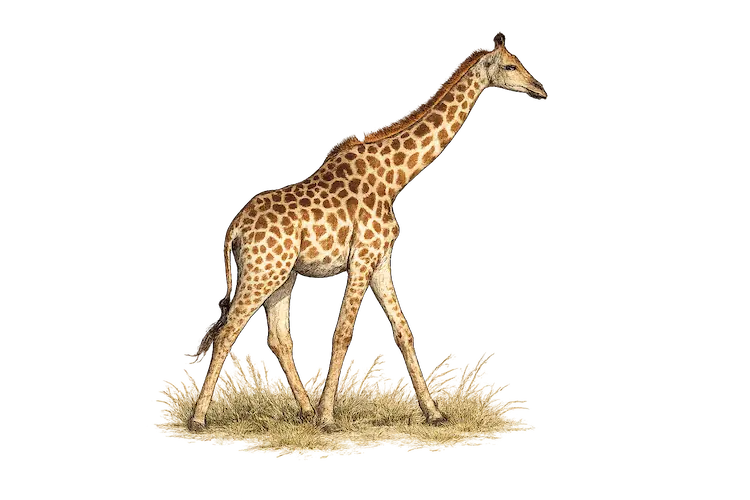
Southern Giraffe
(Giraffa giraffa)
The Southern Giraffe is one of the most quietly captivating animals to encounter in Kruger National Park . Moving slowly across open savanna and woodland, its height and patterned coat make it unmistakable, yet its calm presence often feels understated compared to the park’s more dramatic predators.
Giraffes are seen fairly regularly throughout Kruger, especially in areas with scattered trees and good browse. For many visitors, a sighting becomes less about excitement and more about appreciation — watching the gentle rhythm of their movement, the way they feed, and how they seem to observe the landscape from above.
This guide covers how to identify the Southern Giraffe, where it is most commonly found, and what to look for while exploring Kruger’s wildlife , helping you notice the quieter details that make each sighting more meaningful.
Identification
The Southern Giraffe is the tallest land mammal in Kruger National Park, with adults often reaching heights of up to 5.5 metres. Its long neck, slender legs, and slow, deliberate walk make it easy to recognise even from a distance. The coat is made up of irregular, star-shaped patches in shades of orange-brown, separated by lighter cream lines — a pattern that varies slightly between individuals but remains distinctive to the species.
Males are typically larger and heavier than females, often with darker colouring and more pronounced ossicones (the horn-like structures on the head). Over time, older bulls may develop thicker, almost bald-looking ossicones due to repeated sparring. Females tend to appear slightly more delicate, especially in the face and neck.
One of the easiest ways to identify a giraffe in the field is by its feeding behaviour. You will often see individuals standing beneath trees, using their long, prehensile tongues to strip leaves from branches — something few other mammals can do at the same height. This browsing posture, combined with their height, separates them clearly from other herbivores in Kruger.
While giraffes are unique in appearance, their browsing habits are sometimes shared with species like Greater Kudu and Eland, though these animals remain much smaller and occupy lower feeding levels within the same habitat.
Habitat & Where It Lives
Southern Giraffes are most commonly found in open savanna and lightly wooded areas across Kruger National Park , where scattered trees provide a steady supply of leaves. They favour habitats with acacia and other browse-rich vegetation, avoiding dense thickets and areas with very little tree cover.
In Kruger, giraffes are widely distributed and can be seen in both the northern and southern regions of the park. However, they are often more noticeable in mixed woodland and savanna landscapes where visibility is good and feeding opportunities are consistent. These environments allow them to move slowly between trees while maintaining a broad view of their surroundings.
Unlike many other large mammals, giraffes are not strongly tied to water sources and can go for extended periods without drinking, obtaining much of their moisture from the leaves they consume. This allows them to roam more freely across different parts of the park compared to species that remain close to rivers and waterholes.
If you are exploring different regions of the park, this adaptability makes giraffes one of the more reliable sightings while discovering Kruger’s diverse wildlife and landscapes.
Behaviour
Southern Giraffes are generally calm and slow-moving animals, often seen walking steadily between feeding areas or standing quietly beneath trees. They are loosely social, usually found in small groups that form and separate over time rather than in tightly structured herds. It is common to see females with calves together, while adult males tend to move more independently.
Bulls occasionally engage in a behaviour known as “necking,” where they swing their long necks and heads at each other in slow, powerful contests. These interactions are rarely aggressive in the sense of urgency, but they play an important role in establishing dominance between males.
Despite their size, giraffes remain alert and cautious. Their height gives them a natural advantage, allowing them to scan the surrounding landscape for movement. They are often among the first animals to notice potential danger, and other species will sometimes respond to their posture and attention.
While adult giraffes have few natural predators, calves are vulnerable to animals such as Lion and Spotted Hyena . Even so, a defensive adult giraffe can deliver powerful kicks, making them a formidable animal when threatened.
Diet
Southern Giraffes are browsers, feeding mainly on the leaves, shoots, and seed pods of trees. In Kruger, they are particularly fond of acacia species, using their long, prehensile tongues to strip leaves from branches with surprising precision.
Their height allows them to feed well above the reach of most other herbivores, reducing competition and giving them access to a steady food source throughout the year. This high browsing level often places them alongside other species that feed at different heights, creating a natural layering of feeding activity within the same habitat.
Giraffes spend a large portion of the day feeding, moving slowly from tree to tree. Their specialised mouths and thick saliva help protect them from thorns, allowing them to browse efficiently even on plants that would deter other animals.
While they rely mostly on leaves for moisture, giraffes will occasionally drink from water sources, though this is done cautiously as it requires them to spread their legs and lower their heads — a position that leaves them more vulnerable to predators such as Lion .
Breeding
Southern Giraffes can breed throughout the year, although calving often peaks during periods when food is more abundant. After a gestation period of around 15 months, a single calf is born, already standing at close to two metres tall.
Birth usually takes place with the mother standing, meaning the calf experiences a short drop to the ground before quickly attempting to stand. Within a few hours, it is able to walk and keep up with the mother, an important adaptation in a landscape where predators are always present.
Females are attentive and protective, often forming loose nursery groups where calves remain close together while mothers feed nearby. These early stages are when giraffes are most vulnerable, and survival depends on staying close to the group and remaining alert.
As calves grow, they gradually become more independent, learning feeding behaviour and movement patterns by observing older individuals. Over time, they blend into the same slow, steady rhythm that defines giraffe life in Kruger.
How to Find Southern Giraffe in Kruger
Southern Giraffes are one of the more reliable animals to see in Kruger National Park, particularly in areas with open woodland and scattered trees. They are most often spotted while feeding, standing quietly beneath trees or moving slowly between browsing areas.
Sightings can happen at any time of day, but early morning and late afternoon tend to offer the best conditions, when the light is softer and animals are more active. Because giraffes are tall and visible from a distance, they are often noticed before you reach them, sometimes appearing above the tree line long before the rest of the landscape comes into focus.
Exploring both the southern and central regions of the park will usually provide consistent sightings, especially along quieter roads where giraffes can move undisturbed. Taking time to scan the tops of trees and the open horizon often reveals individuals that might otherwise be missed.
A guided experience can make these sightings more meaningful, not just in finding giraffes, but in understanding their behaviour and the surrounding ecosystem. If you are planning your visit, consider joining one of our private Kruger safaris or exploring our all-inclusive safari packages , designed to give you the time and space to experience sightings properly.
Whether seen briefly on the move or watched over time while feeding, giraffes reward a slower pace, often becoming more memorable the longer you stay with them.
Why People Love Seeing Southern Giraffe
There is something quietly grounding about watching a giraffe in the wild. It is not a fast or dramatic sighting, but rather one that unfolds slowly — the gentle movement between trees, the careful selection of leaves, and the stillness that often surrounds them.
For many visitors, giraffes become a moment to pause. Their height gives them a unique presence in the landscape, yet their behaviour remains calm and unhurried. It is this contrast that often leaves a lasting impression, especially when seen in the soft light of early morning or late afternoon.
Photographers are drawn to their shape and patterns, while others simply enjoy the sense of perspective they bring — a reminder of how varied and balanced the natural world can be. Even a single giraffe standing quietly on the horizon can feel like a complete scene.
In a place known for its intensity and big sightings, giraffes offer something different — a slower, more reflective experience that often becomes one of the most memorable parts of time spent in Kruger.
Experience Kruger’s Wildlife for Yourself
Whether you are hoping to see Southern Giraffe or simply want to experience the quieter rhythms of the bush, a guided safari allows you to slow down and notice more. With time, patience, and local insight, even the most familiar sightings become something memorable.
View All Kruger Safari PackagesSouthern Giraffe FAQs
Are giraffes easy to see in Kruger National Park?
Yes, Southern Giraffes are one of the more commonly seen animals in Kruger. They are widely distributed and often spotted in open woodland and savanna areas where trees are present.
Where is the best place to see giraffes in Kruger?
Giraffes can be seen throughout the park, but they are especially common in the southern and central regions where mixed woodland provides good feeding opportunities.
What do giraffes eat in Kruger National Park?
Giraffes are browsers and feed mainly on leaves, shoots, and seed pods from trees, particularly acacia species.
Are giraffes dangerous to humans?
Giraffes are generally calm and not aggressive, but they are powerful animals. If threatened, they can defend themselves with strong kicks, so they should always be observed from a safe distance.
When is the best time to see giraffes in Kruger?
Giraffes can be seen at any time of day, but early morning and late afternoon are often the most rewarding, when the light is softer and animals are more active.