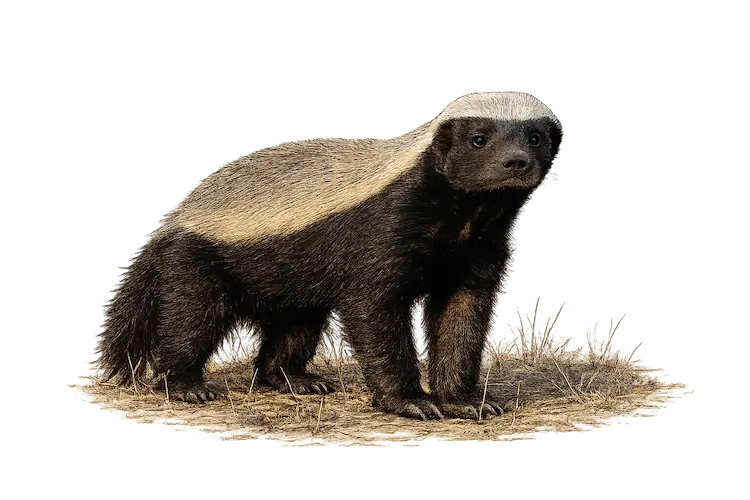
Honey Badger
(Mellivora capensis)
The honey badger is one of the most memorable small carnivores in Kruger National Park , not because it is often seen, but because it has such a bold and unmistakable character. Stocky, powerful, low to the ground, and dressed in a dark body with a pale grey-white mantle, it looks almost drawn from an old field guide plate. A sighting is usually brief, but always exciting.
Although it belongs on any good Kruger mammals list, the honey badger is not an animal one should expect around every bend. It is mostly solitary, wide-ranging, and often active at night or during the cooler hours. During a quiet private Kruger safari , it may be found trotting along a track, digging in dry soil, raiding a beehive, or moving with great purpose through open woodland and scrub.
This guide looks at the honey badger’s identification, habitat, behaviour, diet, breeding, and the best way to look for this tough little member of Kruger’s wildlife . It is not a common sighting, but it is one of those animals that can turn an ordinary morning drive into a story worth remembering.
Identification
The honey badger is a compact, powerfully built mammal with a very distinctive appearance. It carries a broad, pale grey to white mantle that runs from the top of the head down along the back, contrasting sharply with the dark brown to black underparts, legs, and face. This bold colour pattern makes it one of the easier small carnivores to recognise in Kruger National Park , even from a distance.
The body is low to the ground, with short but strong legs and large forefeet equipped with long, curved claws. These are well suited for digging, whether searching for prey or breaking into termite mounds and burrows. The head appears broad and flattened, with small eyes and short ears, giving the animal a sturdy, almost purposeful expression.
In movement, the honey badger often travels with a determined, ground-hugging trot, rarely lingering in one place for long. Its tail is relatively short and bushy, usually held low. When seen well, there is little confusion with other species, although distant or brief sightings could be mistaken for smaller carnivores such as civet or genet , which lack the bold dorsal stripe and have more slender builds.
Males are generally larger than females, but both share the same striking pattern and robust structure. Even in the broader context of Kruger’s mammals , the honey badger stands apart as a unique and unmistakable species.
Habitat & Where It Lives
The honey badger is widely distributed throughout Kruger National Park , though it is seldom encountered. It favours a range of habitats, from open savanna and dry woodland to scrubby areas and riverine fringes. What matters most is the availability of food and suitable ground for digging, rather than any one specific vegetation type.
In the southern regions of the park, where vegetation is denser and prey species are abundant, honey badgers may be slightly more active, particularly along quieter roads and less disturbed areas. Exploring routes through the southern Kruger can sometimes improve your chances, especially during early morning or late afternoon drives.
In contrast, the more open landscapes of the northern Kruger also support honey badgers, where they roam widely across mopane woodland and drier terrain. Sightings here are often even rarer, but the sense of space and quiet makes any encounter particularly memorable.
Because they are highly mobile and largely solitary, honey badgers do not occupy fixed territories in the way some larger predators do. Instead, they move across large areas in search of food, often crossing between different habitat types in a single night. This roaming nature is part of what makes them such an unpredictable but rewarding sight within Kruger’s diverse wildlife landscape.
Behaviour
The honey badger has earned a reputation as one of the most fearless animals in Africa, and while this is often exaggerated, there is truth behind the legend. It is a solitary, determined forager that moves with purpose, rarely hesitating and seldom showing concern for much larger animals. Most sightings in Kruger National Park are brief, as the animal passes steadily through the landscape, nose low to the ground.
Honey badgers are primarily nocturnal, especially in warmer months, but they are also active during the early morning and late afternoon. On cooler days, they may move about during daylight hours, offering a rare opportunity for observation. Much of their time is spent digging, turning over soil, breaking into termite mounds, or investigating burrows in search of food.
Despite their small size, they are known to stand their ground when threatened. Encounters with larger predators such as lion , leopard , or even spotted hyena are uncommon but can be intense when they occur. The honey badger’s thick skin, strength, and willingness to defend itself often allow it to escape situations that would overwhelm most animals of similar size.
Communication is minimal, as individuals spend most of their lives alone, coming together only briefly for mating. Their behaviour is best described as persistent and methodical, shaped by the constant need to search for food across a wide and ever-changing landscape within Kruger’s mammal community .
Diet
The honey badger is an opportunistic and highly adaptable feeder, taking advantage of whatever food sources are available. Its diet in Kruger National Park includes a wide range of prey, from insects and small mammals to reptiles, birds, and even carrion when the opportunity arises.
Much of its feeding behaviour revolves around digging. Using its powerful forelimbs and long claws, the honey badger is able to break into burrows, termite mounds, and underground nests. Rodents, lizards, and ground-nesting birds are all vulnerable to this methodical excavation. It is also well known for tackling species within Kruger’s reptile population , including snakes, which it can subdue with surprising efficiency.
As its name suggests, honey is another prized food source. Honey badgers will raid beehives both on the ground and in trees, tolerating stings to access the energy-rich honey and larvae inside. This behaviour, often associated with their reputation, highlights their persistence and ability to overcome obstacles that deter other animals.
While they are capable hunters, honey badgers are not specialists. Instead, their success lies in their versatility. This flexible diet allows them to survive across a variety of habitats and seasons, making them one of the more resilient small predators within Kruger’s broader wildlife ecosystem .
Breeding
Little is often seen of honey badger breeding behaviour in Kruger National Park , as the species is largely solitary and secretive. Males and females come together only briefly for mating, after which they return to their independent lives.
After a gestation period that is thought to include delayed implantation, a single cub, or occasionally two, is born in a sheltered den. These dens are often dug into the ground, hidden within thick vegetation, or adapted from existing burrows. The cub remains well concealed during its early weeks, relying entirely on its mother for protection and nourishment.
As the young honey badger grows, it begins to accompany the female on foraging trips, learning to dig, hunt, and navigate the landscape. This period of learning is essential, as survival depends heavily on the ability to find food and avoid danger in a complex environment shared with larger predators such as leopard and lion .
Breeding can occur at different times of the year, depending on conditions and food availability. Like much of the honey badger’s life, it remains largely unseen, unfolding quietly within the wider rhythms of Kruger’s natural ecosystem .
How to Find a Honey Badger in Kruger
Finding a honey badger in Kruger National Park is never guaranteed, and that is part of what makes the experience so special. This is not an animal that appears regularly at waterholes or lingers in open view. Instead, sightings tend to happen unexpectedly, often lasting only a few moments before the animal disappears back into the bush.
Your best chance comes during the cooler parts of the day. Early morning and late afternoon drives offer the highest likelihood, particularly along quieter roads where there is less traffic. Honey badgers are often seen moving with purpose along the roadside, occasionally pausing to dig or investigate scents in the ground.
Areas with a mix of open ground and light cover tend to be productive, especially where there is good prey availability. Exploring different regions of the park, from the busier south to the more remote north, can improve your chances over time. Understanding the broader layout of the park through guides like the Kruger National Park guide helps build a clearer picture of where to focus your search.
Patience is key. Unlike larger animals such as elephant or impala , which are encountered frequently, the honey badger is a reward for time spent in the field. It is often the result of many quiet drives rather than a single targeted search.
Joining a private Kruger safari can improve your chances significantly. With an experienced guide who understands animal movement, habitat, and timing, you are better positioned to be in the right place at the right moment. Even then, a sighting remains a special and memorable event — one that reflects the wild and unpredictable nature of Kruger’s wildlife .
Why People Love Seeing Honey Badgers
There are few animals in Kruger National Park that leave such a lasting impression after such a short sighting. The honey badger is not large, nor particularly common, but it carries a presence that feels far greater than its size.
Part of the appeal lies in its reputation. Stories of its toughness and determination have travelled far beyond the bush, giving the animal an almost legendary status. When seen in the wild, that reputation begins to make sense — not as exaggeration, but as a reflection of its confident, purposeful behaviour.
For many visitors, a honey badger sighting feels personal. It is not part of the usual checklist like the Big 5 , and it often appears when least expected. This sense of rarity makes the moment more meaningful, turning a quiet drive into something memorable.
In the broader experience of exploring Kruger’s wildlife , the honey badger represents the smaller, often overlooked side of the ecosystem — the species that reward patience, curiosity, and time spent truly observing the bush.
Experience Kruger’s Wildlife for Yourself
A sighting of a honey badger is never guaranteed, but that is part of what makes Kruger so special. Every drive holds the potential for something unexpected — whether it is a rare small carnivore or a classic encounter with the Big 5 .
If you are looking to explore the park in a more personal and immersive way, consider joining one of our private Kruger safaris . With expert guiding and flexible itineraries, you will have the time and space to truly experience Kruger’s wildlife — from the well-known to the rarely seen.
View All Kruger Safari PackagesFrequently Asked Questions About Honey Badgers in Kruger
Are honey badgers common in Kruger National Park?
No, honey badgers are considered rare sightings in Kruger National Park . They are widely distributed but difficult to see due to their solitary and often nocturnal behaviour.
When is the best time to see a honey badger in Kruger?
Early morning and late afternoon offer the best chances. On cooler days, honey badgers may also be active during daylight hours, especially in quieter areas of the park.
What do honey badgers eat in Kruger?
Honey badgers are opportunistic feeders. Their diet includes insects, rodents, reptiles, birds, and occasionally honey and larvae from beehives.
Are honey badgers dangerous to humans?
Honey badgers are known for their defensive nature, but they generally avoid humans. As with all wildlife in Kruger, they should be observed from a safe distance and never approached.
Where in Kruger can you see a honey badger?
They can be found throughout the park, from the southern regions to the more remote northern areas. Sightings are unpredictable and often occur along quiet roads or open woodland areas.
Why are honey badgers so famous?
Honey badgers are known for their toughness and fearless reputation. Their ability to defend themselves and adapt to different food sources has made them one of Africa’s most talked-about small carnivores.