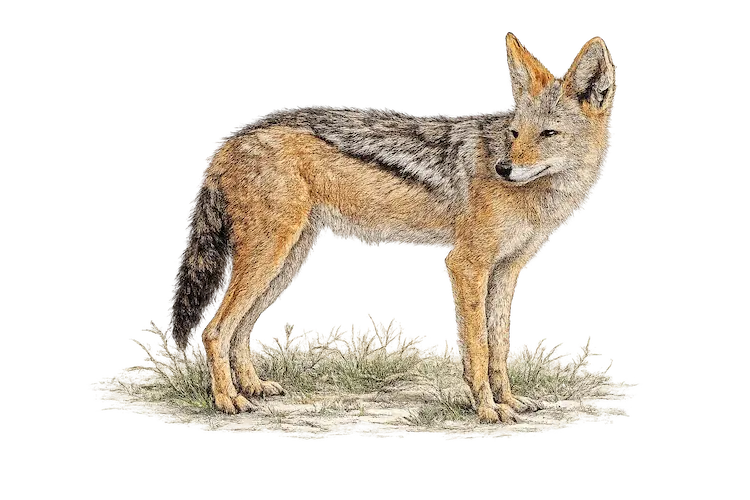
Black-backed Jackal in Kruger National Park
(Lupulella mesomelas)
The black-backed jackal is one of the most familiar and characterful predators found in Kruger National Park. Often seen trotting along roads at first light or calling across the bush at dusk, it brings a sense of life and movement to even the quietest landscapes.
Unlike some of Kruger’s larger predators, the jackal is relatively easy to find, especially in open areas where its sharp senses and alert posture make it stand out. Its distinctive black saddle, warm russet tones, and bushy tail give it a striking appearance, while its clever and adaptable nature allows it to thrive across much of the park.
This guide covers identification, habitat, behaviour, diet, breeding, and how to find this species while exploring Kruger’s wildlife. Along the way, you will begin to notice how often this small predator quietly shapes the rhythm of the bush.
Identification
The black-backed jackal is a small to medium-sized predator with a slim, athletic build and a sharp, fox-like face. Its most distinctive feature is the dark black-and-silver “saddle” that runs across its back, contrasting strongly with the warm reddish-brown flanks and pale underparts. The legs are long and slender, and the bushy tail is tipped with black.
Large, upright ears and bright, alert eyes give the jackal a constantly watchful expression. It moves with a light, effortless trot, often covering long distances along roads or open ground. When standing still, it holds a poised, slightly cautious posture, always ready to react.
It can occasionally be confused with a young spotted hyena, but the jackal is much smaller, more lightly built, and lacks the sloping back and heavy head. It may also be compared to the African wildcat, though the jackal’s longer legs, pointed muzzle, and distinctive black saddle make it easy to distinguish once familiar.
Habitat & Where It Lives
The black-backed jackal is highly adaptable and can be found across a wide range of habitats throughout Kruger National Park. It is most commonly seen in open savanna, grassland, and lightly wooded areas, where visibility is good and prey is easily located.
It tends to favour areas with a mix of open ground and scattered cover, allowing it to move freely while still having access to shelter. Road edges, dry riverbeds, and the fringes of woodland are all productive places to encounter jackals, especially in regions where grazing animals are abundant.
Although present across the entire park, jackals are often more noticeable in the southern regions, where higher animal densities create more feeding opportunities. However, their adaptability allows them to thrive just as comfortably in the drier central and northern areas, making them one of the more consistently encountered predators when exploring Kruger’s diverse landscapes.
Behaviour
The black-backed jackal is a highly alert and intelligent predator, most often seen alone or in pairs. It is strongly territorial, with bonded pairs maintaining and defending a defined area, often working together to hunt or scavenge. Their communication is one of their most memorable traits, with sharp calls and eerie yelps echoing across the bush, particularly at dawn and dusk.
Jackals are opportunistic by nature and are frequently seen moving through the landscape with purpose, scanning for food or following larger predators. They are well known for trailing animals such as lions or leopards, waiting patiently for an opportunity to scavenge from a kill.
Despite their size, they are bold and adaptable, often competing with other scavengers like the spotted hyena. However, they rely more on speed, awareness, and timing than strength, quickly darting in and out to take advantage of any available opportunity.
Diet
The black-backed jackal is an opportunistic omnivore, feeding on a wide variety of food depending on what is available. Small mammals, birds, reptiles, insects, and fruit all form part of its diet, making it one of the most adaptable feeders in Kruger.
It is an efficient hunter of smaller prey, often catching rodents, young antelope, or ground-nesting birds. At the same time, it is equally comfortable scavenging, regularly feeding on carcasses left behind by larger predators such as lions or leopards.
This flexibility allows the jackal to survive in a wide range of conditions, from times of abundance to harsher, drier periods. Whether hunting alone in open grassland or quietly feeding at the edge of a carcass, it plays an important role in keeping the ecosystem balanced as both predator and scavenger.
Breeding
Black-backed jackals form strong, monogamous pair bonds, often staying together for life. Breeding typically takes place during the cooler months, with pups born in a well-hidden den, usually dug into sandy soil or adapted from an abandoned burrow.
Litters usually consist of three to six pups, which are cared for by both parents. The pair works closely together, with one often guarding the den while the other hunts. As the pups grow, they begin to emerge cautiously, learning to explore their surroundings under the watchful eyes of the adults.
This cooperative behaviour plays an important role in their survival, and it is not uncommon to see small family groups moving together through the bush once the young are old enough to travel.
How to Find Black-backed Jackal in Kruger
Black-backed jackals are among the easier predators to find in Kruger, especially if you spend time driving slowly through open areas at sunrise and sunset. These cooler parts of the day are when they are most active, often seen trotting along roads, pausing to listen, or scanning the surroundings for food.
Look for them in open savanna, grasslands, and along road edges where visibility is good. They are particularly common in the southern regions of the park, where higher concentrations of wildlife provide more feeding opportunities. Listening can also be just as effective as looking, their high-pitched calls often reveal their presence before they are seen.
Another reliable way to spot jackals is to watch the behaviour of other animals. Vultures circling overhead or the presence of larger predators can often attract jackals to the scene, where they wait patiently for a chance to feed.
While sightings are frequent, understanding their behaviour and knowing where to look can make all the difference. A guided experience allows you to slow down, read the landscape properly, and notice the smaller details that are often missed when driving independently.
If you would like to experience these moments more consistently, consider exploring private Kruger safaris or fully tailored Kruger safari packages, where time, flexibility, and local knowledge make a meaningful difference.
Why People Love Seeing Black-backed Jackal
There is something quietly captivating about the black-backed jackal. It is not the largest or most dramatic predator in Kruger, but it is often one of the most consistently present, weaving in and out of the landscape as the day unfolds.
For many visitors, it becomes a familiar companion on safari. A jackal seen at sunrise, moving lightly along the road, or heard calling as the light fades, adds a sense of atmosphere that is difficult to describe but easy to remember.
Its intelligence and adaptability are part of its appeal. Watching a jackal observe a situation, wait patiently, and then act with precision offers a glimpse into the smaller, more subtle stories of the bush.
In a place known for iconic wildlife, the black-backed jackal stands out in a quieter way, reminding those who take the time to notice that some of the most rewarding sightings are not always the most obvious.
Experience Kruger’s Wildlife for Yourself
Whether you are hoping to see the black-backed jackal or simply want to enjoy the quieter details of the bush, a guided safari gives you the time and awareness to experience Kruger in a more meaningful way.
With a slower approach, flexible routes, and local insight, each drive becomes more than just a search for wildlife, it becomes an opportunity to understand the rhythms of the landscape and the stories unfolding within it.
View All Kruger Safari Packages