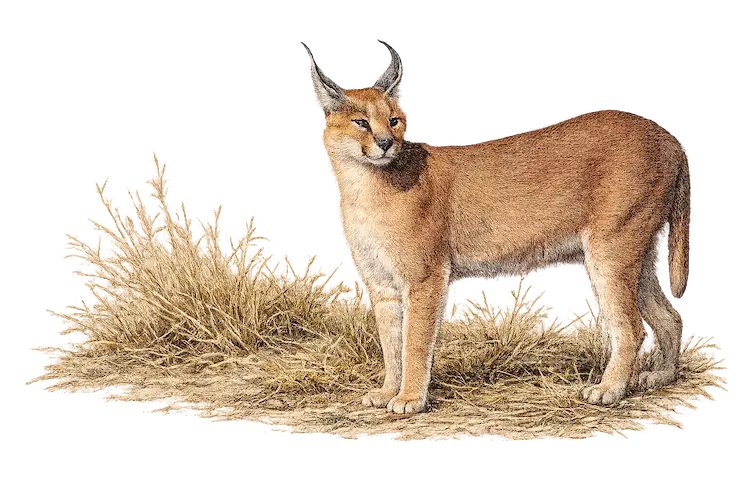
Caracal in Kruger National Park
(Caracal caracal)
The caracal is one of the more elusive and quietly striking predators found in Kruger National Park. With its rich reddish coat, long legs, and distinctive black ear tufts, it carries a presence that feels both refined and wild at the same time. Although sightings are not common, those who do encounter a caracal often remember the moment for years to come.
Unlike larger predators such as the lion or the leopard, the caracal moves quietly through the landscape, often unnoticed. Its ability to blend into dry grasslands and open woodland makes it a master of stealth, and a special find for those who enjoy the slower, more detailed side of a safari.
This guide covers identification, habitat, behaviour, diet, breeding, and how to find this species while exploring Kruger’s wildlife, helping you better understand one of the park’s most underrated predators.
Identification
The caracal is a medium-sized, slender cat with long legs and a smooth, athletic build. Its coat is a rich reddish-tawny colour, often appearing almost golden in good light, with a paler underside. Unlike many other small cats, the caracal has very few markings, giving it a clean and almost refined appearance in the field.
The most distinctive feature is its long, black ear tufts, which can reach up to 5 cm in length. These tufts, combined with sharply pointed ears and dark markings around the face, give the caracal a very alert and expressive look. The backs of the ears are solid black, which is often the first thing noticed when the animal is partially hidden in grass.
In terms of size, the caracal is larger and more powerful than the African wildcat, with longer legs and a more upright posture. It also lacks the striping and spotted pattern seen on the wildcat, making the two relatively easy to separate when seen clearly.
When moving, the caracal carries itself with a smooth, controlled gait. It often pauses to scan its surroundings, ears constantly rotating to pick up sound. In short grass or open areas, its height and long legs become especially noticeable, giving it a slightly elevated, almost antelope-like stance compared to other cats.
Habitat & Where It Lives
The caracal is a highly adaptable predator, found across a range of habitats in Kruger National Park. It is most often associated with open savanna, dry grassland, and lightly wooded areas, where it can use both cover and visibility to its advantage while hunting.
Areas with a mix of short grass and scattered shrubs tend to be ideal. These environments support a healthy population of small mammals and birds, which form a large part of the caracal’s diet. You will often find that regions with well-developed grassland systems and seasonal changes in vegetation offer the best conditions for this species.
While they can occur throughout the park, caracals are more likely to be encountered in quieter areas with less traffic. They tend to avoid heavily wooded riverine zones where larger predators such as the leopard dominate, instead favouring more open terrain where their speed and agility give them an advantage.
Because of their wide distribution and ability to move across different habitat types, sightings can occur almost anywhere in Kruger. However, understanding the landscape and reading the subtle changes in vegetation can greatly improve your chances of encountering this elusive cat.
Behaviour
The caracal is a solitary and highly secretive predator, spending most of its time alone and moving quietly through its territory. It is primarily active during the early morning and late afternoon, although in quieter areas it may also be seen during the day. Much of its activity, however, takes place at night, which is one of the reasons sightings are relatively rare.
Unlike larger predators such as the lion or spotted hyena, the caracal relies on stealth rather than strength or numbers. It moves slowly and deliberately, often stopping to listen, with its ears constantly turning to pick up the slightest movement in the grass.
One of the most remarkable aspects of caracal behaviour is its ability to hunt birds. With explosive power, it can leap high into the air and catch birds in flight, sometimes striking more than one at a time. This makes it particularly effective in areas where birdlife is abundant, linking it closely to Kruger’s rich birdlife.
Caracals are territorial, with individuals maintaining and marking their range using scent. Encounters between adults are uncommon, and most sightings involve a single animal moving through its environment with quiet confidence. This sense of independence and subtle presence is part of what makes the species so special to observe.
Diet
The caracal is a carnivore, feeding primarily on small to medium-sized animals that it can overpower with speed and precision. Its diet includes rodents, hares, and small antelope, but it is especially well known for its ability to hunt birds.
In areas where birdlife is abundant, the caracal takes full advantage. Using a sudden burst of energy, it can leap into the air to catch birds in flight, making it one of the most skilled avian hunters among Kruger’s predators. This close relationship with the park’s bird species often goes unnoticed, but it plays an important role in the ecosystem.
It will also opportunistically hunt small antelope such as common duiker, particularly younger or more vulnerable individuals. Most hunts are short and explosive, relying on surprise rather than endurance.
Like many smaller predators, the caracal must hunt regularly to meet its energy needs. It typically feeds alone, consuming its prey quickly and often moving off soon after, avoiding attention from larger predators that may try to steal its kill.
Breeding
Caracals do not have a strictly defined breeding season, and mating can occur at different times of the year depending on local conditions. After a gestation period of around two to three months, the female gives birth to a small litter, usually consisting of one to three kittens.
The young are typically hidden in dense cover, such as thick grass, rocky crevices, or abandoned burrows, where they remain well concealed during their early weeks. The female raises the kittens alone, moving them if necessary to avoid detection by predators.
As the kittens grow, they begin to follow their mother and learn to hunt through observation and practice. This period is short but important, as young caracals must quickly develop the skills needed to survive in an environment shared with larger predators such as the leopard and spotted hyena.
How to Find Caracal in Kruger
Finding a caracal in Kruger National Park requires patience and a bit of luck, as this is one of the more elusive predators in the park. Sightings are most likely during the early morning and late afternoon, when the light is soft and the bush is still quiet. During these times, caracals may move between hunting areas or pause briefly in open ground.
Open grasslands and lightly wooded savanna offer the best chances of a sighting, particularly in quieter areas with less traffic. Roads that pass through mixed habitat—where short grass meets scattered shrubs—are often worth exploring slowly. Paying attention to bird activity or sudden movement in the grass can sometimes reveal the presence of a hunting caracal.
Because of their secretive nature, caracals are often missed by casual visitors. Taking a slower, more observant approach to driving can make all the difference. This is where guided experiences can be especially valuable, as local knowledge and careful tracking significantly improve your chances of encountering rarer species like this.
If seeing a caracal is high on your list, consider joining one of our private Kruger safaris, where the pace is tailored to your interests and time is spent focusing on the finer details of the bush.
For a more complete experience that includes accommodation, guiding, and logistics, explore our Kruger safari packages, designed to give you the best possible chance of seeing both iconic wildlife and the park’s more elusive species.
Why People Love Seeing Caracal
There is something quietly special about seeing a caracal in the wild. It is not just the rarity of the sighting, but the way the animal seems to appear and disappear so effortlessly within the landscape. One moment the bush feels still, and the next, a flash of reddish movement reveals itself before fading back into the grass.
Its clean lines, long legs, and striking ear tufts give it an almost elegant presence, very different from the heavier build of larger predators. There is a sense of refinement to the caracal, as though every movement is measured and intentional. For many visitors, it feels like a more intimate encounter, something discovered rather than simply seen.
Unlike the more commonly spotted animals in Kruger, a caracal sighting often happens quietly, without crowds or noise. It becomes a personal moment, shared between you and the landscape, and often remembered as one of the highlights of a safari.
For those who appreciate the finer details of the bush—the small movements, the subtle signs, and the patience it takes to notice them—the caracal represents exactly what makes Kruger so rewarding to explore.
Experience Kruger’s Wildlife for Yourself
Whether you are hoping to see a caracal or simply want to experience the quieter, more detailed side of the bush, a guided safari allows you to slow down and notice what others often miss. With time, patience, and local knowledge, even the most elusive species can become part of your story.
View All Kruger Safari Packages