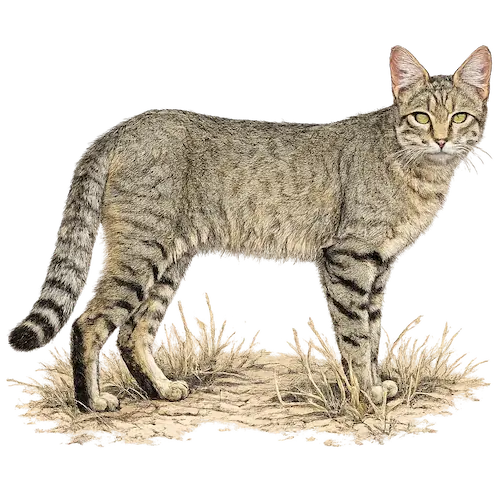
African Wildcat in Kruger National Park
(Felis lybica)
The African Wildcat is one of the more overlooked predators in Kruger National Park, often mistaken for a domestic cat at first glance. Yet, for those who take the time to notice the finer details of the bush, this small and perfectly adapted hunter becomes a rewarding sighting. Quiet, alert, and beautifully marked, it represents the subtle side of Kruger’s wildlife — a reminder that not all predators announce themselves loudly.
Sightings are not uncommon, especially in open grassland and lightly wooded areas, but they are often brief. The African Wildcat moves with purpose, pausing only momentarily before slipping back into cover. For photographers and patient observers, these moments offer something truly special — a glimpse into one of Africa’s most ancient and unchanged feline lineages.
This guide covers identification, habitat, behaviour, diet, breeding, and how to find this species while exploring Kruger’s mammals, with helpful comparisons to similar species like the African leopard and caracal.
Identification
At first glance, the African Wildcat looks very similar to a domestic tabby cat, but a closer look reveals a more refined and wild appearance. It is slightly longer-legged, with a lean, athletic build and a more upright posture. The coat is typically a soft grey-brown with faint stripes along the body, darker bands on the legs, and a clearly ringed tail ending in a black tip.
One of the most reliable features is the tail. Unlike many domestic cats, the African Wildcat’s tail is thick, distinctly banded, and blunt at the tip rather than tapering. The ears are also more pointed and alert, often showing a reddish or sandy tone on the back. The face carries subtle markings, including faint stripes and a slightly more angular, focused expression.
Movement is another useful clue. African Wildcats tend to move with purpose, staying low and alert, often pausing to scan their surroundings before continuing. They rarely appear relaxed or casual in the way domestic cats sometimes do, especially in open areas.
In Kruger National Park, they may occasionally be confused with young leopards or even the slightly larger caracal, but their smaller size, subtle markings, and characteristic tail quickly set them apart once you know what to look for.
Habitat & Where It Lives
The African Wildcat is highly adaptable and can be found across much of Kruger National Park, favouring open savanna, grassland, and lightly wooded areas. It is particularly at home in regions where there is a mix of cover and visibility, allowing it to hunt effectively while still remaining concealed from larger predators.
In Kruger, they are often associated with areas that support healthy rodent populations, such as open plains, edges of drainage lines, and the fringes of riverine vegetation. These transition zones provide both food and shelter, making them ideal habitat for a small, solitary predator.
While they can occur throughout the park, sightings are often more frequent in the central and southern regions, where a combination of grassland and mixed bushveld creates favourable hunting conditions. Seasonal changes also play a role, with thicker summer vegetation making them harder to spot, while the drier winter months can improve visibility.
For a broader understanding of how these habitats fit into the ecosystem, it helps to explore the full Kruger National Park wildlife guide, where predators, prey, and landscapes all connect to shape sightings like this.
Behaviour
The African Wildcat is a solitary and largely nocturnal predator, though it is not unusual to encounter one during the early morning or late afternoon when activity begins to overlap with daylight. It moves quietly through the bush, often keeping low to the ground, using grass and scattered cover to remain unnoticed.
Unlike some of Kruger’s more visible predators, this is an animal that relies on subtlety rather than strength. It pauses often, listening and watching, before continuing with a slow, deliberate walk. When hunting, it becomes even more focused, stalking carefully before making a short, quick dash to catch its prey.
African Wildcats are territorial and generally avoid one another outside of breeding periods. They mark their range through scent and visual cues, maintaining a quiet presence across their chosen area. Because of this, sightings are usually brief and individual, adding to the sense that you have stumbled upon something private rather than something commonly seen.
They also share their environment with larger predators such as the African leopard and opportunistic scavengers like the black-backed jackal, which means staying hidden is often just as important as hunting successfully.
Diet
The African Wildcat is a skilled and efficient hunter, feeding primarily on small mammals such as rodents, which make up the bulk of its diet in Kruger National Park. These prey species are abundant in grassland and savanna habitats, allowing the wildcat to hunt regularly without needing to travel long distances.
In addition to rodents, it will opportunistically take birds, reptiles, and insects when the chance arises. Ground-nesting birds and small lizards are particularly vulnerable, especially in open areas where cover is limited. This flexible approach to feeding allows the African Wildcat to adapt to seasonal changes in prey availability.
Hunting is usually done alone and involves a combination of patience and speed. The wildcat will stalk quietly through grass or along the edges of vegetation before making a short, precise dash. Most hunts are over in seconds, relying on accuracy rather than prolonged pursuit.
As part of the wider Kruger ecosystem, the African Wildcat plays an important role in controlling small animal populations, helping to maintain balance among the park’s diverse birdlife and other prey species.
Breeding
African Wildcats do not have a strict breeding season in Kruger National Park, although activity often peaks during warmer months when prey is more abundant. After a gestation period of roughly two months, a female will give birth to a small litter, usually between two and four kittens.
Dens are typically well hidden in thick grass, under fallen logs, or in abandoned burrows, offering protection from predators and the elements. During this time, the female becomes especially secretive, moving carefully between hunting areas and the den to avoid drawing attention.
The kittens grow quickly and begin exploring their surroundings within a few weeks, though they remain dependent on their mother for several months. As they develop, they learn essential hunting skills through observation and play, gradually preparing for a solitary life.
Like many of Kruger’s smaller mammals, survival at this stage is not guaranteed. Predators such as the African leopard and opportunistic hunters like the black-backed jackal pose a constant threat, making concealment and caution essential in the early months of life.
How to Find African Wildcat in Kruger
Finding an African Wildcat in Kruger National Park often comes down to timing, habitat, and a bit of patience. They are most active during the early morning and late afternoon, when temperatures are cooler and prey is more active. These quieter hours offer the best chance of seeing one moving along the edge of a road or slipping through the grass.
Look for them in open savanna and grassland areas, particularly where there is a mix of short grass and scattered cover. Roads that pass through these habitats, especially in the central and southern parts of the park, can be productive. Wildcats will often use road edges to move more easily, pausing briefly before disappearing back into vegetation.
One of the most important things is to slow down. Unlike larger animals that are easier to spot, African Wildcats can be missed in seconds. Scanning ahead, watching for movement rather than shape, and paying attention to subtle changes in the landscape can make all the difference.
Guided safaris increase your chances significantly. With experience, it becomes easier to recognise the small details — the posture, the movement, or even the habitat that suggests a sighting is possible. A slower, more attentive approach often turns a fleeting glimpse into a meaningful encounter.
If you are planning a visit, consider exploring private Kruger safaris or fully guided Kruger safari packages, where the focus can be tailored to wildlife like this and the pace allows for more careful observation.
Why People Love Seeing African Wildcat
There is something quietly special about seeing an African Wildcat in Kruger National Park. It is not a sighting that draws crowds or creates noise. More often, it is a brief moment — a pause on the road, a glance through the grass — and then it is gone.
For many visitors, that fleeting nature is exactly what makes it memorable. It feels less like something staged and more like something discovered. A reminder that the bush is full of life beyond the obvious, and that some of its most rewarding encounters come from slowing down and paying attention.
The African Wildcat represents the quieter side of Kruger’s predators. Not defined by size or power, but by precision, awareness, and adaptability. And for those who notice it, even for a few seconds, it often becomes one of the most meaningful sightings of the journey.
Experience Kruger’s Quieter Wildlife for Yourself
Whether you are hoping to see an African Wildcat or simply want to enjoy the slower details of the bush, a guided safari gives you the time, patience, and local knowledge to experience Kruger properly.
View All Kruger Safari Packages