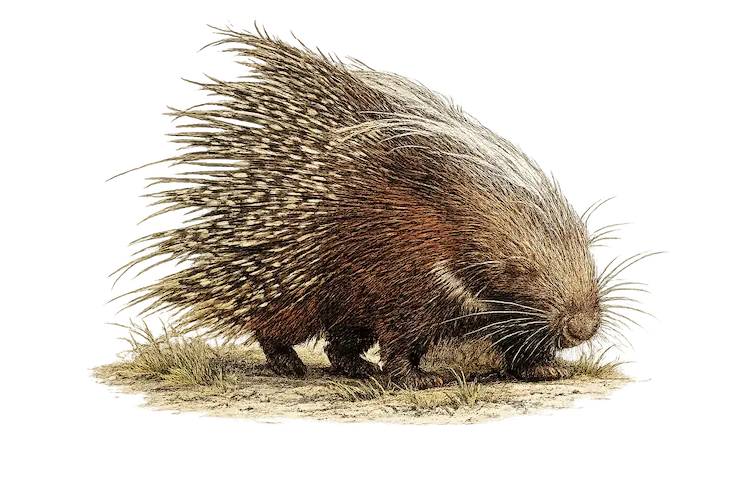
Cape Porcupine in Kruger National Park
(Hystrix africaeaustralis)
The Cape porcupine is one of the most unusual and memorable mammals found in Kruger National Park. Although seldom seen during the day, this large, nocturnal rodent leaves a lasting impression with its striking black-and-white quills and slow, deliberate movements. Encounters are often brief and special, usually taking place in the quiet hours of the night when the bush begins to settle.
Unlike many of Kruger’s more frequently spotted species, the Cape porcupine is a quieter presence, moving carefully through the landscape in search of food. For those fortunate enough to see one, it offers a glimpse into a different side of the park’s wildlife—one that is often hidden, patient, and beautifully adapted to life after dark.
This guide covers identification, habitat, behaviour, diet, breeding, and how to find this species while exploring Kruger’s wildlife.
Identification
The Cape porcupine is Africa’s largest rodent and is unmistakable once seen. It has a heavy, low-slung body covered in coarse dark hair and long, sharply pointed quills that run from the head down to the tail. These quills are banded in black and white and can be raised when the animal feels threatened, creating a striking, almost crest-like appearance.
A broad head, small eyes, and prominent whiskers give it a somewhat gentle expression, quite different from the dramatic defence it is capable of. The hindquarters are especially well-armoured, with thick quills and hollow rattling spines near the tail that produce a warning sound when shaken. Movement is slow and deliberate, with a slightly shuffling walk as it forages along the ground.
In low light, the Cape porcupine can sometimes be confused with smaller nocturnal mammals such as the honey badger, but its much larger size, distinctive quills, and rounded shape quickly set it apart.
Habitat & Where It Lives
The Cape porcupine is widely distributed throughout Kruger National Park, favouring areas where there is a mix of cover and open ground. It is most commonly associated with woodland and savanna habitats, particularly where there are rocky outcrops, riverbanks, or dense thickets that provide shelter during the day.
Porcupines spend daylight hours in burrows, often using natural cavities between rocks or digging their own dens in sandy soils. These burrows are usually well hidden and may be used repeatedly over long periods. Areas with good ground cover and access to roots, bulbs, and fallen fruit tend to support higher numbers of porcupines.
While they occur across much of the park, sightings are slightly more likely in quieter regions with less disturbance, particularly along river systems and in mixed woodland habitats described in the broader Kruger wildlife guide. Because they are nocturnal, however, their presence is often noticed more through tracks and signs than direct sightings.
Behaviour
The Cape porcupine is a largely nocturnal and secretive animal, spending most of the day resting in burrows and emerging after sunset to feed. It is usually seen alone, in pairs, or as part of a small family group, moving slowly and deliberately through the bush with its nose close to the ground.
Despite its calm appearance, the porcupine is well defended. When threatened, it will raise its quills, turn its back toward danger, and rattle the hollow spines on its tail as a warning. If pushed further, it may charge backwards in a sudden, forceful movement. This behaviour is highly effective, and even large predators such as lion and leopard tend to avoid them after a bad experience.
Much of their activity takes place quietly and unnoticed. They follow well-worn paths between feeding areas and burrows, often returning to the same routes night after night. Signs such as tracks, dug-up soil, and gnawed bones are often the only indication that a porcupine is nearby.
Diet
The Cape porcupine is primarily herbivorous, feeding on a wide variety of plant material found across Kruger National Park. Its diet includes roots, bulbs, tubers, bark, fallen fruit, and occasionally cultivated crops on the edges of protected areas.
Using its strong front claws and sharp incisors, it digs into the soil to uncover underground food sources. This digging behaviour often leaves noticeable patches of disturbed earth, especially in sandy areas. Porcupines are also known to strip bark from trees and feed on seasonal fruits when available.
An interesting and often overlooked behaviour is their habit of gnawing on bones. These are collected and chewed to obtain essential minerals such as calcium, which helps maintain the strength of their continuously growing teeth. It is not uncommon to find scattered bones near feeding sites, quietly marking their presence within Kruger’s broader ecosystem.
Breeding
Cape porcupines are generally monogamous and may form long-term pair bonds, often sharing the same burrow system over extended periods. Breeding can occur throughout the year, although peaks may be influenced by seasonal food availability within Kruger National Park.
After a gestation period of around three months, the female gives birth to one to three young in the safety of a burrow. The young are born relatively well developed, with soft quills that harden within a few days, allowing them to begin exploring their surroundings at an early age.
Both parents may remain close to the young, and family groups can often be seen moving together at night. Despite their vulnerable start, the protection offered by the adults and the burrow gives them a strong chance of survival in Kruger’s dynamic and competitive wildlife environment.
How to Find Cape Porcupine in Kruger
Seeing a Cape porcupine in Kruger National Park requires patience and a bit of luck, as they are almost entirely nocturnal. Most sightings occur after sunset, often along quieter roads where vehicle traffic is low and the bush begins to settle.
They are most likely to be found moving between burrows and feeding areas, particularly in woodland habitats and along river systems. Slow night drives near rest camps or in areas with sandy soils can increase your chances, as porcupines tend to follow familiar paths and may cross roads while foraging.
Even if you do not see the animal itself, signs such as tracks, diggings, and chewed bones can reveal their presence. Guides familiar with these subtle clues often have a much better chance of locating them, especially when moving slowly and allowing time for the bush to come alive after dark.
This is where a guided experience can make a meaningful difference. On private Kruger safaris, the pace is slower and more flexible, allowing time to focus on smaller, often overlooked species like the Cape porcupine rather than only the more obvious sightings.
For those wanting a fully seamless experience, Kruger safari packages combine accommodation, guiding, and local knowledge, giving you the best possible chance of experiencing the quieter side of Kruger’s wildlife.
Why People Love Seeing Cape Porcupine
There is something quietly special about seeing a Cape porcupine in the wild. Unlike the more familiar sightings in Kruger National Park, this is an encounter that often feels more personal—unexpected, unhurried, and deeply connected to the rhythm of the bush after dark.
Their slow, deliberate movements and striking quills create a moment that feels almost timeless, as if stepping into an older, quieter version of the African wilderness. It is not a dramatic sighting in the usual sense, but rather one that invites you to pause and observe the finer details that are so often missed.
For many visitors, it becomes a highlight precisely because of its rarity. It is a reminder that Kruger is not only about the Big 5, but also about the smaller, quieter moments that bring the landscape to life in a different way.
In the end, a porcupine sighting is less about ticking a species off a list, and more about experiencing the stillness of the bush at the right time—when the night settles in and the hidden side of Kruger begins to reveal itself.
Experience Kruger’s Wildlife for Yourself
Whether you are hoping to see a Cape porcupine or simply want to experience the quieter side of Kruger National Park, a guided safari allows you to slow down and notice the details that are often missed.
With time, patience, and local knowledge, even the most elusive species become part of a deeper and more meaningful experience in the bush.
View All Kruger Safari Packages