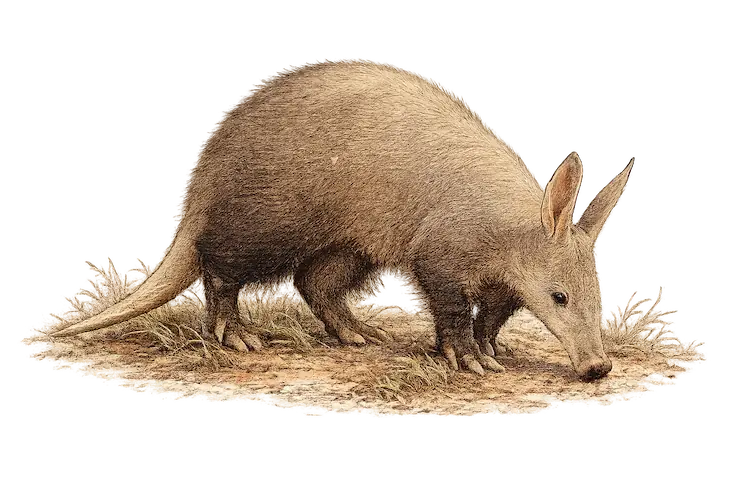
Aardvark in Kruger National Park
(Orycteropus afer)
Quiet, elusive, and almost mythical in appearance, the aardvark is one of the more unusual mammals found in Kruger National Park. Unlike the more frequently encountered species such as lions or elephants, this nocturnal insectivore is seldom seen, making every sighting feel particularly special.
Most active after sunset, the aardvark moves slowly through the bushveld, using its powerful claws and keen sense of smell to locate termite mounds. For many visitors, it remains a “bonus species” — something quietly hoped for rather than expected. Those fortunate enough to encounter one on a private safari or during a warm summer evening drive often describe the experience as one of the most memorable moments in the park.
This guide covers identification, habitat, behaviour, diet, breeding, and how to find this species while exploring Kruger’s wildlife.
Identification
The aardvark is instantly recognisable, though seldom seen. It has a pig-like body with a long, tubular snout, large upright ears, and a thick, tapering tail. The skin appears pale grey to sandy brown, often sparsely covered with coarse hair, giving it a slightly rough, almost unfinished look compared to other mammals in Kruger National Park.
One of its most distinctive features is its powerful forelimbs, equipped with large, spade-like claws used for digging into termite mounds. Its movement is slow and deliberate, often with the head held low to the ground as it searches for scent. When disturbed, however, it can move surprisingly quickly before disappearing into a burrow.
While it shares some superficial resemblance to species like the warthog, the aardvark’s long snout, large ears, and digging claws make it unmistakable once properly observed. Unlike most mammals in the park, it belongs to its own unique group, adding to its unusual appearance and appeal.
Habitat & Where It Lives
Aardvarks are widely distributed throughout Kruger National Park, though they are rarely seen due to their nocturnal nature. They favour open savanna, lightly wooded bushveld, and areas where the soil is soft enough for digging. These habitats allow them to excavate burrows with ease while also supporting healthy populations of termites and ants.
They are less commonly found in dense thickets or heavily rocky terrain, where digging becomes difficult. Instead, aardvarks tend to move quietly through open areas, often near dry riverbeds, grassland edges, and gently undulating plains where termite activity is high.
Across the park, suitable habitat can be found from the southern regions up into the mopaneveld of the north, making them widely present but seldom encountered. Exploring different regions of the park — especially with a flexible approach — often improves the chances of being in the right place at the right time.
Behaviour
Aardvarks are solitary and almost entirely nocturnal, spending the daylight hours resting in deep burrows before emerging after sunset to feed. Their movements are slow and purposeful, with the nose held close to the ground as they follow scent trails in search of termites and ants. Because of this quiet and secretive nature, they often go unnoticed even in areas where they are present.
They are not territorial in the traditional sense but maintain large home ranges, moving between feeding areas and a network of burrows. These burrows play an important role in the ecosystem, often being reused by other animals such as the warthog or smaller mammals seeking shelter.
Despite their calm appearance, aardvarks are well adapted for survival. If threatened, they will dig rapidly or retreat into a burrow, though they may occasionally fall prey to larger predators such as the lion or leopard. Encounters are rare, however, as their nocturnal lifestyle keeps them largely out of sight.
Diet
The aardvark is a specialised insectivore, feeding almost entirely on termites and ants. Using its powerful claws, it breaks open termite mounds and anthills before extending a long, sticky tongue to gather its prey. This tongue can reach deep into tunnels, allowing the aardvark to feed efficiently without destroying the entire colony.
Its sense of smell is highly developed and plays a key role in locating food, especially in the darkness of night. As it moves slowly through the bush, it pauses frequently to investigate the ground, often feeding at multiple sites over the course of a single evening.
In doing so, the aardvark plays an important ecological role within Kruger National Park, helping to regulate insect populations while also creating feeding opportunities for other species that take advantage of disturbed termite mounds.
Breeding
Aardvarks breed year-round, though births are often timed to coincide with warmer, wetter periods when food is more abundant. After a gestation period of around seven months, a single young is usually born in a well-prepared burrow.
The young aardvark remains underground for the first few weeks of its life, protected from predators and the elements. As it grows, it begins to accompany its mother on nighttime foraging trips, learning how to locate termite mounds and develop the skills needed to survive independently.
Compared to many other mammals in Kruger’s wildlife, breeding behaviour is seldom observed, largely due to the species’ secretive and nocturnal nature.
How to Find Aardvark in Kruger
Finding an aardvark in Kruger National Park requires patience, timing, and a fair amount of luck. As a strictly nocturnal species, they are almost never seen during the day. The best chance of an encounter comes in the early evening, particularly on warm nights when insect activity is high.
Open savanna and lightly wooded areas tend to offer the best opportunities, especially where termite mounds are visible. Slow driving, scanning open ground, and paying attention to movement along road edges can sometimes reveal an aardvark quietly feeding. Sightings are often brief, as the animal may quickly move off or disappear into a nearby burrow.
Seasonal conditions can also play a role. During the warmer, wetter months — typically highlighted in the best time to visit Kruger National Park guide — aardvarks may be slightly more active and visible in the early evening hours.
For many visitors, the most realistic chance of seeing one comes with time in the bush and a flexible approach. A private Kruger safari allows for slower, more focused searching, while longer stays through all-inclusive safari packages naturally increase the chances of being out at the right time.
Even then, an aardvark sighting remains a true highlight — something that cannot be planned, only appreciated when it happens.
Why People Love Seeing Aardvark
Seeing an aardvark in the wild is something that stays with you. It is not a dramatic sighting in the way that predators often are, but rather a quiet, unexpected moment — a glimpse into a side of Kruger National Park that many visitors never experience.
Its unusual shape, slow movements, and almost prehistoric appearance make it feel unlike any other mammal in the park. For many, it represents the quieter rhythm of the bush — the small, often overlooked details that reveal themselves only with time and patience.
Because sightings are so rare, encountering an aardvark often becomes a personal highlight. It is a reminder that some of the most meaningful wildlife experiences are not planned, but simply unfold when you are present and willing to look a little closer.
Experience Kruger’s Wildlife for Yourself
Whether you are hoping to see an aardvark or simply want to enjoy the slower details of the bush, a guided safari gives you the time and local knowledge to experience Kruger properly. From the well-known sightings to the quieter, more elusive moments, each drive becomes part of a deeper understanding of the wild.
View All Kruger Safari PackagesAardvark FAQ
Are there aardvarks in Kruger National Park?
Yes, aardvarks occur in Kruger National Park, but they are rarely seen because they are mostly nocturnal and spend the day resting in burrows.
Is it rare to see an aardvark in Kruger?
Yes, an aardvark sighting is considered very rare. Most visitors will not see one, which makes an encounter especially memorable.
When is the best time to see aardvark in Kruger?
The best chance is after sunset, especially on warm evenings when termites and ants are active. They are almost never seen during normal daytime drives.
What do aardvarks eat?
Aardvarks feed mainly on termites and ants. They use strong claws to open mounds and a long sticky tongue to collect insects.
Where do aardvarks live in Kruger?
Aardvarks prefer open savanna, lightly wooded bushveld, and areas with soft soil where they can dig burrows and find termite mounds.