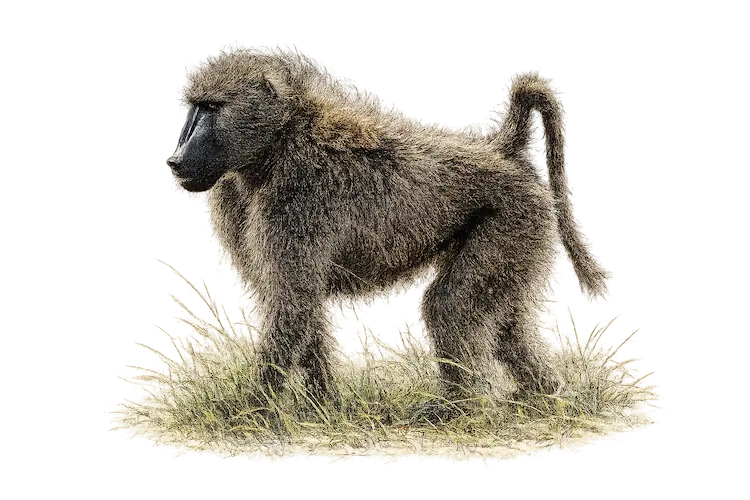
Chacma Baboon in Kruger National Park
(Papio ursinus)
The chacma baboon is one of the most familiar and widely seen mammals in Kruger National Park, often encountered moving confidently along roads, resting on rocky outcrops, or foraging through the surrounding bushveld. Highly intelligent and deeply social, these primates bring a different rhythm to the safari experience—less about fleeting sightings, and more about watching behaviour unfold.
Troops vary in size and character, from relaxed groups grooming in the morning sun to more alert and vocal gatherings near water or camps. While they are seen regularly throughout the park, no two encounters feel quite the same, and spending a few quiet minutes observing them often reveals a surprising level of complexity and interaction.
This guide covers identification, habitat, behaviour, diet, breeding, and how to find chacma baboons while exploring Kruger’s wildlife.
Identification
The chacma baboon is a large, powerfully built primate, easily recognised by its long dog-like muzzle, dark face, and shaggy grey-brown coat. Adult males are noticeably bigger than females, often appearing bulky through the shoulders with a thick mane of longer hair around the neck. Their tails are distinctive, held in a characteristic arch—upright at the base before curving downward at the tip.
When moving, baboons walk on all fours with a steady, deliberate gait, but they are also capable climbers, often retreating to rocky outcrops or trees when disturbed. Their facial expressions, posture, and vocalisations are key features, with sharp barks and calls often signalling movement or alert within the troop.
They are sometimes confused with the smaller vervet monkey, but the difference is usually clear. Vervet monkeys are slimmer, lighter, and more agile in trees, while chacma baboons are larger, more terrestrial, and move in more structured social groups.
Habitat & Where It Lives
Chacma baboons are highly adaptable and can be found across a wide range of habitats throughout Kruger National Park. They occur in open savanna, woodland, riverine areas, and rocky hillsides, often favouring landscapes that offer both feeding opportunities and elevated sleeping sites.
Rocky outcrops and cliffs are particularly important, as baboons use these areas as safe overnight roosts away from predators such as lion and leopard. During the day, they move out into surrounding areas to forage, often covering large distances as a troop.
They are commonly seen along roads, near rest camps, and around water sources, making them one of the more reliable primates to encounter across the park. Their ability to live in both dry and more riverine environments means they are present from the far north to the southern regions of Kruger.
Behaviour
Chacma baboons are highly social animals, living in structured troops that can range from a handful of individuals to large groups of over 50. Within each troop there is a clear hierarchy, particularly among dominant males, and much of their daily life revolves around maintaining these social bonds through grooming, vocal communication, and subtle body language.
They are primarily active during the day, leaving their sleeping sites shortly after sunrise to begin foraging. As a troop moves through the landscape, individuals spread out while still maintaining contact through calls and visual cues. There is often a sense of order to their movement, with more experienced individuals guiding direction and younger baboons learning as they go.
Baboons are intelligent and adaptable, known for their problem-solving abilities and opportunistic behaviour. Around rest camps and picnic sites, they quickly learn to associate people with food, which is why it is important to keep a respectful distance and avoid feeding them.
Despite their confidence, they remain alert to danger. Predators such as leopard are a constant threat, and troops will often react quickly—issuing alarm calls, climbing to safety, or grouping together to protect vulnerable members.
Diet
Chacma baboons are omnivorous and highly opportunistic, feeding on a wide variety of natural foods depending on what is available. Much of their diet consists of grasses, seeds, roots, fruits, and pods, which they gather while moving steadily through the landscape.
They will also supplement this with animal protein, including insects, eggs, and small vertebrates. In some cases, baboons have been observed catching and eating young antelope such as impala, although this is less common and usually opportunistic rather than a regular behaviour.
Their adaptable diet is one of the reasons they are so successful across different habitats in Kruger, allowing them to make use of both seasonal plant resources and occasional protein sources when the opportunity arises.
Breeding
Chacma baboons do not have a strict breeding season, and young can be born throughout the year. Females give birth to a single infant after a gestation period of around six months, with newborns clinging closely to their mother’s underside before gradually riding on her back as they grow.
Within the troop, infants are a central part of social life. Grooming, play, and close contact help strengthen bonds, and younger baboons often spend time interacting with one another under the watchful presence of adults. Mothers are attentive and protective, particularly in the early months.
As they mature, young baboons begin to learn the structure of the troop, gradually finding their place within the social hierarchy. This process is shaped by both age and relationships, making troop life an important part of their development.
How to Find Chacma Baboons in Kruger
Chacma baboons are among the easiest mammals to find in Kruger National Park, and are often seen throughout the day. Early mornings are particularly rewarding, as troops leave their sleeping sites and begin moving through the bush in search of food, often crossing roads in long, loosely organised lines.
Look for them along roadsides, near rocky outcrops, riverbeds, and around rest camps. Their presence is usually easy to detect—either through movement, vocal calls, or the sight of individuals sitting upright scanning their surroundings. In quieter moments, stopping to observe a troop can reveal a fascinating range of behaviour, from grooming and play to subtle interactions within the group.
Because they are so widespread, baboons can be seen across both the northern and southern regions of the park, making them a consistent sighting on most drives. Their visibility also makes them a great species to spend time with, especially when the pace of the safari slows and attention shifts to behaviour rather than just ticking off sightings.
While sightings are common, understanding their behaviour and knowing where to pause can greatly enhance the experience. This is where a guided safari can make a difference, offering the time and insight to fully appreciate what is happening within the troop.
If you would like to experience these encounters in a more meaningful way, explore our private Kruger safaris or fully tailored Kruger safari packages.
Why People Love Seeing Chacma Baboons
At first glance, chacma baboons may seem like a common sight in Kruger, but spending a few quiet minutes with a troop often changes that perception completely. Their world is full of movement, interaction, and subtle detail—youngsters playing, adults grooming, and dominant individuals quietly holding their place within the group.
Unlike many animals that appear briefly and disappear, baboons invite you to slow down and observe. There is a sense of familiarity in their behaviour, and it becomes easy to recognise individual personalities and relationships as the troop goes about its day.
For photographers and nature lovers, they offer endless opportunities. Whether it is soft morning light catching the texture of their fur, or a moment of interaction between mother and infant, there is always something unfolding if you are willing to watch a little longer.
In many ways, chacma baboons represent the quieter side of a safari—less about rare sightings, and more about understanding the rhythms of the bush. For those who take the time, they often become one of the most memorable parts of the experience.
Experience Kruger’s Wildlife for Yourself
Whether you are hoping to see chacma baboons up close or simply want to enjoy the quieter, more detailed moments of the bush, a guided safari allows you to experience Kruger at a more natural pace. With time to stop, observe, and understand behaviour, even the most familiar animals become part of a deeper and more rewarding experience.
Explore our Kruger safari packages or view our fully tailored all-inclusive Kruger safaris to start planning your journey.
Enquire About a Private Safari