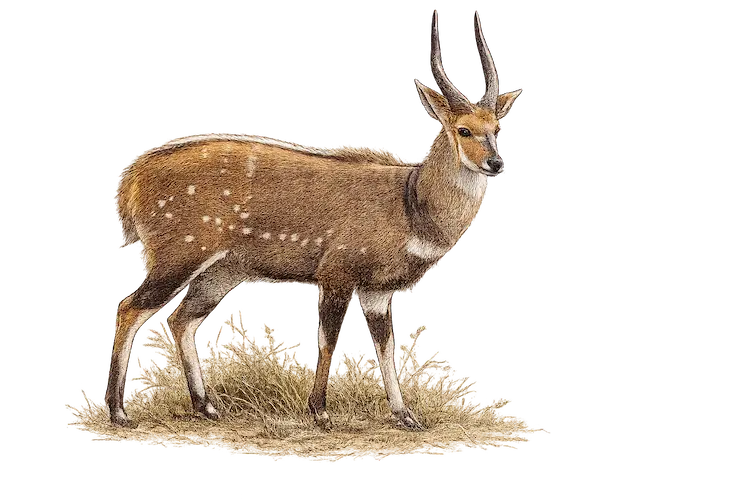
Bushbuck in Kruger National Park
(Tragelaphus scriptus)
The bushbuck is one of the more quiet and often overlooked antelope found in Kruger National Park, yet it remains one of the most rewarding to encounter. Moving softly through dense vegetation and riverine thickets, it is typically seen alone, standing still in the shadows or slipping away before most visitors even notice it.
Unlike the more common antelope of Kruger’s open plains, such as the impala, the bushbuck prefers cover and patience. Sightings are not always frequent, but they are far from rare—especially along river systems and quieter roads where the bush feels a little thicker and more undisturbed.
This guide covers identification, habitat, behaviour, diet, breeding, and how to find this species while exploring Kruger’s wildlife.
Identification
The bushbuck is a medium-sized antelope with a rich brown to chestnut coat, often marked with scattered white spots and faint stripes along the flanks. A distinct white throat patch and facial markings give it a slightly refined appearance, especially when seen in good light. Males are larger and darker than females and carry a pair of elegant, spiralled horns that sweep backward in a gentle curve.
Its build is compact and slightly heavier than many of Kruger’s more common antelope, with relatively short legs and a rounded body. When moving, the bushbuck tends to walk slowly and deliberately, often pausing to listen before slipping quietly back into cover. This cautious movement is one of the easiest ways to distinguish it in the field.
It is sometimes confused with the nyala, which shares a similar habitat and general appearance, but nyala are larger, more boldly striped, and males have a shaggy crest along the back. Compared to the more familiar impala, the bushbuck is darker, stockier, and far more associated with thick vegetation than open grassland.
Habitat & Where It Lives
The bushbuck is closely tied to dense vegetation and is most commonly found in riverine thickets, woodland edges, and areas where water and cover come together. In Kruger National Park, this usually means the thicker vegetation along rivers, seasonal drainage lines, and well-wooded areas that provide both shade and protection.
Unlike many antelope that favour open savanna, bushbuck avoid wide, exposed plains. Instead, they remain close to cover, often just a few steps away from dense shrubs or tangled undergrowth. This preference makes them more common in the southern and central regions of Kruger, where river systems and mixed woodland create ideal habitat.
Visitors exploring quieter roads near water, particularly early in the morning or later in the afternoon, have a good chance of encountering bushbuck standing at the edge of the bush. These moments often feel brief and intimate, as the animal will usually retreat softly back into cover rather than run into the open like other species found within Kruger’s wildlife.
Behaviour
The bushbuck is a solitary and highly cautious antelope, most often seen alone or occasionally as a female with a young lamb. It is naturally shy and relies on stillness and cover rather than speed to avoid danger. When disturbed, it will often freeze briefly before quietly slipping back into thick vegetation, making many sightings feel fleeting and easily missed.
Activity is generally concentrated in the early morning and late afternoon, although bushbuck can remain active throughout the day in well-covered areas. They are territorial animals, particularly the males, which will mark and defend small home ranges within suitable habitat. Despite their quiet nature, they are alert and aware, constantly listening and watching their surroundings.
In areas where predators such as the African leopard are present, bushbuck become even more secretive, favouring dense cover and moving with slow, deliberate steps. Their survival depends less on outrunning danger and more on avoiding detection altogether.
Diet
The bushbuck is a browser, feeding mainly on leaves, shoots, and soft plant growth rather than grazing on grasses. It selects tender vegetation from shrubs and low branches, often moving slowly through dense cover while feeding.
Its diet includes a variety of natural foods such as fallen fruit, flowers, herbs, and young shoots, depending on what is available in the season. Because it lives in well-vegetated areas, it rarely needs to travel far to find food and can remain hidden while feeding.
This browsing lifestyle is one of the key differences between bushbuck and more open-area antelope like the impala, which spend much of their time grazing in open grassland. Bushbuck instead rely on thick vegetation, both for food and protection.
Breeding
Bushbuck do not have a strict breeding season, and lambs can be born throughout the year. However, births are often more common during the warmer, wetter months when food is more abundant and conditions are favourable.
Females give birth to a single lamb, which is carefully hidden in dense vegetation for the first few weeks of its life. During this time, the mother returns quietly to feed it, keeping movement to a minimum to avoid attracting attention.
This secretive approach to raising young reflects the bushbuck’s overall behaviour—relying on concealment rather than confrontation. As the lamb grows stronger, it begins to follow its mother more closely, though it will still remain within the safety of thick cover.
How to Find Bushbuck in Kruger
Bushbuck are best found in areas where thick vegetation meets water. In Kruger National Park, this often means driving slowly along river roads, crossing points, and shaded drainage lines where the bush feels dense and quiet.
The best time to look is early morning or late afternoon, when the light is softer and the bushbuck is more active. Unlike many other antelope, they are rarely seen out in the open, so patience is key. Often, it is just a slight movement, a flick of an ear, or a shape in the shadows that reveals their presence.
Slower, quieter roads tend to produce better sightings than busy routes. Areas with well-developed river systems in the southern and central parts of the park are particularly reliable, especially where thick cover remains undisturbed.
Because sightings are subtle and easy to miss, having an experienced guide can make a significant difference. A trained eye will often pick up small details that most visitors drive past without noticing.
If you are hoping to include species like bushbuck in your experience, a private Kruger safari allows for a slower, more focused approach, while Kruger safari packages provide a seamless way to explore the park with everything arranged for you.
Why People Love Seeing Bushbuck
The bushbuck is not an animal that demands attention, and that is exactly why it leaves such a lasting impression. Unlike the more obvious wildlife of Kruger National Park, a bushbuck sighting often feels personal—something discovered rather than presented.
There is a quiet beauty in the way it moves through shadow and light, pausing just long enough to be seen before disappearing back into the bush. These moments tend to be brief, but they stay with you, especially when the rest of the world feels still around you.
For many visitors, seeing a bushbuck becomes a reminder that Kruger is not only about the big, dramatic sightings, but also about the smaller, more subtle encounters. It is in these quieter moments that the bush begins to feel deeper, more alive, and more rewarding to explore.
Experience Kruger’s Wildlife for Yourself
Encounters with animals like the bushbuck are often quiet and easily missed, but they are some of the most memorable moments in Kruger National Park. With time, patience, and the right guidance, these subtle sightings become part of a much deeper safari experience.
Whether you are hoping to see bushbuck or simply want to enjoy the slower details of the bush, a guided safari allows you to experience Kruger in a more meaningful way.