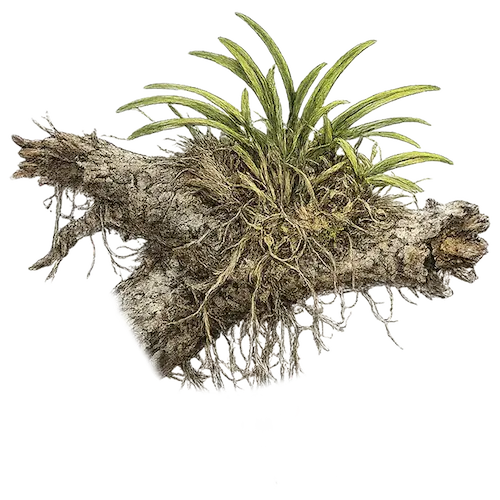
Leopard Orchid
(Ansellia africana)
The Leopard Orchid (Ansellia africana) is one of the most striking and easily overlooked flowers in Kruger National Park . Growing high up in the branches of large trees, this epiphytic orchid produces sprays of yellow flowers marked with deep brown spots, giving it the distinctive “leopard” pattern that inspired its name.
Unlike most plants you’ll encounter on a safari in Kruger National Park , the Leopard Orchid lives above the ground, anchored to tree limbs rather than rooted in soil. During the late summer months, these orchids come into bloom, transforming otherwise ordinary trees into something extraordinary for those who know where to look.
For many visitors, it goes completely unnoticed — but for those who take the time to scan the canopy, the Leopard Orchid becomes one of Kruger’s most rewarding botanical sightings.
Identification
The Leopard Orchid is one of the most distinctive flowering plants in Kruger National Park, although it is often missed because it grows high up in the branches of large trees. Unlike ground-growing wildflowers, this species is usually seen as a clump of stems, roots, leaves, and flowers perched above eye level, often in open sunlight.
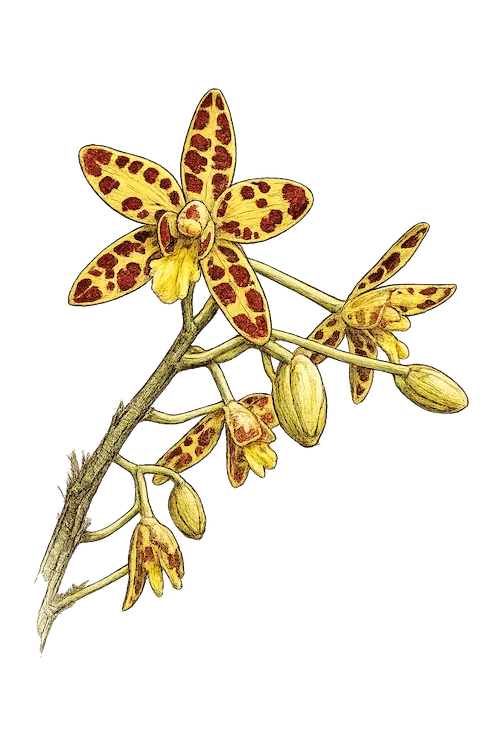
When in bloom, the most obvious feature is the flower itself. The blooms are yellow to greenish-yellow and are marked with rich brown spots, giving the plant its unmistakable leopard-like appearance. The flowers are carried in branching sprays and can appear in impressive numbers on a mature plant, making a flowering specimen stand out clearly against the canopy.
Even when not in flower, the plant has a recognisable structure. Leopard Orchids form large clumps made up of upright, cane-like swollen stems known as pseudobulbs. From the tops of these grow several narrow, leathery leaves, while the roots often form a dense mass around the base of the plant where it grips onto the branch.
One of the easiest ways to identify a Leopard Orchid in the field is to remember that it does not grow in the soil below. Instead, it lives as an epiphyte on trees, using the branch for support rather than feeding from the tree itself. Once you learn to scan the upper branches of large trees for these clumps of spotted flowers and strong, arching growth, the species becomes much easier to recognise.
Habitat and Where It Grows
The Leopard Orchid is most commonly found growing high up in the branches of large trees throughout Kruger National Park’s diverse wildlife habitats . Unlike many flowering plants that root themselves in the soil, this species lives as an epiphyte, using trees purely for support while drawing moisture and nutrients from the surrounding air and rainfall.
It favours open woodland and savanna habitats where sunlight can reach the canopy, particularly in areas with well-established trees. You’ll often find it along river systems, drainage lines, and slightly denser woodland where larger trees such as knobthorns and marulas provide the perfect structure for the plant to anchor itself.
In Kruger, Leopard Orchids are more commonly encountered in the southern and central regions of the park, where tree density and suitable habitat are more consistent. That said, they can easily be overlooked, as they tend to grow well above eye level and blend into the branches when not in flower.
One of the most important things to understand is that the Leopard Orchid does not harm the tree it grows on. It is not parasitic, and instead simply uses the branch as a platform to access better light and airflow. This elevated position also helps protect it from grazing animals and competition on the ground.
Flowering and Seasonality
The Leopard Orchid flowers during the warmer months of the year, with its peak blooming period typically falling between January and April in Kruger National Park . This late summer window is when the plant is at its most visible, producing large sprays of striking flowers that stand out clearly against the surrounding canopy.
Each mature plant can produce multiple flowering stems, carrying dozens of individual blooms at once. These flowers range from yellow to greenish-yellow and are marked with bold brown spots, creating the distinctive leopard pattern that gives the orchid its name. When a plant is in full bloom, it can transform an otherwise ordinary tree into a focal point along the road.
Outside of the flowering season, the Leopard Orchid becomes far more difficult to spot. The leaves and stems blend naturally into the branches, and without the bright flowers, most plants go unnoticed by visitors. This makes timing particularly important for those hoping to see or photograph this species at its best.
Seasonal rainfall plays an important role in flowering, with good summer rains often leading to more impressive displays. For visitors planning a trip, the late summer months offer the highest chance of success, as explained in our guide to the best time to visit Kruger National Park .
How to Find Leopard Orchids in Kruger National Park
Finding a Leopard Orchid in Kruger National Park is less about luck and more about knowing where to look. Because these orchids grow high up in trees, most visitors simply drive past them without ever noticing they are there.
The key is to slow down and start scanning the upper branches of large trees, especially in open woodland and along river systems. Trees such as knobthorns and marulas are particularly good places to check, as they provide strong, exposed branches where the orchids can anchor themselves and receive plenty of sunlight.
During the flowering season, the task becomes much easier. The bright yellow, spotted blooms stand out against the sky and can often be seen from a distance if you know what to look for. In many cases, you’ll spot the flowers first and only then realise there is a full plant growing high above.
Some of the most reliable areas to search include the southern parts of the park around Skukuza and Lower Sabie, as well as the central regions near Satara. Roads that follow rivers or pass through mature woodland tend to offer the best opportunities.
On a slow, observational drive — such as those offered on our guided Kruger safari experiences — the Leopard Orchid becomes one of those rewarding sightings that most people miss. Once you’ve seen your first one, you’ll find your eye quickly adjusts, and suddenly they begin to appear everywhere in the canopy above.
For nature-focused travellers and birders, developing this slower, more observant approach is key, and it’s something we explore further in our guide to birding in Kruger National Park .
Why It’s Worth Looking For
The Leopard Orchid is not the kind of sighting that announces itself. It doesn’t move, it doesn’t make a sound, and it’s often hidden high above the road — which is exactly what makes it so rewarding to find.
For those who take the time to slow down and scan the canopy, it offers something different to the usual safari experience. A flowering plant growing high in a tree, covered in bold, spotted blooms, is not something most people expect to see in Kruger.
It’s these quieter sightings that often stay with you the longest — the ones that reward patience, observation, and a slightly different way of looking at the bush.
Experience Kruger Beyond the Obvious
The Leopard Orchid is just one of many hidden details that most visitors miss in Kruger National Park . On a slow, guided safari, it’s not just about ticking off sightings — it’s about learning how to see the bush differently.
If you’d like to experience a more immersive Kruger National Park safari , with a focus on observation, wildlife, and the smaller details that make each drive unique, explore our safari options below.