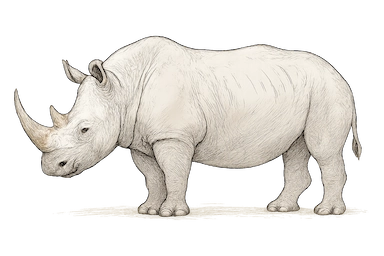
White Rhinoceros
(Ceratotherium simum)
The white rhinoceros is the second-largest land mammal on Earth, surpassed only by the elephant, and holds its place among the iconic Big Five, animals once considered the most dangerous to hunt, but today among the most sought-after sightings on safari. Despite its name, the white rhinoceros is not actually white; the name is believed to come from the Afrikaans word “wyd,” meaning wide, referring to its broad, square shaped mouth adapted for grazing. In contrast, the black rhinoceros has a distinctive hooked upper lip, perfectly suited for browsing on shrubs and trees.
| Size | 1.8 meters at the shoulder |
|---|---|
| Weight | Males up to 2400kg and females 1600kg |
| Lifespan | 40 years |
| Habitat & Distribution | Flat undulating terrain with grassland to feed, thick cover to rest up and water to drink and swallow |
| Gestation | 16 months |
| Number of Young | One |
| Food | Selective grazer, prefers short, fresh growth |
| Predators | Humans, calves preyed on by lions and hyenas |