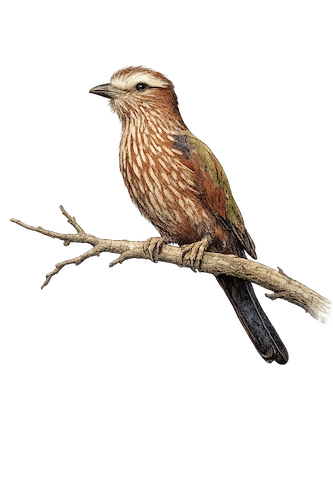
Purple Roller
(Coracias naevius)
The Purple Roller is one of Africa’s most underrated birds. While it lacks the electric colours of its cousin the lilac-breasted roller, it makes up for it with character, subtle beauty, and classic roller behaviour. Found across much of sub-Saharan Africa, this species is a favourite among seasoned birders who appreciate its streaked plumage, powerful build, and dramatic aerial displays. Often perched quietly on a dead branch in dry savanna, the Purple Roller rewards patient observation with moments of real excitement.
Purple Roller Identification
The Purple Roller is the largest member of the roller family, measuring around 35–40 cm in length and weighing roughly 168 grams. Its size alone can be a useful clue in the field, especially when comparing it to other rollers in the same area.
At first glance, it may appear fairly plain compared to its more colourful relatives, but a closer look reveals a beautifully detailed bird. The overall plumage is brownish with rich rufous tones, giving it a warm, earthy appearance that blends well into dry savanna habitats. A distinct white supercilium (eyebrow stripe) stands out above the eye, along with a pale nape patch, both of which help with identification.
The underparts are particularly striking on closer inspection, showing a subtle purplish-pink wash with heavy white streaking across the chest and belly. The bird also has a strong, slightly hooked bill typical of rollers, well-suited for catching a variety of prey. Its square-cut tail and long wings give it a solid, powerful silhouette when perched or in flight.
There is also some variation across its range. Southern birds often show more olive tones on the crown, while northern populations tend to be more distinctly rufous overall.
Habitat of the Purple Roller
Purple Rollers favour dry, open habitats where visibility is good and suitable perches are available. They are most commonly found in thornveld, mopane woodland, and open savanna with scattered trees, all of which provide the structure they need for hunting and resting.
A key part of their habitat preference is the availability of elevated perches. They rely heavily on exposed lookout points such as dead trees, bare branches, fence posts, or even utility poles. From these vantage points, they can scan the ground for movement before dropping down to catch prey.
Unlike some of the more colourful rollers, the Purple Roller is strongly associated with arid environments. It is often found in harsher, drier regions where vegetation is sparse and competition from other roller species is lower. This makes it a characteristic bird of Africa’s drier savanna landscapes.
Distribution of the Purple Roller
The Purple Roller is widespread across sub-Saharan Africa, occurring in two main population groups. Northern populations range from Senegal across to Somalia and down into northern Tanzania, while southern populations are found from Angola through Namibia and into northern South Africa. Within South Africa, the species is most commonly associated with the northern bushveld regions, making Kruger National Park one of the best places to encounter it.
Behaviour
Like all rollers, the Purple Roller is a classic sit-and-wait predator. It spends long periods perched quietly, often on an exposed branch, carefully scanning the ground before suddenly swooping down to catch prey.
Much of its daily activity revolves around this patient hunting style. It tends to perch high for extended periods, using its vantage point to detect movement below. During the breeding season, individuals become more territorial, actively defending their chosen area from intruders.
One of the most exciting aspects of their behaviour is their aerial display. During these flights, they perform steep plunges and rolling movements through the air—this is where the name “roller” originates. These displays are often accompanied by vocalisations and can be quite dramatic to witness.
Their call is harsh and repetitive, typically described as a grating “ka” or “gaa,” and is often heard before the bird is seen.
Diet
Purple Rollers are opportunistic feeders, mainly hunting from a perch before dropping onto prey. Their diet consists largely of insects such as beetles and grasshoppers, but they will also take spiders, scorpions, and small reptiles like lizards when the opportunity arises.
They forage primarily on the ground, using their excellent eyesight to detect movement. Once prey is spotted, they make a quick, direct strike from their perch, returning to a vantage point to consume it.
Breeding
Breeding in Purple Rollers is somewhat flexible and often linked to rainfall patterns rather than a fixed season. This allows them to take advantage of increased food availability when conditions are favourable.
They typically nest in natural tree cavities, including old woodpecker holes, but will also use suitable man-made structures if available. A clutch usually consists of around three white eggs, and both parents share the responsibilities of incubation and raising the chicks. During this period, they become highly territorial and will aggressively defend their nesting site from other birds and potential threats.
Finding the Purple Roller
In Kruger National Park, Purple Rollers are most commonly found in the northern regions, particularly in areas dominated by mopane veld around Punda Maria, the Shingwedzi region, and open thornveld habitats.
The best approach to finding them is to scan dead trees and exposed branches, as they prefer prominent perches. Driving slowly through open woodland increases your chances, especially if you focus on spotting a larger, brown-toned roller rather than looking for the bright colours of species like the lilac-breasted roller. Early mornings and late afternoons are the most productive times, when the birds are more active and engaged in feeding.
Why Birders Love the Purple Roller
While it may not be the most colourful roller, the Purple Roller has developed a strong following among birders who appreciate its more subtle appeal.
Its finely detailed plumage rewards close observation, revealing layers of colour and pattern that are easy to overlook at first glance. As a specialist of dry habitats, it is also an important species for those exploring northern and more arid regions. Its powerful and often unexpected flight displays add an element of excitement, and for many birders, successfully identifying a Purple Roller brings a deeper sense of satisfaction than spotting more obvious, brightly coloured species.
Want to Find the Purple Roller in Kruger?
If you’re planning a birding safari in Kruger National Park, don’t overlook the quieter species. The Purple Roller is a perfect example of how the bush rewards patience and observation.
Join me on a guided birding safari, and I’ll help you not only find species like the Purple Roller—but truly understand them. From subtle field marks to behaviour and habitat, we’ll turn every sighting into a deeper experience of the African bush.
Small groups • Local guide • Tailored birding experience