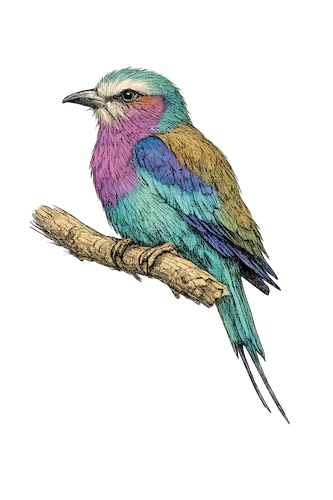
Lilac-Breasted Roller
(Coracias caudatus)
The Lilac-breasted Roller is often described as one of the most beautiful birds in Africa, and once you see it in the wild, that reputation makes complete sense. With its striking combination of lilac, turquoise, green, and deep blue, it stands out even in the vibrant landscapes of the African bush. Common across much of eastern and southern Africa, including South Africa’s iconic safari destinations, this species is a firm favourite among birders, photographers, and first-time safari guests alike.
What makes the lilac-breasted roller even more special is not just its appearance, but its behaviour. It is bold, often perching out in the open, and frequently performs spectacular aerial displays. For your slow, observational safari style, it is one of those species that rewards patience with both beauty and behaviour.
Lilac-Breasted Roller Identification
The lilac-breasted roller is a medium-sized bird with a large head and a compact, upright posture when perched. Its plumage is unmistakable. The throat and upper breast are a soft lilac colour, which deepens into a richer shade across the chest. The belly transitions into turquoise and blue tones, while the back is greenish, and the wings flash brilliant blues when the bird takes flight.
One of its most distinctive features is the long outer tail feathers, known as streamers, which extend beyond the rest of the tail and end in darker tips. These are absent in juveniles, making younger birds slightly less dramatic in appearance.
Males and females look very similar, with only slight size differences, meaning identification is more about appreciating colour and structure rather than distinguishing between sexes.
Habitat of the Lilac-Breasted Roller
Lilac-breasted rollers prefer open savanna and woodland habitats where trees are scattered rather than dense. This allows them to use elevated perches such as dead branches, fence posts, or even the backs of large animals to scan for prey.
They are especially common in Acacia and mopane woodlands, where the balance between open ground and perching sites is ideal. These birds avoid dense forests and heavily urbanised areas, instead favouring natural, open landscapes where visibility is key.
Distribution of the Lilac-Breasted Roller
The lilac-breasted roller is widely distributed across sub-Saharan Africa. Its range stretches from East Africa, including Kenya and Tanzania, down through southern Africa, where it is common in countries like Botswana, Zimbabwe, Namibia, and South Africa.
In South Africa, it is most frequently encountered in the northeastern regions, particularly in and around the Kruger National Park and surrounding reserves. It is largely a resident species, although some local movements may occur depending on seasonal conditions.
Behaviour
This species is typically seen alone or in pairs, perched prominently on a branch or exposed lookout. From this vantage point, it scans the ground for movement before launching into a swift, direct dive to capture prey.
During the breeding season, its behaviour becomes even more dramatic. The bird performs acrobatic display flights involving dives, rolls, and twists in the air, often accompanied by harsh calls. These aerial displays are where the name “roller” comes from.
They are also known to take advantage of bushfires, positioning themselves near the edges to catch insects and small animals fleeing the flames.
Diet
The lilac-breasted roller is a carnivorous hunter that feeds mainly on insects and small animals. Its diet includes beetles, grasshoppers, spiders, scorpions, and centipedes, as well as small reptiles, amphibians, and occasionally small birds.
It hunts by watching from a perch before swooping down to grab prey with precision. Smaller prey is swallowed immediately, while larger items are often taken back to a perch and beaten before being eaten.
This feeding style makes it highly visible and engaging to watch, especially during active hunting periods in the early morning and late afternoon.
Breeding
Lilac-breasted rollers are generally monogamous and nest in natural cavities in trees or sometimes even in termite mounds. They do not excavate their own nests but instead use existing holes created by other species.
The female typically lays between two and four eggs, and both parents share incubation duties. The incubation period lasts around three weeks, and the chicks develop relatively quickly once hatched.
During this time, the adults become highly territorial and will aggressively defend their nest, even taking on larger birds.
Finding the Lilac-Breasted Roller
In Kruger National Park, the lilac-breasted roller is one of the most reliable and rewarding birds to find. It is widespread across the park, particularly in open savanna areas with scattered trees.
You will often see them perched along roadsides, on dead trees, or even on signposts, making them easy to spot during a slow drive. They are especially common in areas like the Satara region, Lower Sabie, and along river systems where insect life is abundant.
For your guiding style, this species fits perfectly. Driving slowly and scanning prominent perches almost guarantees sightings, and once found, guests can enjoy extended views as the bird hunts or simply sits in the open.
Why Birders Love the Lilac-Breasted Roller
There is a reason this bird is often considered the highlight of a safari checklist. Its colours are unmatched, its behaviour is dynamic, and its visibility makes it accessible to both beginners and experienced birders.
Birders love it because it offers everything in one package. It is consistently present, easy to observe, and provides incredible photographic opportunities. The combination of bold perching behaviour and dramatic flight displays means there is always something happening.
It is also one of those species that captures the imagination of guests instantly. Even non-birders tend to remember it long after the safari ends.
Want to Find the Lilac-Breasted Roller in Kruger?
If seeing a lilac-breasted roller in its natural habitat is on your list, there is no better place than Kruger National Park. Join me on a guided birding safari where we take the time to truly observe species like this, not just tick them off a list.
With a slow, immersive approach, you will have the opportunity to watch these birds hunt, display, and interact with their environment in a way that brings the experience to life. Whether you are a seasoned birder or just starting out, this is a species that will stay with you long after your safari ends.
Small groups • Local guide • Tailored birding experience