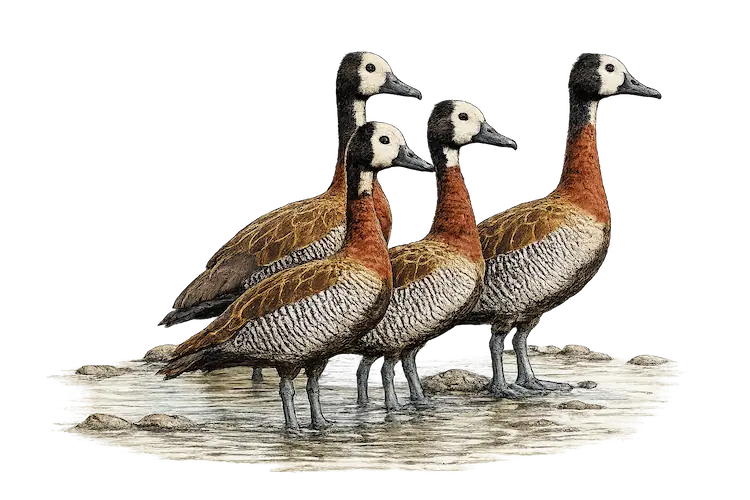
White-Faced Whistling Duck in Kruger National Park
Dendrocygna viduata
The White-faced Whistling Duck is one of the most recognisable waterbirds you can encounter in Kruger National Park. Identified by its bold white face, upright posture, and distinctive whistling call, this species is a regular sight around the park's dams, pans, and river edges. Often moving in pairs or loose flocks, these ducks bring both sound and life to wetlands throughout the park, a favourite among birders and safari guests alike.
Whether you're scanning a quiet dam at sunrise or watching activity build along a river in the late afternoon, the White-faced Whistling Duck adds a calm yet lively presence to any birding experience in Kruger.
How to Identify the White-Faced Whistling Duck
The White-faced Whistling Duck is one of the easier waterbirds to identify once you know what to look for. The most obvious feature is the bold white face and forehead, sharply contrasting with a dark crown, nape, and neck. This gives the bird a striking masked appearance that stands out clearly, even at a distance or in a mixed flock.
The neck and breast are rich chestnut, while the flanks are patterned with fine black-and-white barring. The bill is long and grey, the legs are long and pale, and the overall posture is notably upright, more goose-like than duck-like. Both sexes look alike, which makes field identification straightforward regardless of time of year. Juveniles are similar but duller, with a greyer, less defined face pattern that fills in as the bird matures.
In flight, the White-faced Whistling Duck appears fairly dark overall, with steady wingbeats and a slightly elongated profile, long neck and legs trailing, giving it an almost gangly silhouette against the sky.
The call is one of the most reliable identification features. Rather than a typical duck quack, this species produces a clear, high-pitched three-note whistle, often described as swee-swee-sweeoo, that carries well across open water. In Kruger, you will often hear a White-faced Whistling Duck before you see one, particularly when flocks are moving between feeding sites at dusk or dawn.
Habitat & Where to Find Them in Kruger
In Kruger National Park, White-faced Whistling Ducks are closely tied to water. They favour a wide range of freshwater wetland habitats, including dams, pans, rivers, floodplains, seasonal waterholes, and even reservoirs and sewage ponds where other food sources concentrate. Wherever there is standing or slow-moving water with vegetation nearby, this species is worth looking for.
They are particularly fond of shallow water with dense emergent vegetation, where they can feed undisturbed and take cover during their post-breeding moult — a period when they are temporarily flightless and especially reliant on thick wetland cover. Outside of feeding, they often rest on exposed sandbanks, muddy shorelines, or in shallow water during the heat of the day, making them easy to spot from a good vantage point.
Seasonal water levels have a strong influence on where White-faced Whistling Ducks are found. During the dry season, birds concentrate around permanent water bodies as temporary pans dry out. In the wet season, their range expands considerably as floodplains fill and new feeding areas become available. This species is known to make nomadic movements of 100 kilometres or more in response to shifting water availability — so numbers at any given site can vary significantly between visits.
Distribution & Range of the White-Faced Whistling Duck
The White-faced Whistling Duck has a remarkably wide distribution, occurring across sub-Saharan Africa — from Senegal and Guinea in the west to Ethiopia and Somalia in the east, and south through Zimbabwe, Mozambique, Botswana, Namibia, and into South Africa. It is also found on Madagascar and the Comoros Islands. Uniquely among whistling ducks, this species also occurs across much of South America, from Colombia and Venezuela south to Argentina — a disjunctive distribution that sets Dendrocygna viduata apart from almost all other African waterbirds.
Within Kruger National Park, the White-faced Whistling Duck is considered a common and widespread resident. It is most reliably encountered in the southern regions of the park where permanent rivers and productive dams provide year-round habitat, though it can turn up anywhere suitable water exists. Numbers at any given location shift with rainfall — during good wet seasons, birds spread out across temporary pans and floodplains, while dry conditions push them back toward permanent water sources.
This is a species visitors to Kruger are very likely to encounter, particularly when time is spent around well-known birding waterspots in the park. It is listed on CITES Appendix III and covered under the Agreement on the Conservation of African-Eurasian Migratory Waterbirds (AEWA), reflecting its importance as a migratory waterbird species across its African range.
White-Faced Whistling Duck Behaviour
The White-faced Whistling Duck is a highly social species, rarely encountered alone. Birds are typically seen in pairs or family groups, and outside the breeding season they gather into larger flocks that can number in the hundreds — and at particularly productive wetlands, into the thousands. Watching a large flock arrive at a dam at first light is one of the more impressive waterbird spectacles Kruger has to offer.
Foraging is primarily nocturnal. Birds tend to feed through the night and into the early morning, then spend much of the day resting on exposed sandbanks, muddy shorelines, or in shallow water. During rest periods they are often seen standing on one leg, preening, or engaging in mutual preening — a behaviour that plays an important role in maintaining pair bonds within the flock.
The three-note whistling call — swee-swee-sweeoo — is produced constantly throughout the day and night, used to maintain contact within groups. When a flock is disturbed, birds take off together with loud, repeated calls, typically circling once or twice before settling back close to where they lifted from.
This species forms long-term monogamous pair bonds, which is relatively unusual among ducks. Pairs remain together outside of the breeding season and are often seen moving and resting in close proximity within larger flocks. In Kruger, White-faced Whistling Ducks are frequently found alongside the Fulvous Whistling Duck — a closely related species that shares similar habitat preferences and is worth looking out for in mixed waterbird assemblages.
White-Faced Whistling Duck Diet & Feeding
The White-faced Whistling Duck is primarily herbivorous, feeding on seeds, grasses, aquatic vegetation, and underwater tubers. It will also take small invertebrates including molluscs, crustaceans, and aquatic insects — particularly during the breeding season when the higher protein intake supports chick development.
Feeding behaviour is a mix of dabbling in shallow water, grazing along muddy shorelines, and submerging the head to reach submerged plant material. This grazing style is more goose-like than typical duck feeding, which reflects the species' position in the Dendrocygna lineage — a group distinct from true dabbling ducks like those in the genus Anas.
Because this species forages primarily at night, daytime sightings in Kruger typically show birds resting rather than actively feeding. If you do observe feeding activity during the day, it tends to occur in the cooler early morning or late afternoon hours — often in groups working methodically through the shallows of a pan or along a quiet river edge.
White-Faced Whistling Duck Breeding & Nesting
Breeding is closely tied to rainfall and rising water levels. In South Africa, nesting typically begins at the start of the rainy season, with activity peaking between December and February when wetlands are full and food is most abundant. In good seasons, breeding pairs are relatively easy to find around productive dams and pans throughout Kruger.
Nests are usually a shallow depression in the ground, placed in dense reed beds or tall grass close to water's edge. Less commonly, pairs will use tree cavities — a habit that gave this group the old common name of "tree ducks," still sometimes used today. The nest is lined with vegetation and kept well hidden from predators.
Clutches typically contain 6 to 12 eggs, incubated by both parents over a period of 26 to 28 days. Shared incubation is uncommon among ducks and reflects the strong, long-term pair bonds this species maintains. Once the eggs hatch, both adults continue to guard and guide the ducklings closely — often hiding them in dense aquatic vegetation during the early days after hatching.
The ducklings are precocial, meaning they are capable of feeding themselves within a day of hatching. Family groups remain tightly together, with chicks clustered between the adults for warmth and protection. The young fledge after approximately eight weeks, at which point they begin to integrate into larger flocks alongside adult birds.
Finding the White-Faced Whistling Duck in Kruger
The best strategy for finding White-faced Whistling Ducks in Kruger is simple: focus on water. Any dam, pan, or slow-moving river edge has the potential to hold birds, and the species is widespread enough that a well-planned day in the park will almost always produce a sighting.
Among the most reliable locations are Lake Panic and Sunset Dam in the south, both of which consistently attract large numbers of waterbirds and offer excellent viewing conditions. River viewpoints along the Sabie and Letaba Rivers are also productive, particularly during the dry season when birds concentrate around permanent water. In the far north, the wetlands around Punda Maria are worth exploring for this and many other waterbird species.
Timing matters. Because White-faced Whistling Ducks forage primarily at night, early morning is the most rewarding time to find them — birds are often still active as they return from nocturnal feeding, and the light is ideal for observation and wildlife photography. Late afternoon offers a second window, with birds becoming increasingly vocal and active as temperatures drop.
Smaller, quieter pans away from the main roads can be just as productive as the well-known hotspots — and often more so, with less disturbance and more natural behaviour on display. If you spot one White-faced Whistling Duck, scan carefully: where there is one, there are usually many more resting nearby on the bank or in the shallows.
White-Faced Whistling Duck — Quick Facts & Conservation
The White-faced Whistling Duck is classified as a species of Least Concern on the IUCN Red List, reflecting its large range and stable global population. In South Africa it is considered a common resident, though its dependence on healthy wetland systems makes it a useful indicator species for wetland quality. It is protected under the Agreement on the Conservation of African-Eurasian Migratory Waterbirds (AEWA) and listed on CITES Appendix III, highlighting its importance as a migratory waterbird across its African range. The primary threats to the species in South Africa are wetland degradation, pollution, and the artificial alteration of water levels — all of which reduce the quality of breeding and foraging habitat.
| Scientific name | Dendrocygna viduata |
| Family | Anatidae |
| Length | 40–45 cm |
| Weight | 0.5–0.9 kg |
| Clutch size | 6–12 eggs |
| Incubation period | 26–28 days |
| Fledging period | ~8 weeks |
| IUCN status | Least Concern |
| CITES listing | Appendix III |
| Global range | Sub-Saharan Africa, Madagascar, South America |
Want to Find the White-Faced Whistling Duck in Kruger?
The White-faced Whistling Duck is just one of the many waterbirds you can encounter on a guided birding safari in Kruger National Park. With the right guide and the right locations, sightings like this become the rule rather than the exception.
On a birding safari with Eugene, you won't just see birds — you'll understand what you're looking at. Behaviour, habitat, call, and context. From the wetlands of the south to the fever tree woodlands of the north, every environment in Kruger holds something worth stopping for.
If you want to experience Kruger at a slower, more rewarding pace — built around birds, not just the Big Five — join me on a tailored birding safari.
Small groups • Local guide • Tailored birding experience