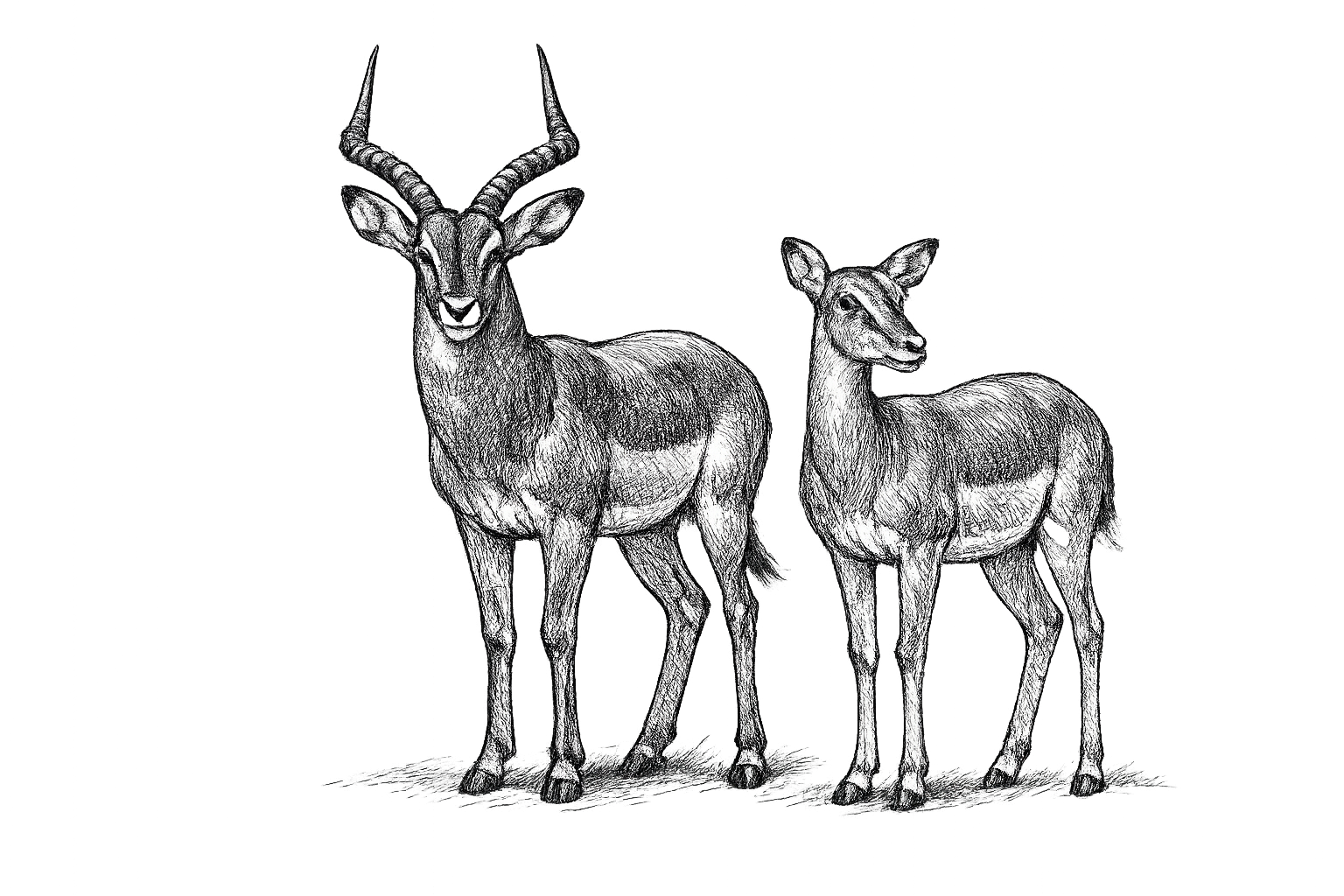
Impala
(Aepyceros melampus)
Impala are among the most common antelope in the Lowveld, yet they remain one of the most remarkably well-adapted species in the region. These antelope typically thrive in ecotone areas, where grassland and woodland habitats meet.
| Size | 90 cm shoulder height |
|---|---|
| Weight | 40–60 kg |
| Lifespan | 9-12 years |
| Habitat & Distribution | Bushveld ecotone speices, woodland especially acacia and mopane woodland, they need cover and water |
| Gestation | 6–7 months |
| Number of Young | Usually one lamb |
| Food | They are adapted and are mixed feeders. They browse leaves, graze grass, and also eat fruits and flowers |
| Predators | Most large to medium carnivores, baboons, pythons, large bird of prey take young lambs |
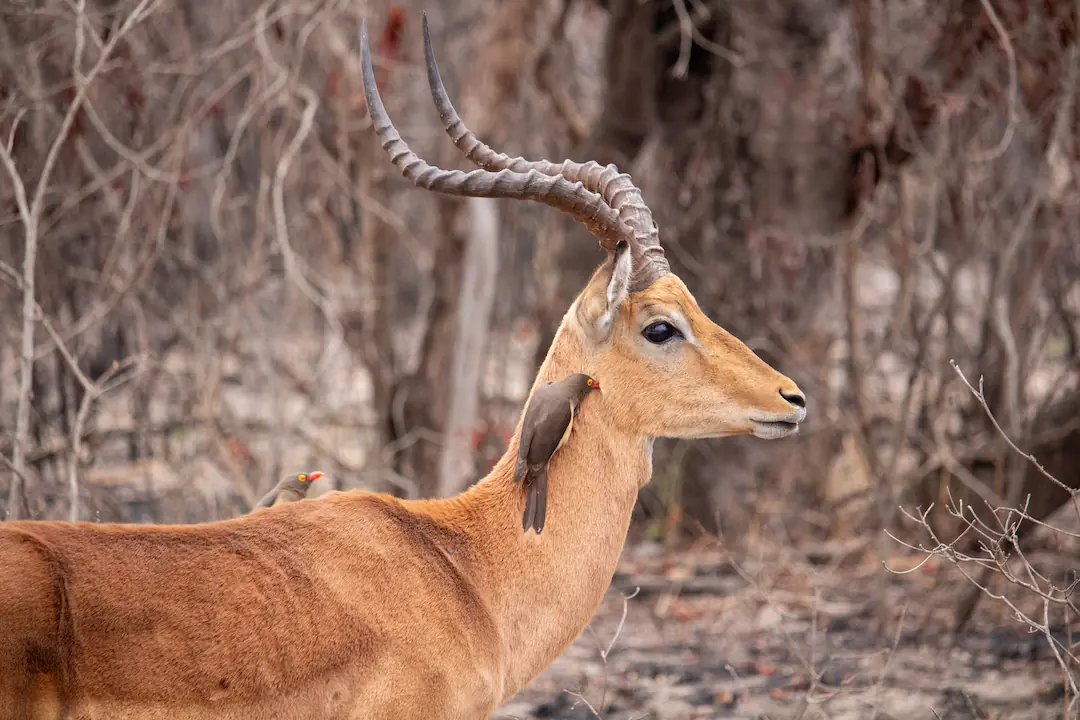
An Oxpecker feeding on parasites
How impala stay clean and healthy
Impala are fastidious groomers, spending a significant amount of time maintaining their hygiene, something clearly reflected in their sleek, glossy coats. To assist with this, impala have specially adapted lower incisors that are slightly loose in their sockets. As they groom, these teeth splay apart to form a comb-like structure, allowing the impala to effectively remove dirt and parasites from its coat.
They also engage in allo-grooming, a reciprocal behaviour where individuals groom one another, particularly in hard-to-reach areas such as the head and neck. This interaction is typically balanced, with each impala grooming the other for roughly the same amount of time.
Interestingly, they are the smallest antelope species that tolerate oxpeckers on their backs. These birds act as natural grooming assistants, feeding on ticks and other parasites found in their coat. During the rut, male impala are often too preoccupied with territorial behaviour to groom themselves or allow allo-grooming. As a result, they can carry up to six times more parasites than females, attracting a greater number of oxpeckers.
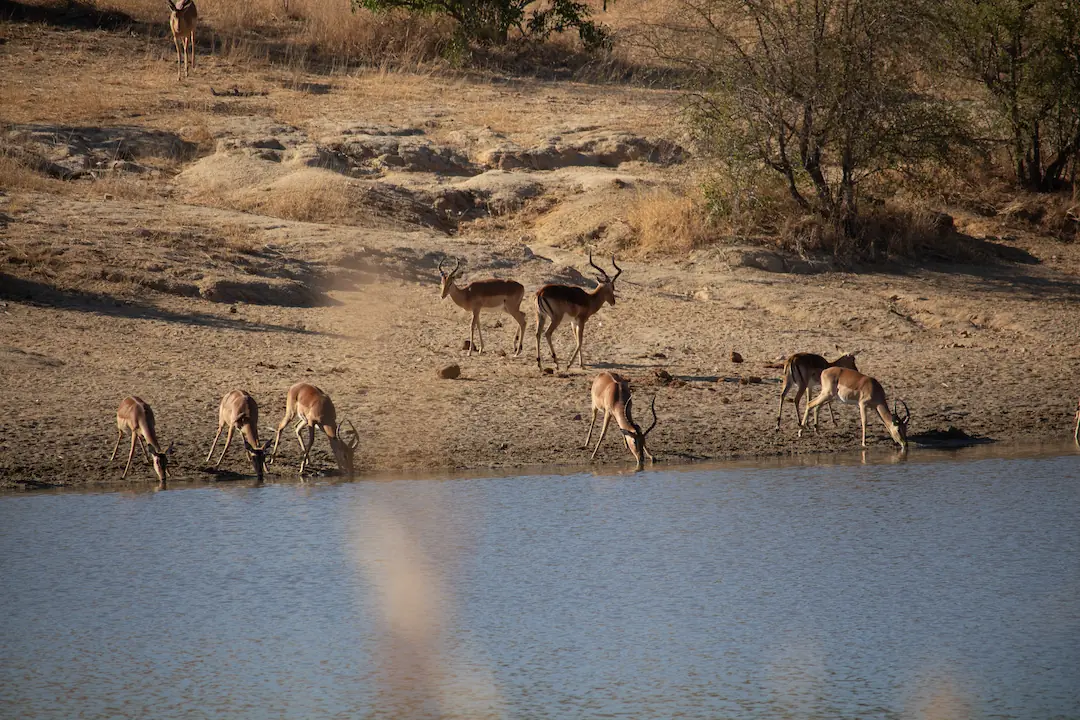
Drinking water at Transport Dam
Feeding behaviour and adaptibility
Impala are highly adaptable feeders, able to make use of whatever food is available in their environment. While many antelope species are strictly browsers or grazers, impala are mixed feeders, meaning they both browse on leaves and graze on grass. Their diet shifts with the seasons, they browse more during the dry winter months when grass is scarce, and switch to grazing in summer when fresh grass is rich in protein and easier to digest.
Impala are also water-dependent and are seldom found far from a reliable water source, typically remaining within a 5 km radius. They drink daily and are often seen feeding alongside other species. In these cases, the association is usually driven by a shared food resource, but there is also a significant survival advantage in numbers.
Impala frequently form mixed-species feeding groups with animals like baboons. While baboons feed in fruiting trees, impala benefit by collecting fallen fruit and flowers. In return, they contribute to group vigilance, there is almost always at least one individual standing alert while others feed. This coordinated awareness is highly effective, as baboons also provide early warning of predators from their elevated vantage points in the trees.
Impala senses and predator avoidance
Impala possess highly developed senses that play a crucial role in their survival. Their large, mobile ears allow them to detect even the faintest sounds, while their large eyes provide excellent vision. Positioned on the sides of the head, these eyes give them a wide field of view, enabling them to detect movement and potential threats from multiple directions.
When danger is detected, they emit a loud alarm snort to alert other members of the group. While this may appear to be cooperative behaviour, it also serves an individual purpose. The alarm call triggers a rapid and explosive flight response, causing the herd to scatter in multiple directions.
This sudden chaos makes it difficult for predators to single out one individual, effectively increasing each impala's chance of survival.
Impala temperature regulation and piloerection
Piloerection is a physiological response found in many mammals, referring to the ability to raise the hair on the body, similar to goosebumps in humans. They make use of this adaptation during cooler mornings, when their typically sleek, glossy coats appear darker and less shiny.
By raising the hair on their bodies, they trap a layer of air close to the skin. This air is warmed by body heat, creating a layer of insulation that helps the animal retain warmth in colder conditions.
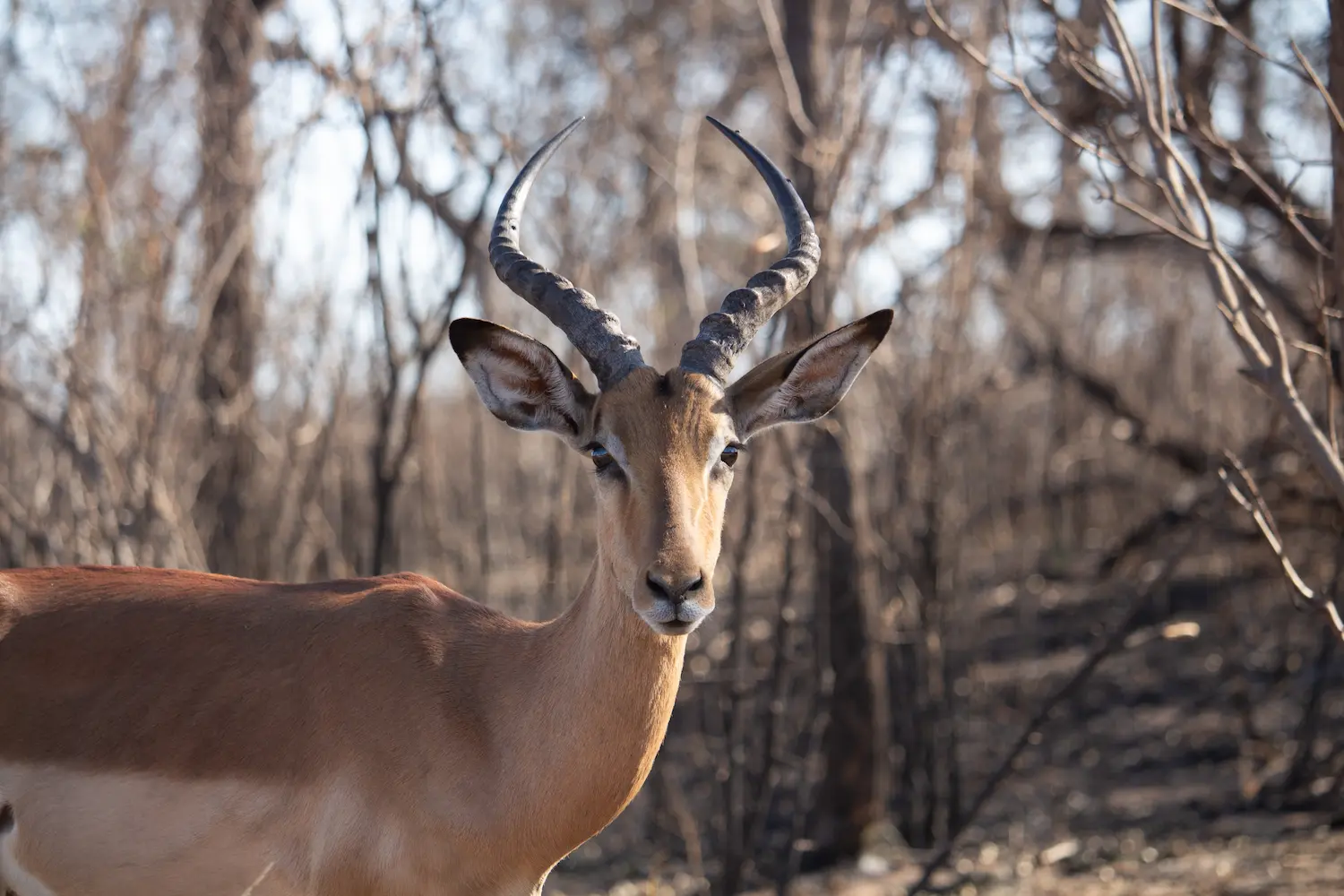
Young male in bachelor group
Social structure and breeding behaviour
Females and their young live year-round in breeding herds, while males spend most of the year in bachelor groups, joining the herds only during the rutting season. This grouping strategy is often referred to as a “selfish herd,” where safety in numbers reduces the likelihood of any one individual being targeted by predators. As one of the most abundant antelope species in Kruger National Park, impala face a wide range of predators, including lions, leopards, cheetahs, spotted hyenas, jackals, caracals, pythons, and even chacma baboons, which occasionally prey on lambs.
One of the key reasons they remain so numerous is their highly effective breeding strategy. Toward the end of January, decreasing day length triggers a rise in testosterone in males, prompting them to leave bachelor groups and establish territories. These territories are ideally located in areas with good grazing and access to water, resources that attract females. Males actively defend these areas, chasing off rivals with tails raised and emitting deep, resonant calls that can sound surprisingly powerful for their size.
As the rut intensifies, particularly in May, males herd females into their territories and compete more aggressively, sometimes engaging in horn clashes. This heightened activity stimulates females to come into oestrus over a short, synchronized period. Within roughly three weeks, most females are mated, resulting in a highly synchronized birthing season.
By late November to early December, the majority of impala lambs are born within a similarly short window. This strategy, known as predator swamping, overwhelms predators with sheer numbers, although many lambs are taken, a large proportion survive, helping to sustain the population. During the peak of the rut, males are so focused on defending territories and mating that they rarely feed or groom, and can only maintain their territories for about eight days. This turnover ensures genetic diversity, as multiple males get the opportunity to breed.
Territorial males also mark their boundaries using dung middens, which are often visible along roads in the Kruger National Park. These concentrated piles of droppings serve as scent markers, defining territorial limits and providing information to other impala. Males also scatter dung throughout their territory, while females contribute to these middens as they move through the area, allowing males to track their presence through scent.
Impala movement and unique adaptations
Impala are highly athletic antelope, capable of clearing jumps of up to 3 metres in height and 12 metres in length. This remarkable agility is particularly well suited to their woodland habitat, allowing them to leap over obstacles such as bushes rather than navigating around them.
When fleeing from danger, impala often use a distinctive gait known as “rocking horse” movement. In this motion, the animal bounds forward in a controlled, springing canter, shifting weight between the front and hind limbs. This behaviour is thought to signal strength and fitness to predators, effectively communicating that the individual would be difficult to catch and not worth pursuing.
Young frequently display similar bounding behaviour during play. While this may appear purely playful, it likely serves an important developmental role, helping to build the strength, coordination, and agility needed for survival in adulthood.
Another unique feature of impala is the presence of black glands located on the ankles of their hind legs, known as metatarsal glands. These structures are unique to the species, and although their exact function remains uncertain, they are believed to release scent when activated during running.
It is thought that this scent may help them regroup after fleeing from a threat, providing a chemical trail that assists scattered individuals in finding one another again.
Impala visual adaptations and camouflage
To enhance their survival within a herd, they display distinctive black markings on the rump that are often referred to as “follow-me” signals. These markings become especially visible when the animals are in motion, encouraging individuals to follow one another during flight. This behaviour creates a dynamic positioning effect, where an impala benefits from having others both ahead and behind it, reducing the risk of being singled out by a predator.
Impala also make use of a camouflage strategy known as countershading. Their bodies are darker along the back, gradually becoming lighter along the flanks and palest on the belly. This colour gradient counteracts the natural effect of sunlight, which typically illuminates the top of an animal more than its underside.
As a result, their body appears flatter and less three-dimensional to predators, particularly those that rely on contrast and shadow rather than full colour vision. This visual illusion helps the impala blend more effectively into its surroundings, reducing its chances of being detected.
Impala breeding myths explained
There has long been a misconception that they are able to delay giving birth until environmental conditions are favourable. In reality, this is not the case. Later births observed in areas with poor nutrition are typically the result of delayed conception, not delayed development.
Once a foetus reaches full term, it must be born, as continued growth would make delivery impossible. Impala, like other mammals, cannot pause or arrest the development of a foetus at an advanced stage.
In some cases, females may reabsorb a foetus during periods of unfavourable conditions, but this occurs very early in pregnancy. Alternatively, a pregnancy may be aborted, although evidence of this is rarely seen in the wild, as remains are quickly removed by scavengers.