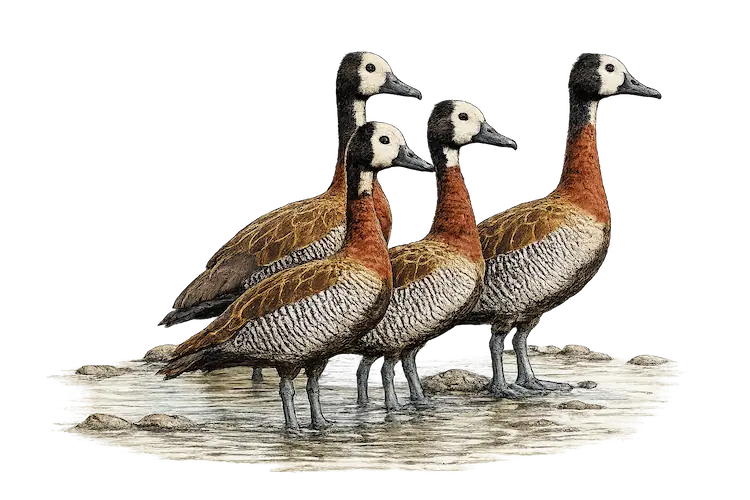
White-Faced Whistling Duck
(Dendrocygna viduata)
The White-faced Whistling Duck is one of the most charming and recognisable waterbirds you can encounter in Kruger National Park. Often seen in small groups or loose flocks, these elegant ducks bring both sound and movement to wetlands across the park. Their soft whistling calls, upright posture, and striking facial pattern make them a favourite among birders and safari guests alike.
Whether you’re scanning a quiet dam at sunrise or watching activity build around a river in the late afternoon, this species adds a calm yet lively presence to any birding experience in Kruger.
White-Faced Whistling Duck Identification
The White-faced Whistling Duck is instantly identifiable once you know what to look for. The most obvious feature is the bold white face, sharply contrasting with a dark crown and neck. This gives the bird a masked appearance that stands out even at a distance.
The body is rich chestnut-brown across the breast and upperparts, while the flanks are beautifully patterned with fine black-and-white barring. This intricate feather detail is especially rewarding for those who enjoy slow, observational birding. The legs are long and grey, giving the bird a more upright stance than most ducks, almost goose-like in posture.
In flight, they appear fairly dark overall, with steady wingbeats and a slightly elongated profile. Their call—a soft, high-pitched whistling note—is often heard before the birds are seen, especially when they move between feeding areas.
Habitat of the White-Faced Whistling Duck
In Kruger National Park, White-faced Whistling Ducks are closely tied to water. They favour a variety of wetland habitats, including dams, pans, rivers, floodplains, and seasonal waterholes.
They are particularly fond of shallow water areas with plenty of vegetation, where they can feed comfortably and remain relatively undisturbed. Calm, sheltered waters are often more productive than fast-flowing rivers, although they will still be found along quieter river edges.
During the dry season, when water sources become limited, they tend to concentrate around permanent water bodies. In the wet season, their range expands significantly as temporary pans fill and provide additional feeding opportunities.
Distribution of the White-Faced Whistling Duck
The White-faced Whistling Duck is widely distributed across sub-Saharan Africa, and Kruger National Park falls well within its core range. Within the park, they are considered a common and widespread species, particularly in the central and southern regions where water sources are abundant.
That said, they can be found throughout Kruger wherever suitable habitat exists. Their movements are often influenced by rainfall patterns, meaning numbers may fluctuate between areas depending on seasonal conditions.
For visitors, this is a reassuring species—one you are very likely to encounter on a well-planned safari, especially if time is spent around productive water sources.
Behaviour
One of the most endearing aspects of the White-faced Whistling Duck is its social behaviour. These ducks are rarely alone and are usually seen in pairs, family groups, or larger flocks.
They are most active during the early morning and late afternoon, although they may also feed at night. During the heat of the day, they often rest along the water’s edge or in shallow water, sometimes standing on one leg in a relaxed posture.
Their whistling calls are a constant feature of their behaviour, used to maintain contact within groups. When disturbed, they may take off together, circling before settling again nearby.
Unlike many ducks, they are not particularly aggressive and tend to coexist peacefully with other waterbirds. This makes them a great species for observing interactions within mixed flocks.
Diet
White-faced Whistling Ducks are primarily plant feeders, with a diet consisting mainly of seeds, grasses, and aquatic vegetation. They often forage by dabbling in shallow water or grazing along muddy edges.
They will also take small invertebrates, particularly during the breeding season when protein is important for chick development. However, compared to some other waterfowl, their diet remains largely herbivorous.
Feeding is often done in groups, and watching them methodically work through a shallow pan can be a rewarding experience for patient observers.
Breeding
Breeding in White-faced Whistling Ducks is closely linked to rainfall and water availability. In good seasons, when wetlands are full, breeding activity increases significantly.
They typically nest in dense vegetation near water, using grass and plant material to create a well-hidden nest. In some cases, they may even use tree cavities or old nests of other birds.
Clutch sizes are relatively large, often ranging between 6 and 12 eggs. Both parents are involved in caring for the young, and once hatched, ducklings are quickly led to water where they begin feeding under close supervision.
Family groups can often be seen moving together, with chicks staying tightly clustered between adults for protection.
Finding the White-Faced Whistling Duck
If you’re hoping to find White-faced Whistling Ducks in Kruger, your best strategy is simple: focus on water.
Look for them at well-known birding hotspots such as Lake Panic, Sunset Dam, and various river viewpoints along the Sabie and Letaba Rivers. Smaller, quieter pans can be just as productive, especially if you prefer a more relaxed and less crowded birding experience.
Early mornings are particularly rewarding, as the birds are active and the light is ideal for both viewing and photography. Late afternoons offer another excellent window, with increased movement and vocal activity.
For your style of guiding—slow, immersive, and observational—this species is perfect. Guests can spend time watching behaviour, listening to calls, and appreciating fine plumage detail without needing to rush from sighting to sighting.
Why Birders Love the White-Faced Whistling Duck
There’s a quiet charm to the White-faced Whistling Duck that grows on you the longer you spend with it. It’s not a “flashy” bird in the traditional sense, but it rewards patience and attention—qualities that define truly memorable birding experiences.
Want to Find the White-Faced Whistling Duck in Kruger?
If you’d like to experience species like the White-faced Whistling Duck in their natural habitat, there’s no better way than joining a guided birding safari in Kruger National Park.
With a knowledgeable guide, you won’t just tick species off a list—you’ll understand their behaviour, habitats, and the subtle details that make birding so rewarding. From peaceful wetlands to productive river systems, every day offers something new.
Join me on a Kruger birding safari and experience the park at a slower, more meaningful pace—where every bird, including the humble White-faced Whistling Duck, has a story to tell.
Small groups • Local guide • Tailored birding experience