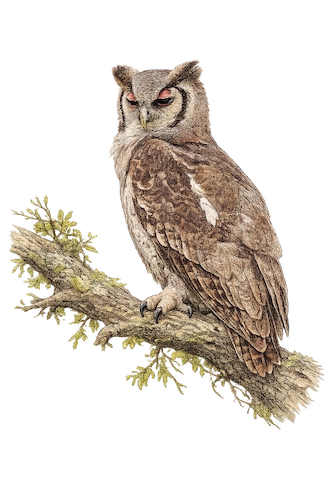
Verreaux's Eagle-Owl
(Bubo lacteus)
The Verreaux’s Eagle-Owl is one of Africa’s most iconic and unmistakable nocturnal predators. Known for its massive size, piercing dark eyes, and striking pink eyelids, this species commands attention wherever it occurs. Often heard before it is seen, its deep, booming calls echo across riverine woodlands and savannas after sunset. For birders visiting southern Africa, especially Kruger National Park, encountering a Verreaux’s Eagle-Owl is a true highlight—one that blends mystery, power, and quiet elegance.
Verreaux's Eagle-Owl Identification
The Verreaux’s Eagle-Owl is Africa’s largest owl species, and its sheer size is often the first giveaway. Adults can reach up to 65 cm in length, with a wingspan of around 1.5 meters. Despite their bulk, they are surprisingly well camouflaged.
Their plumage is predominantly grey-brown with fine vermiculations, giving them a soft, mottled appearance that blends seamlessly into tree bark. The underparts are paler, often with faint barring. One of the most striking features is the facial disc, which is framed by a bold black border that contrasts against the lighter face.
But what truly sets this species apart—and what you captured beautifully in your reference image—is the pink eyelids. When the owl closes or half-closes its eyes during the day, these vivid pink lids become visible, creating a unique and slightly eerie look. Unlike many other large owls, the Verreaux’s Eagle-Owl has dark brown to black eyes, not yellow or orange.
The ear tufts are short and often held flat, especially when the bird is relaxed during daylight roosting.
Habitat of the Verreaux's Eagle-Owl
Verreaux’s Eagle-Owls prefer open woodland and savanna habitats, particularly areas with large, mature trees that provide suitable roosting and nesting sites. Riverine forests are especially favoured, as they offer both shelter and a steady supply of prey..
They are not typically found in dense forests or completely arid regions without trees. Instead, they thrive in landscapes that provide a balance of open hunting grounds and shaded perches.
Because they feed high in the canopy, they can be surprisingly difficult to detect despite being fairly widespread.
Distribution of the Verreaux's Eagle-Owl
The Verreaux’s Eagle-Owl has a wide distribution across sub-Saharan Africa. It occurs in countries such as South Africa, Botswana, Namibia, Zimbabwe, Mozambique, Kenya, and parts of West Africa. Despite its wide range, it is often locally scarce, mainly due to its low population density and large territorial requirements.
Behaviour
This species is primarily nocturnal, becoming active shortly after sunset. During the day, it roosts quietly in dense foliage, often remaining motionless and relying on camouflage to avoid detection.
Verreaux’s Eagle-Owls are generally solitary or found in pairs. They are highly territorial, and pairs will defend large areas, especially during the breeding season.
Their call is one of the most memorable aspects of their behaviour—a deep, resonant “hoo-hoo” that carries far across the bush. Often, pairs will duet, creating an atmospheric soundscape that many birders associate with African nights.
Interestingly, they are known to be relatively tolerant of humans when undisturbed, sometimes roosting in the same tree for extended periods.
Diet
As apex nocturnal predators, Verreaux’s Eagle-Owls have a powerful and varied diet. They primarily feed on Medium-sized mammals (hares, rodents), birds (including guineafowl and other ground-dwelling species), reptiles, occasionally insects.
They are particularly known for their ability to hunt hedgehogs, one of their signature prey items. Using their strong talons, they can flip the hedgehog onto its back to avoid the spines.
Hunting typically involves a silent glide from a perch, using exceptional hearing and eyesight to locate prey in low light conditions.
Breeding
Breeding usually takes place during the dry season, although timing can vary depending on location and rainfall. Unlike many birds, Verreaux’s Eagle-Owls do not build their own nests. Instead, they use old stick nests built by other large birds (like eagles), natural tree cavities, occasionally cliff ledges
The female typically lays 1–2 eggs and does most of the incubation, while the male provides food. Chicks are covered in white down and remain in the nest for several weeks before fledging. Parental care continues long after fledging, with juveniles staying in the territory and learning to hunt.
Finding the Verreaux's Eagle-Owl
The best way to find Verreaux’s Eagle-Owl is to focus on large river systems, Look for them during the day in dense shade within large trees. They often sit quietly on a thick branch close to the trunk
Why Birders Love the Verreaux's Eagle-Owl
There’s something undeniably special about the Verreaux’s Eagle-Owl. For many birders, it ticks several boxes: It’s large and impressive, making sightings memorable The pink eyelids and dark eyes are completely unique It has a powerful, haunting call that defines the African night It can often be observed at rest during the day, allowing for prolonged viewing From a photographic and illustrative perspective (which ties into what you're creating), the textures, posture, and facial expression make it an incredibly rewarding subject.
Want to Find the Verreaux's Eagle-Owl in Kruger?
If the Verreaux’s Eagle-Owl is on your birding wishlist, there’s no better place to look than Kruger National Park. With the right guidance, patience, and a bit of luck, you can experience this incredible bird in its natural habitat.
Join me on a guided birding safari through Kruger, where we focus not just on ticking species, but truly understanding and appreciating them. Whether it’s tracking down a roosting owl in riverine woodland or listening to its call echo through the night, these are the moments that stay with you long after the trip ends.
Small groups • Local guide • Tailored birding experience