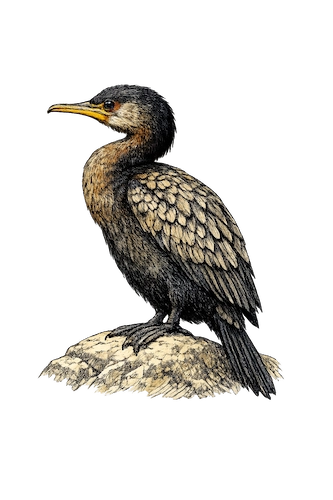
Reed Cormorant
(Microcarbo africanus)
The Reed Cormorant, also known as the Long-tailed Cormorant, is one of Africa’s most familiar waterbirds and a species many birders quickly grow fond of. Found across wetlands, rivers, and dams throughout sub-Saharan Africa, this small, elegant cormorant combines subtle beauty with fascinating behaviour. Whether you’re guiding guests in Kruger or building out your birding content, this species is a classic example of how “common birds” can still be incredibly rewarding.
Reed Cormorant Identification
The Reed Cormorant is a small, slender cormorant measuring around 50–55 cm in length, with a relatively long tail and compact body that gives it a balanced but slightly elongated appearance. In breeding plumage, it appears glossy black with a subtle greenish sheen, complemented by striking silvery wing coverts that can stand out beautifully in good light. The face patch ranges from yellow to reddish tones, and the bill is a clean yellow, adding a gentle contrast to the otherwise dark bird.
Non-breeding birds and juveniles look noticeably different, often appearing browner overall with a paler or white belly. Despite these changes, the overall shape remains consistent, and both sexes look alike in the field, which makes sexing individuals quite difficult. When identifying this species, it helps to focus on its long tail, which is more pronounced than in many similar cormorants, along with its small size, slim build, and characteristic yellow bill. You will also often see it perched with its wings spread, a classic cormorant posture used to dry its feathers.
Habitat of the Reed Cormorant
Reed Cormorants are highly adaptable birds and can be found across a wide range of aquatic habitats. They favour freshwater environments such as wetlands, rivers, lakes, farm dams, and reservoirs, but they are equally comfortable in estuaries and quieter coastal areas. Their name comes from their strong association with reed-lined water bodies, where they are often seen perched, nesting, or moving quietly along the water’s edge.
This adaptability allows them to thrive in many different environments, including semi-urban areas where suitable water sources are present. As a result, they are one of the more reliable waterbirds to encounter, whether you are deep in the bush or closer to developed landscapes.
Distribution of the Reed Cormorant
This species is widespread across sub-Saharan Africa and Madagascar, where it is considered common and not globally threatened.
Although largely resident, Reed Cormorants may undertake local seasonal movements depending on water availability and rainfall patterns.
For birders in South Africa, it is one of the most reliable waterbirds to encounter throughout the year.
Behaviour
The Reed Cormorant is an excellent diver and spends much of its time hunting underwater. It typically forages in shallow water, moving quietly before slipping beneath the surface, but it is more than capable of diving deeper when necessary. After a short dive, it often resurfaces with prey, bringing it above the water before adjusting and swallowing it headfirst.
Like other cormorants, it is frequently seen perched with its wings outstretched after feeding. This classic pose allows the bird to dry its feathers, which are not fully waterproof. This behaviour is one of the most recognisable traits of the species and offers great viewing opportunities for birders and photographers alike.
Reed Cormorants are generally social birds and are often observed fishing in small groups, especially in productive waters. They may also roost together in suitable trees or reedbeds and sometimes nest in loose colonies when conditions are favourable. Despite this social nature, they are relatively quiet birds, with most vocalisations consisting of soft croaks or low grunting sounds that are easy to miss in the field.
Diet
The Reed Cormorant is primarily piscivorous, with fish making up the bulk of its diet. It tends to favour small, slow-moving fish that are easier to catch underwater, including elongated species such as catfish and cichlids that are common in many African freshwater systems.
Despite this preference, the species is quite opportunistic and will take advantage of whatever food is available. This can include frogs and a variety of aquatic invertebrates, and on rare occasions, even small birds. This flexible feeding strategy plays a key role in the species’ success, allowing it to thrive across a wide range of habitats and conditions.
Breeding
Reed Cormorants typically breed close to water, choosing concealed locations that offer protection from predators and disturbance. Nests are usually well hidden among reeds or dense vegetation, although they may also be placed in trees or, less commonly, on the ground. The nest itself is constructed from sticks and plant material, forming a simple but sturdy platform.
Clutch size generally ranges from two to four eggs, and both parents share responsibilities throughout the breeding cycle. In southern Africa, breeding tends to peak during the warmer months, usually between October and April, often in response to rainfall and increased food availability.
Both adults are actively involved in raising the chicks, taking turns incubating the eggs and later feeding the young. This shared effort helps ensure a higher chance of survival, particularly in environments where conditions can change quickly.
Finding the Reed Cormorant
In Kruger National Park, Reed Cormorants are widespread and relatively easy to find if you know where to look. The best places to focus your efforts are around permanent water sources such as the Sabie and Letaba Rivers, as well as popular dams like Sunset Dam and Lake Panic. Smaller waterholes and seasonal pans can also produce sightings, especially during drier periods when birds concentrate around remaining water.
They are often seen perched in typical cormorant fashion on rocks, dead trees, or exposed branches close to the water’s edge. These vantage points allow them to rest, scan for prey, and dry their wings after feeding. Early morning and late afternoon tend to be the most productive times to observe them, as this is when they are actively hunting and moving between perches.
For your guiding style, which leans toward slow and observational safaris, the Reed Cormorant is an ideal species. Guests can enjoy watching the full sequence of behaviour in a short space of time — from diving and catching fish to climbing back onto a perch and spreading its wings to dry. It’s simple, engaging, and easy to interpret, making it a great bird to include in any safari experience.
Why Birders Love the Reed Cormorant
At first glance, the Reed Cormorant might seem like a fairly common and understated bird, but it quickly becomes a favourite for those who spend time observing it properly. Its constant activity makes it highly engaging, with regular diving, feeding, and wing-drying behaviour providing something to watch almost all the time.
There is also a subtle beauty to the species that rewards closer attention. The fine details in the plumage, especially in breeding condition, along with the coloured facial skin and elegant shape, make it more interesting than many people initially expect. Its reliability is another major draw, as it is almost always present around suitable water, giving birders repeated opportunities to study and photograph it.
For content creation and storytelling, the Reed Cormorant is particularly valuable. It offers consistent behaviour, clean compositions, and a sense of calm, natural rhythm that fits perfectly into a slower, more immersive birding experience.
Want to Find the Reed Cormorant in Kruger?
If you’re planning a birding safari in Kruger National Park, the Reed Cormorant is just one of many incredible waterbirds you can experience up close.
Join me on a guided birding safari where we don’t just tick species — we slow down, observe behaviour, and truly connect with the bush. From common species like the Reed Cormorant to Kruger’s more elusive specials, every sighting becomes part of a deeper story.
Small groups • Local guide • Tailored birding experience