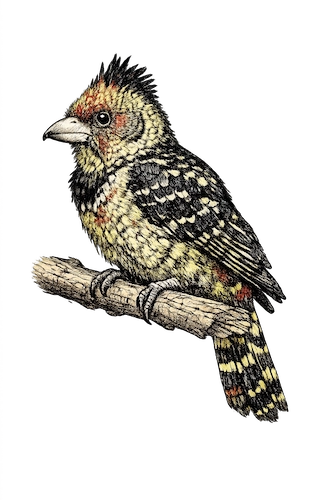
Crested Barbet
(Trachyphonus vaillantii)
The Crested Barbet is one of Africa’s most charismatic and unmistakable birds. With its clown-like face, bold colours, and loud, trilling call, it is often one of the first species birders notice when exploring the bushveld. Found across much of sub-Saharan Africa, this small but striking bird thrives in a wide range of habitats, including gardens, savanna, and woodland. Its adaptability, personality, and constant activity make it a favourite among both beginner and experienced birders alike.
Crested Barbet Identification
The Crested Barbet is instantly recognisable once you know what to look for. It has a thick, pale bill and a distinctive black crest on the crown. The face is a mosaic of bright yellow and red, while the underparts are yellow with red speckling. The wings and back are black with white spotting, and a bold black band runs across the neck.
Its overall appearance is both vibrant and well camouflaged in dappled bushveld light. The combination of colours and patterns can look chaotic at first glance, but this actually helps it blend surprisingly well into its environment.
Habitat of the Crested Barbet
Crested Barbets are highly adaptable and can be found in a wide variety of habitats. These include savanna woodland, forest edges, riverine thickets, and even suburban gardens.
The key requirement is the presence of trees or dead wood for nesting, as they rely on cavities for breeding. This adaptability is one of the reasons why they are so commonly encountered across southern Africa.
Distribution of the Crested Barbet
The species occurs widely across sub-Saharan Africa, from Angola and Zambia down to South Africa, including regions like Botswana, Zimbabwe, and Mozambique.
In South Africa, the Crested Barbet is particularly common from the Free State through to Limpopo and can be found in many reserves, including the Kruger National Park.
Behaviour
Crested Barbets are bold, noisy, and often quite entertaining to watch. They are usually seen alone or in pairs, hopping along the ground or perching conspicuously on branches.
They are extremely vocal, producing a repetitive, trilling call that can go on for long periods. This call often gives away their presence before you even see them. They are also known to be territorial and aggressive, chasing away other birds and even competing species from nesting sites.
Diet
The Crested Barbet is omnivorous, meaning it eats both plant and animal matter. Its diet includes insects, fruits, seeds, and even the eggs of other birds.
They will often forage on the ground, searching for insects, or feed in trees on berries and fruit. In some cases, they have even been recorded taking small vertebrates like mice.
Breeding
Breeding typically takes place between September and December in southern Africa. Crested Barbets nest in cavities, either excavating their own holes in dead wood or using existing cavities.
They are monogamous and highly territorial during this period. The female usually lays between 1 and 5 eggs, which are incubated for about two weeks. Both parents participate in feeding the chicks, primarily with insects, and the young fledge after roughly a month.
Finding the Crested Barbet
In Kruger National Park, the Crested Barbet is a fairly common resident and can be seen throughout much of the park. The best places to find them are around rest camps and picnic sites, where they are comfortable in human-modified environments, as well as in open woodland with scattered trees and areas with dead logs or termite mounds. Listening is often the key to locating them—especially in the early morning when their distinctive trilling call carries through the bush. Once you pick up the sound, you will often find the bird perched openly on a branch or hopping around on the ground nearby.
Why Birders Love the Crested Barbet
There is something undeniably appealing about the Crested Barbet. Its bold colours, quirky behaviour, and constant vocal activity make it a standout species on any birding list.
For photographers and illustrators (like yourself), it’s a dream subject — the contrast, texture, and structure of the plumage lend themselves beautifully to both detailed sketches and vibrant colour work. It also tends to sit still long enough for proper observation, which is a rare gift in birding.
Want to Find the Crested Barbet in Kruger?
If the Crested Barbet is on your target list, the best way to experience it — along with hundreds of other species — is on a guided birding safari.
Join me in Kruger National Park, where we slow things down, listen to the bush, and truly connect with the birds around us. Whether you're building your life list or refining your observation skills, a guided experience will dramatically increase your chances of meaningful sightings.
Small groups • Local guide • Tailored birding experience