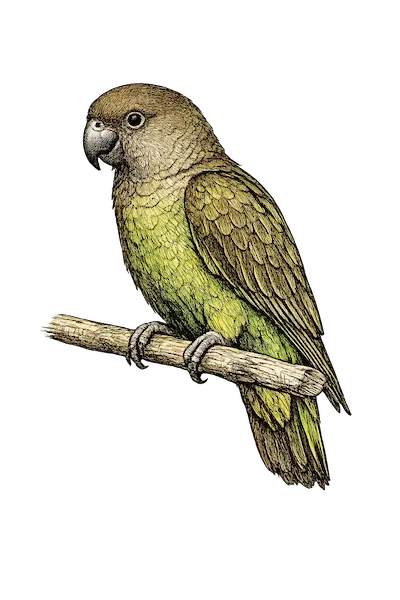
Brown-Headed Parrot
(Poicephalus cryptoxanthus)
The brown-headed parrot is one of southern Africa’s most charming and often overlooked parrots. While it lacks the bright colours of some other parrot species, the brown-headed parrot makes up for this with subtle beauty, interesting behaviour, and a distinctive field presence. Birders exploring woodland habitats across eastern South Africa and further north into Africa often encounter this species quietly feeding high in the canopy.
Brown-Headed Parrot Identification
The brown-headed parrot (Poicephalus cryptoxanthus) is a small green parrot measuring around 22–25 cm in length. It is mostly green, but the head is a soft grey-brown, which gives the species its common name. The neck transitions from grey-brown into a brown head, while the rest of the body remains green.
One of the most distinctive features of these parrots is the bright yellow underwing coverts. These are usually hidden and only visible in flight, which is why the scientific name “cryptoxanthus” means “hidden yellow.”
In flight, the these parrots shows fast, direct wingbeats and often calls softly while moving between trees.
Habitat of the Brown-Headed Parrot
The brown-headed parrot prefers open woodland habitats with plenty of fruiting and seeding trees. It is particularly associated with mopane woodland, acacia savanna, and mixed woodland areas in Kruger National Park.
These parrots rely on trees for feeding, nesting, and roosting. They avoid very dense forests and also tend not to occupy extremely open grassland areas. Instead, they favour landscapes where scattered trees provide both food and cover.
Because they feed high in the canopy, they can be surprisingly difficult to detect despite being fairly widespread.
Distribution of the Brown-Headed Parrot
These parrots occur across southeastern Africa. In South Africa, the brown-headed parrot is commonly found in Kruger National Park and other Lowveld regions where suitable woodland habitat exists.
Behaviour
The brown-headed parrot is generally shy and quiet compared to many other parrots. It is most often seen in pairs or small groups, although flocks of up to 50 birds may gather where food is abundant.
These parrots spend much of their time feeding high in tall trees. Their green plumage provides excellent camouflage, making them hard to spot unless they move or call.
Brown-headed parrots are also known to be monogamous, forming long-term pair bonds. Seasonal flocking may occur, but pairs typically remain together during breeding periods.
Their call is usually soft and less harsh than many larger parrots, which further contributes to their subtle presence in the bush.
Diet
The brown-headed parrot feeds on a wide variety of seeds, fruits, berries and flowers. Seasonal changes influence feeding behaviour, with different tree species being used throughout the year in Kruger National Park.
Breeding
The brown-headed parrot nests in tree cavities, often using old woodpecker holes. The female usually lays between two and four eggs. In South Africa, breeding often occurs during winter, although some pairs may breed year-round depending on conditions.
Finding the Brown-Headed Parrot
The best way to find these parrots is to scan treetops in woodland habitats. Kruger National Park is one of the most reliable places to see these parrots, particularly in mopane woodland areas.
Why Birders Love the Brown-Headed Parrot
Although not as flashy as some parrots, the brown-headed parrot is a favourite among experienced birders. Its subtle colours, gentle behaviour, and woodland habitat make sightings feel rewarding. It is also considered a species of Least Concern, meaning populations are currently stable across its range. For anyone birding in southern Africa, the brown-headed parrot is a species worth looking out for — especially when scanning treetops in warm Lowveld woodland.
Want to Find the Brown Headed Parrot in Kruger?
Join me on a slow-paced guided birding safari in Kruger National Park and improve your chances of seeing the brown headed parrot in its natural woodland habitat. Along the way, we will also look for other Lowveld specials and hidden species that are often missed.
Small groups • Local guide • Tailored birding experience